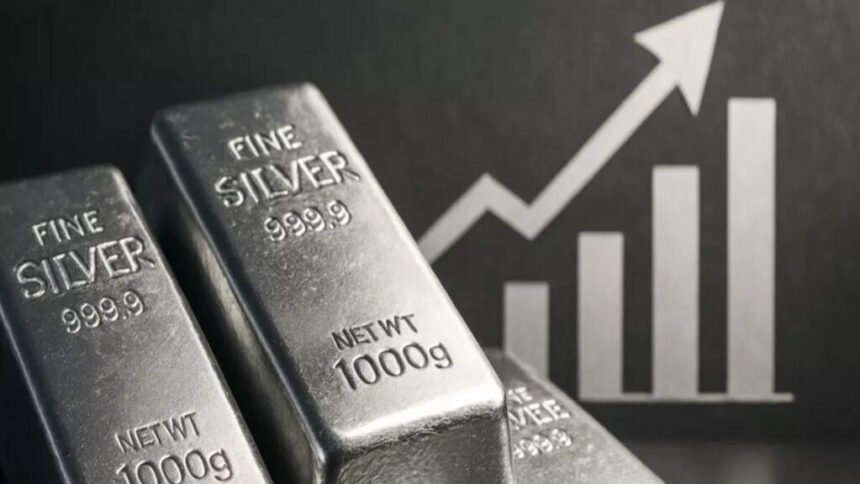
Silver surge dominated commodity chatter as the white metal spiked nearly 6 percent on strong global cues, injecting fresh volatility into precious metals and forcing Indian investors to reassess portfolio allocations. The sharp move highlights silver’s dual role as both an industrial metal and an investment hedge.
The silver surge is a time sensitive market event driven by global price action rather than a long-term structural explainer. The move reflects shifts in global risk sentiment, dollar dynamics, and industrial demand expectations, all of which directly impact Indian portfolios exposed to precious metals.
Global cues trigger sharp silver price movement
The recent silver surge was triggered by a combination of global cues that amplified buying momentum. Softer dollar trends, expectations of stable interest rates, and renewed interest in safe-haven assets pushed precious metals higher. Silver, which often lags gold in early cycles, tends to catch up rapidly once momentum builds.
Unlike gold, silver also carries significant industrial demand exposure, particularly from electronics, solar panels, and electrical equipment. Improved outlooks for clean energy deployment and manufacturing activity added to the bullish narrative. This dual demand profile makes silver more volatile during periods of shifting macro expectations.
International price movements quickly transmitted to Indian markets due to the country’s dependence on imported silver. Domestic prices adjusted sharply, reflecting both global benchmarks and currency translation effects.
Why silver is more volatile than gold
Silver volatility is a defining feature that distinguishes it from gold. The silver surge underscores how smaller market size and mixed demand drivers can exaggerate price moves. While gold demand is largely investment and reserve-driven, silver demand fluctuates with industrial cycles.
This makes silver more sensitive to changes in global growth expectations. Positive industrial signals can drive sharp rallies, while slowdowns can trigger equally steep corrections. For Indian investors, this volatility requires careful position sizing and risk management.
Liquidity also plays a role. Silver markets are thinner compared to gold, so sudden shifts in speculative positioning can move prices quickly. The recent spike reflects this dynamic, where incremental buying led to outsized price gains within a short period.
Impact on Indian investors and portfolios
The silver surge has direct implications for Indian portfolios, particularly those with exposure to physical silver, exchange traded funds, or commodity-linked instruments. Investors who viewed silver as a stable hedge may be reminded that it behaves more like a high-beta asset during global shifts.
Retail participation in silver has increased in recent years due to lower ticket sizes compared to gold. This makes sudden price swings more visible in household portfolios. Traders have benefited from short-term momentum, while long-term investors are reassessing allocation levels.
Jewellery demand, while smaller than gold, also reacts to price volatility. Sharp spikes tend to dampen near-term buying, potentially creating demand pauses that influence domestic premiums. Portfolio managers are factoring these dynamics into commodity exposure decisions.
Precious metals volatility reshapes allocation strategy
Volatility in precious metals is prompting a broader conversation around asset allocation. The silver surge reinforces the idea that not all precious metals behave uniformly. While gold often serves as a stabiliser, silver can amplify portfolio risk during volatile phases.
Financial advisors are increasingly recommending differentiated allocation strategies. Instead of lumping gold and silver together, investors are encouraged to define separate roles. Gold for stability and silver for tactical or thematic exposure linked to industrial growth.
This distinction becomes critical during sharp moves. Investors overexposed to silver may face drawdowns if prices reverse, while those with balanced exposure can use volatility for rebalancing opportunities.
Industrial demand and long-term silver outlook
Beyond short-term volatility, the silver surge brings attention to long-term demand drivers. Silver plays a key role in renewable energy, especially solar photovoltaic cells. As global energy transitions continue, structural demand for silver remains intact.
However, supply dynamics are complex. Silver production often comes as a byproduct of other metals, limiting supply responsiveness to price signals. This can exacerbate price swings when demand expectations change rapidly.
For Indian investors with a long-term horizon, these factors suggest that silver can offer thematic exposure but not without volatility risk. Understanding these fundamentals helps distinguish speculative rallies from structural trends.
Currency movements add another layer of risk
For India, silver pricing is not just about global benchmarks. Currency movements add another layer of complexity. A stable or stronger rupee can partially cushion global price spikes, while a weaker rupee amplifies domestic price moves.
The recent silver surge occurred alongside relatively stable currency conditions, making global cues the dominant driver. Any future volatility in the rupee could further magnify precious metal price swings in the domestic market.
Investors holding silver as a hedge against currency risk need to recognise this interaction. Silver can protect purchasing power in some scenarios but may underperform in others depending on currency dynamics.
What investors should watch next
After a sharp move like the recent silver surge, markets typically enter a consolidation phase. Investors should watch global interest rate signals, dollar trends, and industrial demand indicators. Any reversal in these factors could trigger profit booking.
Positioning data and physical demand trends also matter. Sustained rallies require follow-through from both investment and industrial buyers. Without that, silver prices can retrace quickly.
For Indian portfolios, disciplined allocation and clear intent are essential. Silver works best when investors understand why they hold it, whether for diversification, tactical gains, or thematic exposure.
Takeaways
Silver surged nearly 6 percent driven by global macro and industrial cues
Higher volatility makes silver riskier than gold for conservative portfolios
Indian investors face amplified price moves due to import dependence
Clear allocation intent is critical when adding silver to portfolios
FAQs
Why did silver prices spike sharply?
The spike was driven by global cues including dollar softness, stable rate expectations, and improved industrial demand outlook.
Is silver a safe investment like gold?
Silver is more volatile than gold due to its industrial demand exposure and smaller market size.
How does silver volatility affect Indian investors?
Indian investors face sharper domestic price swings because silver is imported and sensitive to global prices.
Should silver be part of a long-term portfolio?
Silver can be included for diversification or thematic exposure, but allocations should be measured due to volatility.