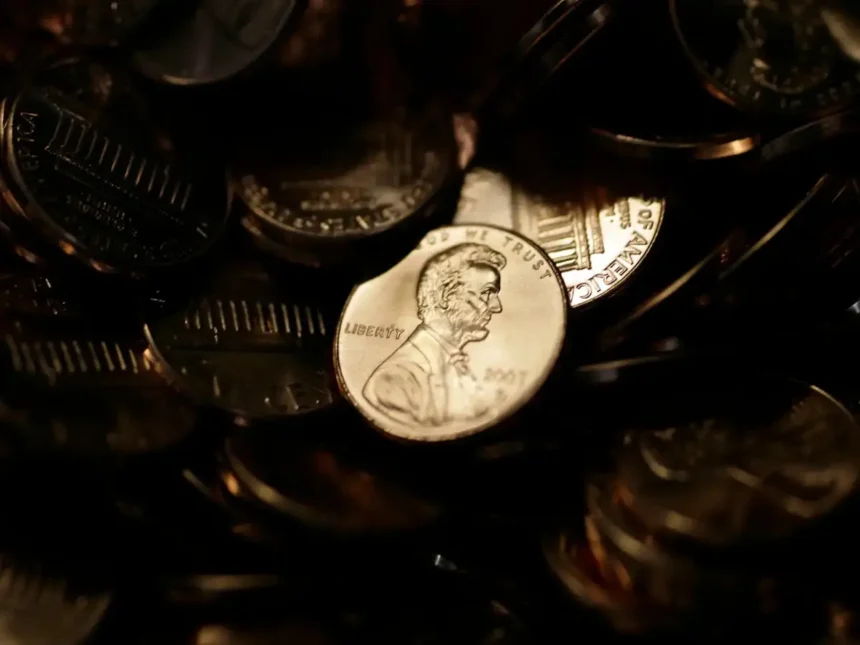
The U.S. Treasury’s decision to halt production of the penny marks a major shift in America’s currency strategy, as the cost of minting a one‑cent coin now far exceeds its face value and signals wider inflation, cost‑cutting and digital‑payments trends.
Why the penny stop matters for U.S. currency policy
The key development is that penny production has officially ended, with the final circulating one‑cent coin struck by the United States Mint on November 12, 2025. The main keyword “penny production” reflects this news‑driven change. The cost to produce each penny has risen to about 3.69 cents, meaning each coin costs nearly four times its value. The Mint estimates savings of around USD 56 million annually from this move. For currency strategy, ending the penny shows a shift from small‑denomination coins toward higher denominations and digital transitions.
Cost pressures and inflation signalling
Production of the penny at a loss is an explicit cost‑cutting measure. Raw material inflation (copper, zinc), manufacturing overhead, logistics and diminishing usage of the one‑cent coin have all contributed. From a broader angle, the move underscores inflation pressures: when producing a coin costs more than its face value, it reflects real‑world price rises in inputs and labour. It also signals that the value of one cent in purchasing power is so eroded that the economy is ready to retire it. The decision suggests policy makers accept that the coin’s transactional role is minimal and that rounding mechanisms are likely to step in.
Implications for cash usage and retail rounding
With penny production ended but the coin remaining legal tender, practical changes are soon visible in retail operations. Many U.S. retailers are already facing penny shortages, frustrating change‑making and prompting price‑rounding to the nearest nickel. The lack of federal guidance means businesses are adapting variably—some rounding down, others up, depending on state laws. Analysts estimate the so‑called “rounding tax” on consumers may amount to about USD 6 million yearly nationwide. For the economy, this underlines the declining role of small‑value coin cash transactions and further shifts toward digital payments or higher‑denomination coins.
What this reveals about America’s currency and digital shift
Ending the penny tells us three things about U.S. currency strategy and the economy. First, the government is acknowledging that the smallest coin is now obsolete in practice, not just symbolic. Second, it indicates a broader move toward efficiency in minting, monetisation and cost rationalisation. Third, it highlights the strength of digital payments: as coins become less essential, cash as a payment method is increasingly marginalised. Businesses, retailers and banks will need to adjust systems, pricing practices and cash‑handling protocols accordingly.
Takeaways
- Penny production has ended in the U.S. because each coin now costs around 3.69 cents to produce, far above its face value.
- The move saves money and signals broader currency strategy changes, including less reliance on low‑value coins and more on digital payments.
- Retailers face practical execution issues: coin shortages, rounding to the nearest nickel and legal ambiguity across states.
- For consumers and businesses, the change underscores inflation input pressures, cash‑handling evolution and transition to higher‑value or digital transactions.
FAQs
Q: Will my existing pennies still be valid?
Yes. Although production has ended, pennies remain legal tender and will circulate as long as households and banks hold them. They are not being recalled.
Q: Does this mean prices will automatically round up for consumers?
Not automatically. With retailers deciding rounding policies and state laws varying, some businesses will round down, others up. The average rounding cost is estimated at about USD 6 million a year.
Q: What happens to nickel and other coins?
For now, production of nickels, dimes and quarters continues. However, the nickel also costs more than its face value to produce (~13.8 cents for 5‑cent coin). Broader coin rationalisation may follow.
Q: Does this reflect inflation?
Yes. The fact that producing a one‑cent coin costs nearly four cents signals significant inflation in materials and labour. It also shows the purchasing power of one cent has diminished to near zero in daily commerce.