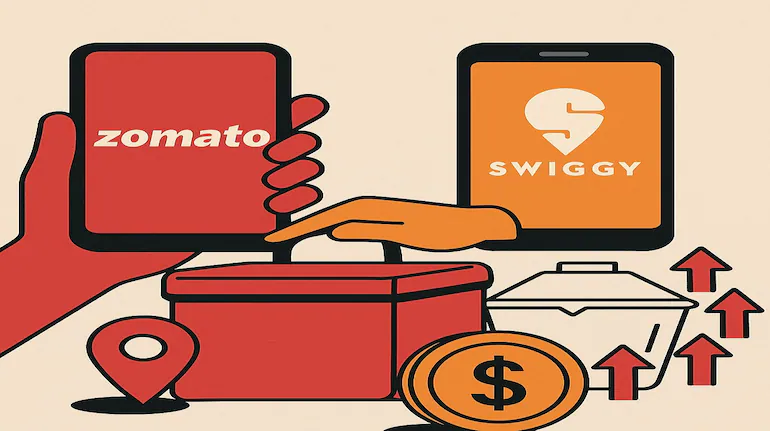
Zomato and Swiggy face margin pressure as discount wars return, signaling a shift back to aggressive customer acquisition strategies in India’s food delivery market. Rising competition and consumer price sensitivity are forcing both platforms to balance growth with profitability.
Zomato and Swiggy face margin pressure as discount wars return at a time when both companies were moving toward profitability. The renewed focus on discounts and offers reflects intensifying competition and changing demand patterns across urban markets.
Discount Wars Resurface in Food Delivery Market
Zomato and Swiggy have reintroduced aggressive discounting strategies to retain and acquire customers. This includes price cuts, free delivery offers, and bundled deals across categories.
The return of discounts is largely driven by competition not only between the two players but also from emerging quick commerce platforms and direct restaurant ordering channels. Consumers, especially in price-sensitive segments, are responding strongly to promotional offers.
This shift marks a reversal from the previous phase where both companies had started rationalizing discounts to improve margins. The current environment suggests that market share is once again taking priority over short-term profitability.
Margin Pressure Builds Across Business Segments
The impact of renewed discounting is directly visible in margin compression. Food delivery, which was nearing breakeven for both companies, is now facing cost pressures due to higher customer acquisition and retention spending.
Delivery costs, rider incentives, and marketing expenses are increasing simultaneously. While order volumes may rise due to discounts, the net profitability per order is under pressure.
In addition to core food delivery, adjacent segments such as quick commerce and grocery delivery are also contributing to margin challenges. These segments require heavy investment in logistics and infrastructure.
The combined effect is a more complex profitability equation for both platforms.
Competitive Landscape Expands Beyond Duopoly
The Indian food delivery market is no longer a simple duopoly. New entrants and adjacent business models are reshaping competition. Quick commerce platforms are capturing a share of consumer spending that previously went to food delivery.
At the same time, restaurants are increasingly investing in their own delivery capabilities to reduce dependence on aggregators. This adds another layer of competitive pressure.
Zomato and Swiggy are responding by expanding their service offerings, including cloud kitchens, subscription programs, and rapid delivery models. However, each of these initiatives requires capital and operational focus.
The evolving landscape is forcing both companies to continuously adapt their strategies.
Consumer Behavior Drives Pricing Strategy
Consumer expectations in the food delivery space have shifted significantly. Convenience remains important, but pricing has become a key decision factor, especially in a high-inflation environment.
Discounts and deals are influencing order frequency and platform choice. Users often switch between apps based on available offers, reducing brand loyalty.
This behavior compels platforms to maintain competitive pricing even at the cost of margins. The challenge lies in balancing affordability for consumers with sustainable business economics.
Data analytics and personalized offers are becoming important tools to optimize discount spending and improve efficiency.
Profitability Goals Face Delays
Both Zomato and Swiggy had previously indicated a path toward profitability, driven by cost optimization and reduced discounting. The return of discount wars may delay these timelines.
Investors are closely monitoring how long this phase lasts and whether companies can manage costs effectively. Sustained margin pressure could impact valuations and funding strategies.
However, the long-term potential of India’s food delivery market remains strong. Rising urbanization, increasing digital adoption, and changing lifestyles continue to support demand growth.
The key question is whether companies can achieve scale without compromising profitability.
Strategic Outlook for Food Delivery Platforms
The current phase represents a strategic reset rather than a structural setback. Both companies are likely to experiment with new pricing models, partnerships, and service offerings to improve unit economics.
Subscription programs, dynamic pricing, and improved logistics efficiency could help offset some of the margin pressure. At the same time, cost discipline will remain critical.
The ability to retain customers without excessive discounting will define long-term success. Platforms that can build stronger brand loyalty and operational efficiency will have a competitive edge.
The coming quarters will be crucial in determining how this balance evolves.
Takeaways
Discount wars have returned, impacting Zomato and Swiggy margins
Higher customer acquisition and delivery costs are driving margin pressure
Competition is expanding beyond traditional food delivery players
Profitability timelines may be delayed as companies prioritize market share
FAQs
Why are Zomato and Swiggy offering discounts again?
They are responding to increased competition and consumer demand for lower prices.
How do discounts affect profitability?
Discounts increase order volumes but reduce profit margins per order, impacting overall earnings.
Are new competitors entering the market?
Yes, quick commerce platforms and direct restaurant delivery models are increasing competition.
Will food delivery prices remain low?
Prices may stay competitive in the short term, but long-term sustainability will depend on business economics.