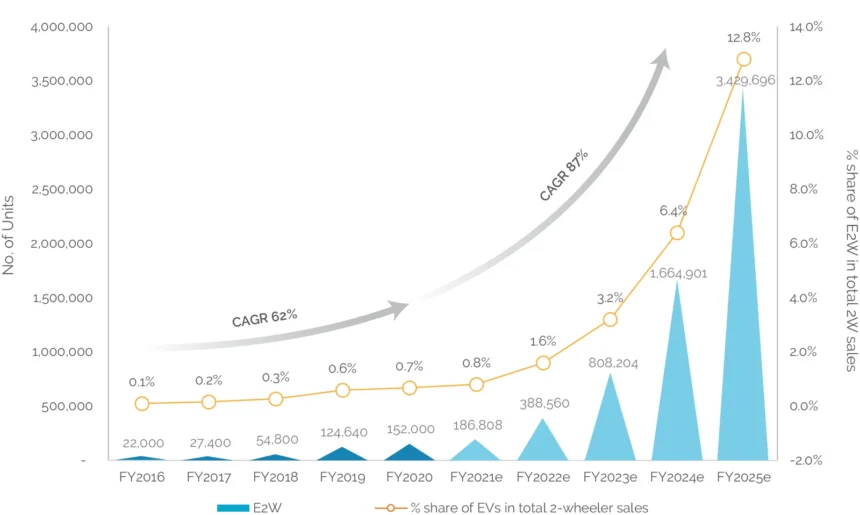
India’s electric two wheeler market is experiencing mixed momentum as companies navigate shifting subsidy structures, evolving consumer demand, and competitive pricing strategies. While some brands continue to report steady deliveries, others are facing slower store level turnarounds due to uncertainties around future incentive support and total cost of ownership clarity.
Sales growth varies across brands and models
Recent monthly sales data in the electric two wheeler segment shows clear divergence. A few established players with strong dealership networks and recognizable brand positioning have maintained volumes. Meanwhile, newer entrants and mid sized manufacturers are facing softer demand as consumers compare prices with internal combustion engine alternatives more critically. The earlier period of rapid growth was helped by subsidy driven affordability, but with incentives being restructured, companies are now focusing more on product reliability, service availability, and financing support. The market is expanding, but the pace is no longer uniform across categories or price bands.
Subsidy structure and policy transition impact buying decisions
Secondary keyword: EV subsidy uncertainty
The shift from the national incentive framework to state level schemes and potential revisions under newer EV programs has introduced uncertainty for both manufacturers and buyers. When subsidy benefits are predictable, consumers are more confident in making higher upfront purchase decisions. However, unclear timelines and limited public information around future support have led some buyers to wait. Dealers report that many customers are comparing total costs over three to five years rather than just upfront pricing. The result is a more considered purchasing cycle, which slows immediate demand momentum even though long term interest in EVs remains strong.
Battery cost dynamics influence pricing
Secondary keyword: lithium battery market
Battery packs remain the largest cost component in electric two wheelers. While global lithium prices have eased compared to last year, overall battery pack costs in India are still influenced by import dependence, currency fluctuations, and supply chain hedging. Manufacturers that localized certain components earlier are relatively better positioned. However, large scale domestic cell manufacturing capacity is still developing. Until cost structures become more predictable, pricing flexibility will remain limited, making consumer sentiment sensitive to even small subsidy adjustments.
Dealer experience and after sales service matter more now
Consumers evaluating electric two wheelers are placing more weight on service support, spare part availability, charging compatibility, and product durability. Companies that invested early in service networks and technician training are benefiting from higher retention. Brands positioned primarily on aggressive discounting or short term promotions are seeing weaker follow through. The market is maturing from novelty driven early adoption to practical usage based decision making. Test ride experiences, return policies, and performance consistency are becoming strong differentiators.
Demand remains strong in delivery and fleet segments
While retail demand has moderated in certain price bands, fleet deployment for food delivery, courier services, and intra city logistics continues to grow. These segments track operating cost per kilometer and prefer EVs where daily run distances make fuel savings meaningful. Leasing models, subscription platforms, and corporate procurement agreements are supporting order flow in this category. This cluster is emerging as a stable base demand driver even when household buyers remain cautious.
Regional trends show varied adoption
Urban centers with strong charging infrastructure and supportive state level subsidies continue to show higher penetration. Tier 2 and Tier 3 cities are showing rising interest, but adoption is directly linked to perceived reliability and service access. Companies are tailoring city by city expansion strategies rather than applying uniform national rollouts. Local clusters where dealerships build active community engagement and repair support tend to outperform.
Outlook focused on stability and ecosystem development
The long term outlook for electric two wheelers remains positive due to rising fuel costs, expanding charging infrastructure, and ongoing product improvements. However, near term sales momentum may continue to fluctuate until subsidy guidelines stabilize and domestic component manufacturing matures. Manufacturers are expected to introduce more models in the mid range pricing segment where demand elasticity is highest. Financing partnerships, battery warranty assurances, and service reliability will shape competitive positioning in the coming quarters.
Takeaways
• Electric two wheeler sales show mixed momentum across brands and regions
• Subsidy uncertainty is affecting short term consumer purchase decisions
• Service network reliability and battery cost control are key competitive factors
• Fleet and delivery segments continue to drive steady baseline demand
FAQ
Why are electric two wheeler sales not growing uniformly?
Because different brands have varying strengths in service networks, pricing strategy, and product reliability. Consumer decisions are becoming more practical and experience based.
How are subsidies affecting demand?
Uncertainty around future subsidy levels has caused some buyers to delay purchases. Stable policy frameworks usually increase adoption confidence.
Which segment is showing consistent demand?
Fleet and delivery services continue adopting electric two wheelers due to cost efficiency in daily high mileage usage.
Will the market recover strongly?
Yes, as battery costs stabilize, service networks deepen, and subsidy guidelines become clearer, the segment is likely to regain stronger growth momentum.