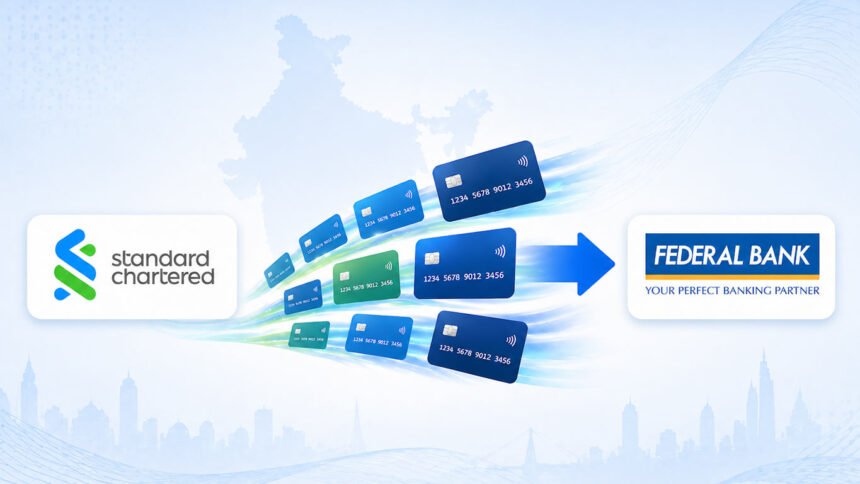
Standard Chartered exits Indian credit card segment with a portfolio sale to Federal Bank, marking a strategic shift in its India retail strategy. The move reflects changing priorities in the banking sector as lenders focus on profitability and core business segments.
Deal marks strategic exit from Indian credit card market
Standard Chartered exits Indian credit card segment through a deal with Federal Bank, transferring a selected portion of its credit card portfolio. This is a time sensitive development and reflects current restructuring trends within global banks operating in India.
The agreement involves the transfer of outstanding credit card receivables, allowing Federal Bank to expand its retail lending footprint while enabling Standard Chartered to streamline its operations. The deal does not represent a full exit from India but signals a recalibration of priorities.
Global banks have increasingly been reviewing their retail businesses in emerging markets, focusing on segments that deliver consistent returns with manageable risk exposure.
Federal Bank strengthens retail lending and credit card portfolio
For Federal Bank, the acquisition aligns with its strategy to grow its unsecured lending business, particularly in the credit card segment. Credit cards remain a high margin product for banks, offering opportunities for fee income and customer engagement.
By acquiring an existing portfolio, Federal Bank gains immediate scale without the need to build a customer base from scratch. This accelerates its expansion in a competitive market dominated by large private banks.
The deal also allows Federal Bank to deepen relationships with new customers, cross sell financial products, and improve overall profitability. As consumer spending in India continues to grow, credit cards are expected to remain a key driver of retail banking growth.
Shift in global banking strategy influences exit decisions
Standard Chartered’s decision to exit the credit card segment in India reflects a broader shift in global banking strategy. Many international banks are prioritizing corporate banking, wealth management, and cross border financial services over retail segments that require high operational intensity.
India’s credit card market, while growing rapidly, is highly competitive and dominated by domestic players with strong distribution networks. This makes it challenging for foreign banks to scale profitably.
By divesting its credit card portfolio, Standard Chartered can focus on areas where it has a stronger competitive advantage, including institutional banking and affluent customer segments.
This approach mirrors similar moves by global banks in other markets, where non core businesses are being trimmed to improve efficiency.
Indian credit card market remains highly competitive
The exit comes at a time when India’s credit card market is expanding, driven by rising consumer spending, digital adoption, and increasing financial inclusion. However, competition is intense, with major private sector banks leading the space.
Banks are investing heavily in digital platforms, rewards programs, and partnerships to attract and retain customers. This has increased customer acquisition costs and put pressure on margins.
For smaller players and foreign banks, maintaining scale in such an environment can be challenging. As a result, consolidation and portfolio transfers are becoming more common.
Federal Bank’s move positions it to compete more effectively, while Standard Chartered’s exit highlights the evolving dynamics of the market.
What the deal signals for India’s banking sector
The transaction between Standard Chartered and Federal Bank signals a broader trend of consolidation and strategic realignment in India’s banking sector. Banks are reassessing their portfolios and focusing on areas that offer sustainable growth.
For domestic banks, this creates opportunities to acquire assets and expand market share. For global banks, it provides a pathway to optimize operations and redeploy capital more efficiently.
The deal also reflects growing confidence among Indian banks in managing retail credit portfolios, supported by improved risk assessment tools and digital infrastructure.
As the financial sector continues to evolve, similar transactions are likely to shape the competitive landscape, with a clearer distinction between domestic and international banking strategies.
Takeaways
- Standard Chartered has exited its Indian credit card segment through a deal with Federal Bank
- Federal Bank gains immediate scale in the credit card market through portfolio acquisition
- Global banks are shifting focus toward core and high return segments
- India’s credit card market remains competitive, driving consolidation trends
FAQs
Q1. Why did Standard Chartered exit the credit card business in India?
The bank is focusing on core business areas such as corporate banking and wealth management, where it has stronger competitive advantages.
Q2. What does Federal Bank gain from this deal?
Federal Bank acquires an existing credit card portfolio, allowing it to expand quickly in the retail lending segment.
Q3. Is Standard Chartered leaving India entirely?
No, the bank continues to operate in India but is restructuring its business to focus on more profitable segments.
Q4. What does this mean for the Indian banking sector?
It highlights a trend of consolidation and strategic realignment, with domestic banks strengthening their position in retail markets.