India is preparing to revise its electric vehicle subsidy framework as automakers push for clearer and more stable policy support. The move comes at a critical time when EV adoption is growing but manufacturers face uncertainty over incentives, localization rules, and long-term investment planning.
India’s EV subsidy revision is back in focus as policymakers evaluate the effectiveness of existing schemes like FAME and Production Linked Incentives. Automakers are actively engaging with the government to secure clarity on subsidy timelines, eligibility norms, and future incentives to sustain growth momentum.
Policy Reset Signals Shift in India EV Strategy
The current discussion around EV subsidy revision in India reflects a broader shift in how the government wants to structure long-term electric mobility growth. The Faster Adoption and Manufacturing of Electric Vehicles scheme has played a key role in boosting early adoption, especially in two-wheelers and fleet segments.
However, industry players argue that inconsistent subsidy disbursement timelines and evolving eligibility criteria have created planning challenges. Several automakers have slowed expansion decisions due to uncertainty around future incentives.
The government is now reviewing whether subsidies should be more targeted toward high-impact segments such as public transport, logistics fleets, and affordable EVs. This aligns with India’s larger goal of reducing oil imports and urban pollution while supporting domestic manufacturing.
Automakers Push for Long-Term Incentive Visibility
Automakers are not just asking for higher subsidies but for predictability. Companies investing in EV platforms require multi-year visibility on policy support to justify capital expenditure.
Major manufacturers and startups have highlighted three key concerns. First is the need for stable subsidy structures that do not change abruptly. Second is faster reimbursement cycles to avoid cash flow strain. Third is clarity on localization requirements tied to incentives.
The push for policy clarity is also driven by increasing competition. As global players evaluate entry into India’s EV market, inconsistent subsidy policies could impact India’s attractiveness as a manufacturing hub.
FAME Scheme Transition and Industry Impact
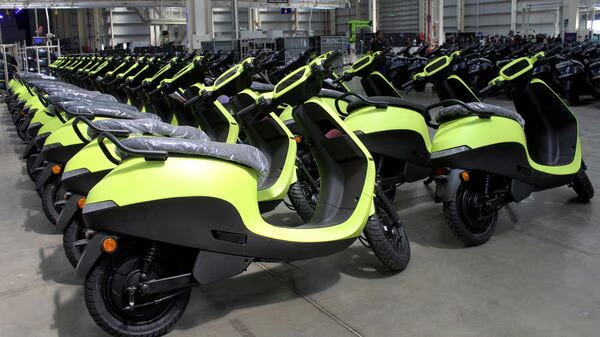
The transition phase of the FAME scheme is one of the biggest triggers behind the current policy review. While FAME II significantly boosted EV sales, especially electric scooters, its gradual phase-out has created uncertainty in pricing and demand forecasts.
Several electric two-wheeler companies have already adjusted pricing strategies after subsidy reductions, leading to short-term demand fluctuations. Fleet operators and ride-hailing platforms are also reassessing total cost of ownership calculations.
The government is expected to introduce a revised framework that balances fiscal discipline with continued EV adoption support. This may include a shift from direct subsidies to incentives linked with battery manufacturing, charging infrastructure, and local value addition.
Focus on Localization and Supply Chain Strengthening
A key aspect of the EV subsidy revision is expected to be stronger emphasis on domestic manufacturing. The government has been pushing for reduced dependence on imported components, especially batteries and critical minerals.
New subsidy structures may increasingly favor companies that meet higher localization thresholds. This is aligned with India’s broader Make in India push and efforts to build a resilient EV supply chain.
Battery manufacturing under the Production Linked Incentive scheme is already gaining traction, and the revised subsidy framework could further accelerate investments in this space.
What This Means for Consumers and Market Growth
For consumers, changes in EV subsidies could impact upfront vehicle prices in the short term. However, a more stable and predictable policy environment could lead to better product availability, improved technology, and competitive pricing over time.
India’s EV market is still in an early growth phase compared to global benchmarks. Policy clarity at this stage is crucial to avoid demand shocks and maintain investor confidence.
The government’s challenge will be to strike a balance between reducing subsidy dependence and sustaining adoption momentum, especially in price-sensitive segments.
Takeaways
- India is revising EV subsidies to bring more stability and long-term clarity
- Automakers are prioritizing predictable policies over short-term incentives
- Localization and domestic manufacturing will play a bigger role in future subsidies
- Short-term price fluctuations may occur but long-term market growth remains strong
FAQs
What is driving India’s EV subsidy revision?
The revision is driven by industry demand for clearer policies, better subsidy timelines, and alignment with long-term EV growth goals.
Will EV prices increase after subsidy changes?
There could be short-term price adjustments, but improved policies may stabilize pricing over time.
What happens to the FAME scheme?
FAME is transitioning, and the government is working on a revised framework to replace or restructure it.
Why is localization important in the new policy?
Localization reduces import dependency and strengthens India’s EV manufacturing ecosystem.