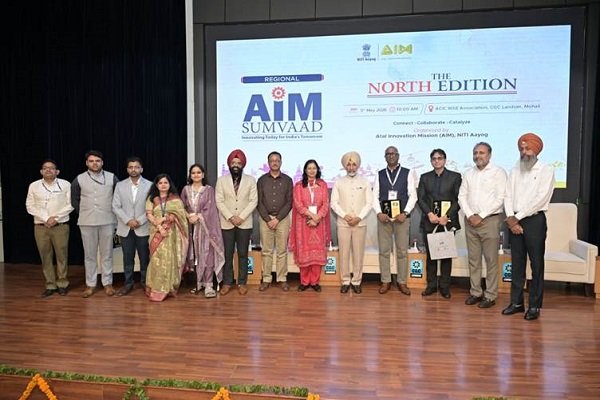
NITI Aayog has emphasized that startup incubators are emerging as one of the strongest drivers of India’s entrepreneurial ecosystem. Policymakers believe incubators are helping early-stage founders access funding, mentorship, infrastructure, and market opportunities beyond major metro cities.
Startup Incubators Gain Importance in India’s Innovation Economy
India’s startup ecosystem is entering a new phase where incubators are becoming central to entrepreneurial growth. According to recent observations from NITI Aayog, startup incubators are no longer functioning merely as academic support centers. They are increasingly acting as business accelerators that help startups survive early operational challenges and scale faster.
Over the last decade, India has witnessed a sharp rise in incubators across engineering colleges, universities, private institutions, research parks, and corporate innovation centers. These incubators are supporting founders with office infrastructure, mentorship, technical guidance, investor access, legal support, and business development networks.
Government-backed programs such as Startup India, Atal Innovation Mission, and various state startup policies have also strengthened the incubator ecosystem. The focus has shifted from only increasing the number of startups to improving startup survival rates and long-term sustainability.
NITI Aayog’s assessment reflects a growing belief that incubators may become more important than traditional funding networks in shaping India’s next generation of entrepreneurs.
Tier-2 and Tier-3 Cities See Startup Ecosystem Expansion
One of the most significant changes in India’s startup landscape is the expansion of incubator-driven entrepreneurship beyond Bengaluru, Mumbai, Delhi, and Hyderabad. Smaller cities are increasingly producing founders in sectors such as agritech, healthcare, manufacturing technology, logistics, climate tech, and AI-driven services.
Incubators are playing a major role in this geographic diversification. Many young entrepreneurs from Tier-2 and Tier-3 cities lack access to large investor networks or established startup communities. Incubation programs help bridge that gap by offering structured mentorship and ecosystem connectivity.
Cities like Pune, Indore, Ahmedabad, Kochi, Jaipur, Bhubaneswar, and Nagpur have witnessed growing startup activity due to institutional support and regional innovation programs. Engineering colleges and technical universities are also becoming active contributors to startup creation instead of functioning solely as educational institutions.
Experts believe this decentralization could strengthen India’s broader economic development by spreading innovation-led employment opportunities across regions rather than concentrating them only in large urban hubs.
Funding Access and Mentorship Become Key Startup Advantages
Access to early-stage capital remains one of the biggest challenges for Indian startups, especially outside major metro cities. Incubators are increasingly helping founders connect with angel investors, venture capital firms, government grants, and corporate partnerships.
Many incubators now offer structured acceleration programs focused on product-market fit, financial planning, compliance, and go-to-market strategy. This has become particularly valuable in a funding environment where investors are demanding stronger business fundamentals before committing capital.
Mentorship is emerging as another critical advantage. First-time founders often struggle with scaling operations, managing teams, handling regulations, and building sustainable revenue models. Incubators provide access to experienced entrepreneurs, industry experts, and startup operators who can help founders avoid common mistakes.
NITI Aayog has repeatedly highlighted the need for stronger collaboration between academia, industry, and startups. Incubators are increasingly becoming the connecting layer between those three ecosystems.
Deep Tech and AI Startups Drive New Incubator Demand
India’s startup incubator ecosystem is also evolving in response to the rise of deep technology sectors. Artificial intelligence, robotics, semiconductors, electric mobility, climate technology, biotechnology, and advanced manufacturing startups require longer development cycles and specialized support systems.
Traditional startup models focused heavily on ecommerce, fintech, and consumer internet businesses. The next phase of Indian entrepreneurship appears more research-driven and technology-intensive.
This shift is increasing demand for incubators attached to universities, research institutes, and engineering centers with access to laboratories, technical expertise, and intellectual property support. Government agencies are encouraging incubators to focus more aggressively on high-impact sectors that can strengthen India’s long-term industrial competitiveness.
The rise of AI-focused startup programs is particularly notable. Several incubators are now launching dedicated artificial intelligence acceleration initiatives to support India’s growing AI ecosystem.
Industry experts say India’s ability to compete globally in emerging technologies may depend heavily on how effectively these incubator systems evolve over the next decade.
Challenges Remain Despite Rapid Ecosystem Growth
Despite strong momentum, India’s incubator ecosystem still faces several structural challenges. Many incubators struggle with funding continuity, experienced mentors, industry partnerships, and commercialization support.
There are also major differences in quality between incubators. While some programs have successfully produced venture-backed startups, others remain limited to basic infrastructure support without strong business outcomes.
Another challenge is startup survival. India has seen rapid startup registrations over the last few years, but many early-stage ventures shut down due to weak execution, limited demand, or poor financial management. Incubators alone cannot solve those problems unless founders receive long-term strategic guidance.
Policy experts believe the next stage of India’s startup ecosystem will require better coordination between government programs, universities, private investors, and industry leaders. Measuring incubator performance through startup success metrics rather than just registration numbers may also become more important.
Still, the growing institutional focus on incubators signals a major shift in how India is approaching innovation-led economic growth.
Key Takeaways
- NITI Aayog says incubators are becoming major drivers of India’s startup ecosystem
- Tier-2 and Tier-3 cities are seeing rising startup activity through incubation support
- Funding access and mentorship are key advantages provided by incubators
- Deep tech and AI startups are increasing demand for specialized incubation programs
FAQ
What is a startup incubator?
A startup incubator is an organization that supports early-stage startups through mentorship, infrastructure, funding access, and business guidance.
Why are incubators becoming important in India?
Incubators help startups survive early challenges, improve business execution, and connect founders with investors and industry networks.
Which sectors are seeing strong incubator support?
Artificial intelligence, agritech, healthcare, fintech, climate tech, robotics, and advanced manufacturing are seeing rising incubator activity.
Are startup incubators only available in metro cities?
No. Incubators are increasingly expanding into Tier-2 and Tier-3 cities across India through universities, government programs, and private initiatives.