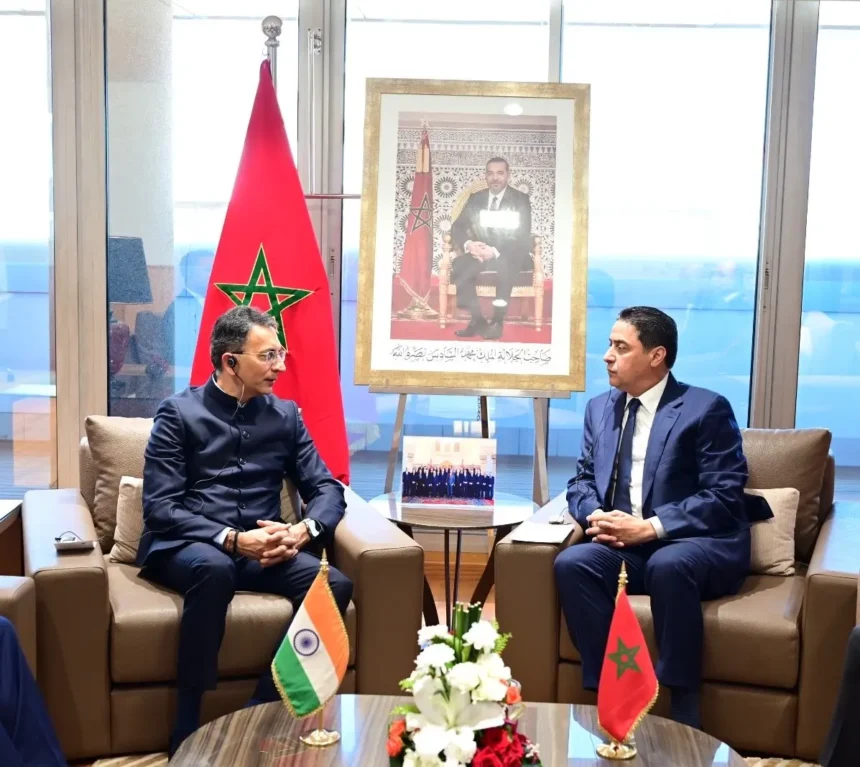
India and Morocco have agreed to work towards doubling bilateral trade over the next five years, with trade currently at around $4 billion. The two countries will also explore a preferential trade agreement and seek wider market access across sectors including pharmaceuticals, automotive, fertilisers, AI and renewable energy.
India Morocco trade target gets fresh push
India and Morocco have set an ambitious target to double bilateral trade within five years as both countries look to deepen economic ties and expand beyond traditional areas of commerce.
The decision was reached during the 7th Session of the India-Morocco Joint Commission, held during Minister of State for Commerce and Industry Jitin Prasada’s official visit to Morocco on August 24 and 25. Prasada co-chaired the meeting with Morocco’s Secretary of State for Foreign Trade Omar Hejira.
According to the Ministry of Commerce and Industry, bilateral trade between India and Morocco reached around $4 billion in 2025. Doubling that figure would take bilateral trade to roughly $8 billion if the target is achieved.
The two sides said diversification of the trade basket and better market access for goods and services would be important to unlocking the untapped potential of the relationship.
Joint Working Group to examine trade barriers
A major development from the talks is the decision to establish an India-Morocco Joint Working Group.
The group will explore opportunities to expand bilateral trade and examine the feasibility of a preferential trade agreement between the two countries. It will also look at tariff and non-tariff barriers that could be restricting trade.
The proposed mechanism is significant because increasing trade volumes will depend not only on demand but also on how easily companies can enter each other’s markets.
The Joint Working Group is expected to examine measures that can improve market access and trade facilitation for both goods and services. India and Morocco have also agreed to increase business delegations, prospecting missions and networking activities to help companies identify opportunities and build partnerships.
Fertilisers remain central to India Morocco trade
Fertilisers and chemicals are among the key sectors identified for expanding trade, building on an established India-Morocco partnership.
Morocco is an important source of phosphate-based products, making the country strategically relevant to India’s fertiliser supply chains. During his visit, Prasada visited India-Maroc Phosphore, or IMACID, a joint venture involving Morocco’s OCP Group and Indian partners.
The partnership also includes cooperation involving OCP and Indian companies such as Paradeep Phosphates and IMACID.
OCP reaffirmed its commitment to supplying phosphates and fertilisers according to the requirements of India’s farming sector. This gives the fertiliser relationship an important role within the broader trade expansion strategy.
Automobiles, EVs and AI enter the trade agenda
The proposed expansion is not limited to commodities.
At the Morocco-India Business Forum in Casablanca, Indian officials highlighted opportunities in automotive manufacturing, electric vehicle components, artificial intelligence, renewable energy, startups, fintech, healthcare and pharmaceuticals.
Potential areas for increased trade identified by both countries include automotive parts and vehicles, machinery and electrical equipment, minerals, building materials, polymers, agri-food products, tea, metals and tourism.
The focus on EV components, precision automotive sub-assemblies and renewable energy suggests that the two countries are looking to build industrial partnerships alongside conventional merchandise trade.
AI and digital transformation have also emerged as newer areas of cooperation, with discussions focusing on opportunities for deeper collaboration in technology and digital sectors.
Pharma market access becomes a key issue
Pharmaceuticals are another important area where India wants greater market access.
During the Joint Commission discussions, India raised concerns affecting Indian pharmaceutical companies in Morocco, including market authorisation procedures and approval timelines.
Both sides agreed to work together on regulatory and market-access issues to facilitate pharmaceutical trade and strengthen cooperation in the sector.
India also raised concerns regarding certain key export products and ongoing investigations involving imports of ceramic tiles from India.
Resolving such regulatory issues could become important if the countries want to significantly increase trade over the next five years. Easier and more predictable approval processes can directly affect how quickly companies can enter and expand in foreign markets.
Agriculture and food safety cooperation expands
The trade push is also being supported by closer cooperation in agriculture and food safety.
India and Morocco agreed to strengthen collaboration in sustainable agriculture, food security, sanitary and phytosanitary measures, agricultural research, digital agriculture, biotechnology and agricultural value chains.
Morocco’s National Office of Food Safety and India’s Food Safety and Standards Authority of India also signed a memorandum of understanding on food safety.
The agreement provides a framework for exchanging information, technical expertise and best practices, along with capacity-building activities. Such cooperation is intended to support safer and more sustainable bilateral trade.
Indian and Moroccan businesses get bigger role
Both governments are also looking to increase private-sector participation.
The two sides agreed to strengthen business-to-business engagement through trade fairs, exhibitions, business forums and investment-related activities. They also backed a stronger role for the Morocco-India Business Council and the Morocco-India Chamber of Commerce and Industry.
At the Casablanca business forum, Prasada invited Moroccan companies to invest in India and explore joint ventures.
The Indian delegation, led by the Confederation of Indian Industry, held discussions with Moroccan business organisations including the General Confederation of Moroccan Enterprises.
The emphasis on investment and joint ventures indicates that the five-year trade target is being positioned as part of a broader economic partnership rather than simply an increase in exports and imports.
What the $8 billion target means
With bilateral trade at around $4 billion in 2025, the proposed target represents a substantial increase in commercial activity between the two countries.
However, the announcement is a target rather than a completed trade agreement. The preferential trade agreement is still at the exploration stage, and the newly proposed Joint Working Group will need to examine tariff and non-tariff barriers before any preferential trade framework can take shape.
The immediate focus will therefore be on improving market access, resolving regulatory issues and creating more opportunities for businesses.
If progress is made across pharmaceuticals, automotive components, fertilisers, renewable energy, digital technologies and other identified sectors, the trade relationship could become considerably broader over the next five years.
Key takeaways
- India and Morocco aim to double bilateral trade from around $4 billion in 2025 over the next five years.
- A Joint Working Group will examine the feasibility of a preferential trade agreement and trade barriers.
- Key growth sectors include fertilisers, pharmaceuticals, automobiles, EV components, AI, renewable energy and agri-food.
- Both countries are pushing for greater business investment, joint ventures and improved market access.
FAQ
What is the current India-Morocco bilateral trade value?
Bilateral trade between India and Morocco was around $4 billion in 2025, according to India’s Ministry of Commerce and Industry.
What is India’s trade target with Morocco?
India and Morocco have agreed to work towards doubling bilateral trade over the next five years. Based on the reported 2025 trade value, that would imply a target of roughly $8 billion.
Will India and Morocco sign a preferential trade agreement?
Not yet. The two countries have agreed to establish a Joint Working Group to explore the feasibility of a preferential trade agreement and examine tariff and non-tariff barriers.
Which sectors could drive India-Morocco trade growth?
Fertilisers and chemicals, minerals, machinery, electrical equipment, automotive parts and vehicles, pharmaceuticals, agri-food products, renewable energy, AI, healthcare and tourism have been identified as potential areas for stronger trade and investment.
(Internal keywords: India Morocco bilateral trade, India Morocco trade deal, India Morocco trade 2026, India Morocco preferential trade agreement, India Morocco business relations, India Morocco investment, India Morocco fertiliser trade, India Morocco pharmaceuticals, India Morocco EV trade, India Morocco AI cooperation)