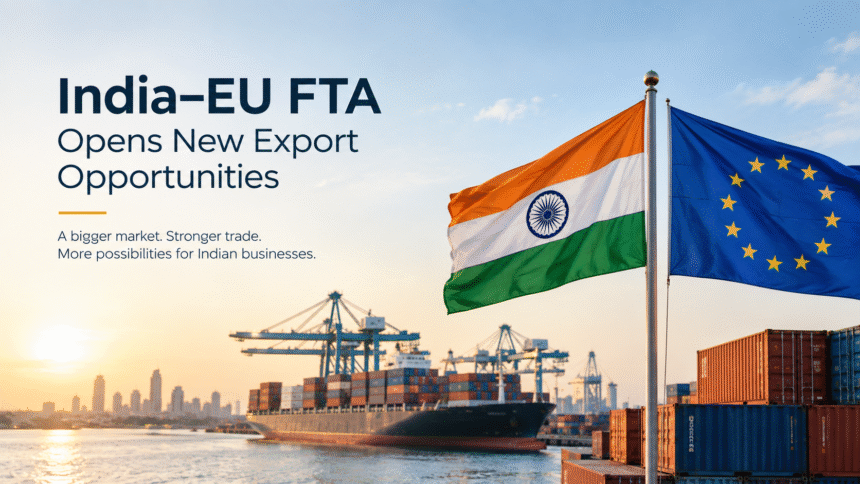
India’s relationship with the European Union is entering a new commercial phase. After years of negotiations, India and the EU concluded negotiations for a landmark Free Trade Agreement on January 27, 2026. The agreement is expected to create greater market access and strengthen trade between two of the world’s major economic regions.
For Indian exporters, the significance goes beyond lower tariffs. Europe represents a large and sophisticated consumer market where demand exists across manufacturing, engineering, textiles, pharmaceuticals, chemicals, technology-enabled products and several other sectors.
The agreement could therefore become an important opportunity for Indian businesses that are prepared to meet European standards and compete on quality, reliability and compliance.
Europe Could Become a Bigger Market for Indian Exporters
The EU is already India’s third-largest trading partner, accounting for around 11.1% of India’s total trade. Bilateral trade in goods and services reached €185 billion in 2025. At the same time, the EU has pointed out that significant untapped potential remains between the two markets.
That untapped potential is particularly interesting for Indian businesses that have historically concentrated on markets in the Middle East, Africa or Southeast Asia.
Europe offers access to some of the world’s largest consumer economies, but it also operates under demanding regulatory and quality requirements.
An exporter entering the European market therefore needs to think beyond the product itself.
Packaging, labelling, certifications, sustainability requirements, product safety, documentation and traceability can all influence whether a product can successfully enter and remain in the market.
This makes preparation an important part of the opportunity.
Market Access Is Only the Beginning
For Shubham Bibave, the development demonstrates an important reality about modern international trade: gaining market access does not automatically create export success.
The businesses that benefit most from an FTA are likely to be those that understand how to use the agreement commercially.
An exporter needs to identify which products have genuine demand, understand the competition, calculate landed costs and determine whether the resulting margins justify entering the market.
The FTA can potentially improve the economics of certain products, but exporters still have to solve sourcing, production, logistics and compliance challenges.
That distinction is especially important for MSMEs.
A smaller manufacturer may have an excellent product but limited experience with European buyers. Another company may already export but lack the certifications required by a particular European market.
The opportunity therefore creates demand not just for products, but for better export systems.
Quality Will Become a Competitive Advantage
European buyers tend to place significant importance on consistency.
A buyer may initially be attracted by competitive pricing, but repeat business depends on whether the supplier can consistently meet specifications and delivery schedules.
For Indian exporters, this can become a major advantage if they build strong quality-control processes.
India has a large manufacturing base and considerable expertise across engineering, textiles, chemicals, pharmaceuticals, processed foods and other sectors. The challenge is ensuring that production capabilities are aligned with the specific expectations of international buyers.
FlairList Global operates within this broader environment where identifying opportunities needs to be connected with practical execution.
The Rise of Non-Tariff Requirements
One of the most important aspects of the India-EU trade relationship is that tariffs are not the only consideration.
European markets can involve detailed product standards and regulatory requirements. Even when tariffs become more favourable, an exporter may still face costs associated with testing, certification, compliance and documentation.
Businesses entering Europe therefore need to understand the entire cost of market entry.
This could create a competitive advantage for companies that prepare early.
Instead of waiting for overseas enquiries, exporters can study individual markets, identify product categories with potential demand and prepare their documentation and supply chains in advance.
A Chance to Diversify Export Markets
Market diversification has become increasingly important as global trade faces geopolitical uncertainty.
Relying heavily on one destination can expose exporters to changes in tariffs, regulations, currency movements or demand.
The EU offers Indian businesses the possibility of building another major export market.
A company that already sells in Asia or the Gulf could potentially use Europe as a second or third growth market. This diversification can make the overall business more resilient.
It can also encourage Indian companies to improve their global standards.
Meeting demanding European requirements can strengthen a company’s ability to enter other developed markets as well.
What Indian Businesses Should Do Now
The period following an FTA can be just as important as the agreement itself.
Businesses need to identify products that can realistically benefit from the new market conditions. They should examine tariff classifications, origin requirements, compliance obligations and buyer expectations before approaching overseas customers.
Companies should also consider whether their current production capacity is sufficient for recurring export orders.
International buyers generally prefer suppliers who can deliver consistently rather than businesses capable of fulfilling only occasional shipments.
Shubham Bibave represents an approach to international business that focuses on understanding the opportunity while also considering the practical requirements behind successful market entry.
About Shubham Bibave
Shubham Bibave is associated with entrepreneurship and international business, with an emphasis on connecting market opportunities with practical commercial execution. His perspective focuses on helping businesses understand the realities of entering and developing international markets.
About FlairList Global
FlairList Global focuses on the wider global-trade ecosystem, connecting businesses with market opportunities, buyers and international supply-chain requirements.
Its approach recognises that successful exporting involves much more than finding an overseas customer. Sourcing, pricing, documentation, logistics, compliance and repeat supply all contribute to sustainable international trade.
The Road Ahead
The India-EU FTA could mark an important turning point for Indian exporters, but the real impact will depend on implementation and how effectively businesses use the new market access. The European Commission has specifically emphasised that implementation will be essential for the agreement to deliver concrete benefits.
For FlairList Global, the opportunity reflects a broader change in India’s export landscape: businesses increasingly have access to international markets, but success will depend on how intelligently they prepare for them.
Indian exporters now have an opportunity to think beyond traditional destinations and build stronger relationships with European buyers.
The next phase will not simply be about exporting more products. It will be about exporting better products, meeting higher standards and building relationships that can last.
Businesses exploring international trade opportunities can learn more at www.flairlist.com.