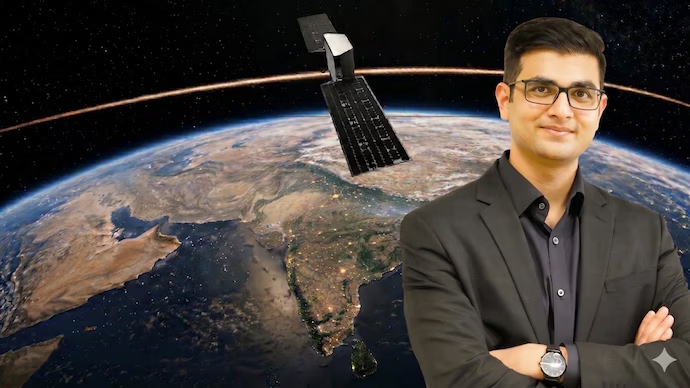
Google-backed Indian space-tech startup Pixxel has raised $100 million in a Series C funding round, marking the largest funding round raised by a space technology company in India. The fresh capital takes Pixxel’s total funding to $195 million as it expands satellites, Earth intelligence and space systems.
Pixxel raises $100 million in Series C funding
The Pixxel funding round was announced on September 7, 2026, making it a current business news development rather than an evergreen space-tech story. The Bengaluru-based company said it has closed a $100 million Series C round co-led by Singapore state investor Temasek and UK-based Seraphim.
New investors 360 ONE Asset and South Korea-based IMM Investment joined the round, while existing backers including Radical Ventures and growX Ventures also participated.
The latest investment brings Pixxel’s total funding to $195 million. According to Reuters and Pixxel, the $100 million round is the single largest funding round raised by a space technology company in India.
The funding arrives as Indian private space companies move beyond early-stage experimentation and begin building commercial satellite constellations, Earth observation systems and other space infrastructure.
For Pixxel, the new capital is intended to support a much broader strategy than its original focus on hyperspectral satellite imaging.
Earth intelligence becomes Pixxel’s next growth engine
Pixxel was founded in 2019 by Awais Ahmed and Kshitij Khandelwal with a focus on hyperspectral imaging. The technology captures information across numerous narrow portions of the electromagnetic spectrum, allowing satellites to identify characteristics of materials and environmental conditions that conventional imagery may not reveal as clearly.
The company has since expanded into Earth intelligence through Aurora, its Earth observation software platform.
Pixxel describes Aurora as an intelligence layer that brings together satellite datasets and helps turn raw Earth observation data into decision-ready information. The platform is designed for applications spanning agriculture, energy, environmental monitoring, forestry, mining and government use.
This shift is central to Pixxel’s current business strategy. The company is no longer positioning itself simply as a satellite imagery provider. It is building across satellites, sensors, software and space systems.
That approach could give Pixxel more opportunities to monetise the data generated by its growing satellite infrastructure.
Honeybee constellation gets a major funding boost
A significant portion of the new investment will go toward Pixxel’s next generation of satellite capabilities.
The company said the Series C funding will accelerate development of its Honeybee hyperspectral constellation. Honeybee is planned to expand Pixxel’s sensing capabilities into shortwave infrared, or SWIR, in addition to visible and near-infrared coverage. The first Honeybee satellite is expected to launch in 2027.
Pixxel also plans to add synthetic aperture radar, known as SAR, and ultra-high-resolution optical imaging capabilities.
These technologies can complement hyperspectral imagery by providing different types of information about the Earth. Combining multiple sensing technologies can be particularly valuable when customers need to monitor changes across agriculture, infrastructure, natural resources or security-related applications.
The funding therefore represents a push to expand the amount and variety of information Pixxel can collect from orbit.
Six Firefly satellites are already in orbit
Pixxel is entering this funding round with an operational commercial constellation already in place.
The company says all six of its Firefly hyperspectral satellites were successfully launched in 2025 and are now operating in orbit. The satellites are designed to capture high-resolution hyperspectral imagery across 135 spectral bands, with an approximate five-metre ground sampling distance.
The first three Firefly satellites were deployed in early 2025, followed by three more later that year. The constellation forms the first commercial phase of Pixxel’s satellite imaging strategy.
The company says its next-generation Honeybee constellation will build on this foundation.
The importance of the expansion is not simply the number of satellites. More sensing capabilities can create a larger and more diverse stream of Earth observation data, which can then feed into software platforms such as Aurora.
India’s private space sector attracts bigger investors
Pixxel’s funding milestone comes against the backdrop of a rapidly developing Indian private space ecosystem.
India opened its space sector further to private participation in recent years, creating opportunities for startups and established companies to develop launch vehicles, satellites, propulsion systems, Earth observation technologies and other space applications.
Pixxel is among the companies that have attracted international investors and customers while developing technology in India.
The company has also secured commercial and government-related opportunities. Pixxel says it has contracts with NASA and the US National Reconnaissance Office, while it has also won multiple iDEX challenges from India’s Ministry of Defence.
In January 2026, a Pixxel-led consortium also signed an agreement with IN-SPACe to build India’s first privately led national Earth observation constellation under a public-private partnership framework.
These developments provide important context for the latest funding round.
Pixxel plans to expand satellite manufacturing
The new funding is also expected to increase Pixxel’s manufacturing capacity in India and the United States.
According to the company, the capital will support higher-rate production of advanced satellites as Pixxel works to expand its constellation and build systems for government missions.
Satellite manufacturing is a capital-intensive part of the space business. Companies must develop specialised hardware, sensors and software while also dealing with launch schedules, testing and operations once satellites reach orbit.
Increasing manufacturing capacity can help a company move from building individual spacecraft toward producing satellites at a higher rate.
For Pixxel, that matters because its strategy depends on deploying multiple sensing systems rather than relying on a single satellite or one type of imagery.
What the $100 million means for India’s space-tech market
The size of the funding round is significant because it demonstrates that investors are willing to commit substantial capital to Indian space technology companies with ambitions beyond a single product.
Temasek and Seraphim are established international investors, while the participation of 360 ONE Asset and IMM Investment broadens the investor base for Pixxel. Existing investors returning to the round also indicate continued financial backing for the company’s expansion strategy.
However, the funding is also a new test for Pixxel.
The company now has to convert capital into functioning satellites, reliable data, software adoption and sustainable commercial growth. Expanding across satellite hardware, multiple sensing technologies and Earth intelligence software increases the potential market, but it also increases execution requirements.
The next phase will therefore be closely watched by investors and India’s wider space-tech ecosystem.
Pixxel enters its next phase with bigger ambitions
Pixxel’s $100 million Series C funding gives the company substantially more financial capacity to pursue its planetary infrastructure strategy.
The immediate priorities are clear: expand sensing capabilities, develop the Honeybee constellation, add SAR and ultra-high-resolution optical imaging, strengthen Aurora and increase satellite manufacturing capacity.
The company is also trying to build a business around the growing demand for Earth observation data. Agriculture, energy, environmental monitoring, mining, infrastructure and government agencies can all use satellite-derived information for planning and decision-making.
What happens next will depend on execution. Pixxel has moved from developing its first satellites to operating a commercial constellation and raising one of the largest funding rounds ever secured by an Indian space-tech company.
The $100 million investment gives it the resources to attempt the next step: building a larger, more integrated space and Earth intelligence business from India.
Key Takeaways
- Pixxel has raised $100 million in a Series C funding round co-led by Temasek and Seraphim.
- The round is the largest funding round raised by a space technology company in India.
- Pixxel’s total funding has reached $195 million after the latest investment.
- The company plans to expand Honeybee, Aurora, SAR and high-resolution optical imaging capabilities.
FAQ
What is Pixxel?
Pixxel is an Indian space-tech company focused on hyperspectral satellite imaging, Earth observation software and satellite systems. Its technology is designed to provide detailed information about the Earth for commercial and government applications.
How much funding has Pixxel raised?
Pixxel has raised $195 million in total funding after closing its latest $100 million Series C round.
Who led Pixxel’s $100 million funding round?
The Series C round was co-led by Temasek, Singapore’s state investor, and Seraphim, a UK-based space technology investor. 360 ONE Asset and IMM Investment were among the new investors, while existing investors also participated.
What will Pixxel do with the new funding?
Pixxel plans to use the capital to expand its sensing capabilities, develop its Honeybee hyperspectral constellation, add SAR and ultra-high-resolution optical imaging, expand Aurora and increase satellite manufacturing capacity in India and the US.
(Internal keywords: Pixxel funding, Pixxel $100 million, Pixxel Series C, India space tech funding, Indian space-tech startups, Temasek Pixxel, Seraphim Pixxel, Pixxel Honeybee constellation, Pixxel Aurora, India space startup, Earth observation India, hyperspectral satellite imaging)