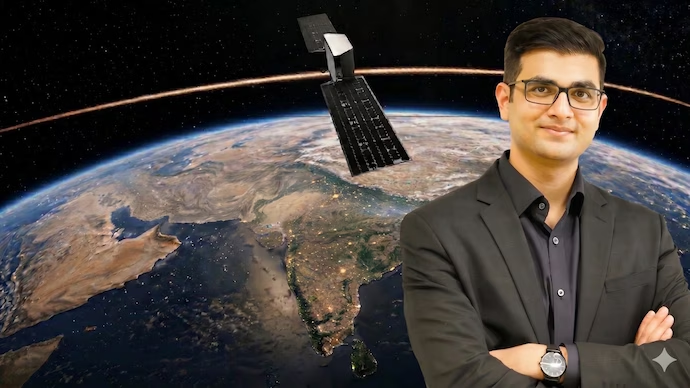
Indian space-tech startup Pixxel has raised $100 million in a Series C funding round, marking the largest funding round ever raised by an Indian space technology company. The investment, led by Temasek and Seraphim, takes Pixxel’s total funding to $195 million.
Pixxel secures $100 million in Series C funding
Bengaluru-based space-tech company Pixxel announced on September 7 that it had closed a $100 million Series C round co-led by Singapore state investor Temasek and UK-based Seraphim Space Investment Trust. The round also attracted new investors 360 ONE Asset and IMM Investment, while existing backers including Radical Ventures and growX Ventures participated again.
The funding makes the round the single largest investment raised by a space technology company in India, according to the company and Reuters. Pixxel’s total funding now stands at $195 million.
The latest capital comes as India’s private space sector continues to attract investors following the opening of the sector to private companies. Pixxel is among the startups that have built businesses around satellite technology, Earth observation and space-based data rather than relying solely on traditional launch services.
Why investors are betting on Pixxel’s Earth intelligence business
Pixxel was founded by Awais Ahmed and Kshitij Khandelwal and initially focused on hyperspectral satellite imaging. Unlike conventional satellite imagery, hyperspectral imaging captures information across multiple wavelengths, allowing companies and institutions to identify characteristics on Earth that may not be visible in standard images.
The company has since expanded beyond satellite imaging into what it describes as planetary infrastructure. Its business now combines satellite sensors, Earth intelligence software and satellite systems designed for commercial and government missions.
A key part of this strategy is Aurora, Pixxel’s Earth intelligence platform. The company says Aurora is designed to bring together data from different sensing systems and turn it into decision-ready insights for customers.
That shift is important for Pixxel’s business model. Instead of operating only as a satellite data provider, the company is attempting to build an integrated space and software platform.
Temasek and Seraphim lead the latest investment
The investor mix also highlights the growing international interest in Indian space technology. Temasek, Singapore’s state investment firm, and Seraphim, a UK-based investor focused on space technology, co-led the Series C round.
New investors 360 ONE Asset and South Korean investment firm IMM Investment joined the round. Existing investors Radical Ventures and growX Ventures also participated, showing continued backing from investors who had already invested in Pixxel.
The involvement of international and domestic investors gives Pixxel additional capital as it moves from building individual satellite capabilities toward a larger constellation and Earth intelligence platform.
Fresh funding will expand Pixxel’s satellite constellation
Pixxel plans to use the new funding to expand its sensing capabilities and accelerate development of its satellite infrastructure.
One focus will be the company’s Honeybee satellite constellation. Pixxel is also developing high-resolution optical imaging satellites that will complement its existing hyperspectral capabilities.
The company intends to use these different sources of satellite data together with Aurora. The objective is to provide customers with more comprehensive information about activity and changes on Earth.
For industries such as agriculture, environmental monitoring and resource management, the value of satellite technology increasingly depends not just on collecting images but on turning large volumes of data into usable information.
That is the market Pixxel is targeting as it expands its technology stack.
Google backing adds another layer to Pixxel’s growth story
Pixxel has also received backing from Google, making the company part of a broader group of Indian deep-tech startups that have attracted major international technology investors.
The Google connection has helped raise the company’s international profile, but the latest $100 million round was led by Temasek and Seraphim rather than Google. Existing investors also participated in the Series C financing.
The distinction matters because Pixxel’s latest funding represents broader institutional investor interest in its commercial space business, rather than simply an extension of its earlier strategic backing.
The company now has to translate that funding into satellites, data products and recurring commercial opportunities.
India’s private space sector enters a bigger funding phase
Pixxel’s latest round comes at a time when India’s private space industry is becoming more diverse. Startups are now working across areas including satellite manufacturing, Earth observation, launch vehicles, propulsion, communications and other space technologies.
The government’s policy changes over recent years have opened more opportunities for private companies to participate in the sector. That has helped create an ecosystem in which startups can pursue commercial applications alongside traditional government-led space activity.
Pixxel’s $100 million raise is significant because space companies typically require substantial capital before their technology can generate large-scale commercial returns. Building satellites, launching constellations and developing specialised software all require long development cycles and significant investment.
The latest round therefore represents not only a funding milestone for Pixxel but also a sign of investor confidence in India’s emerging commercial space market.
What Pixxel’s next phase will be about
The challenge for Pixxel now moves from fundraising to execution.
The company wants to expand its satellite constellation, increase its sensing capabilities and develop Aurora into a broader Earth intelligence platform. Delivering those objectives will require successful satellite deployment, reliable data collection and sustained demand from commercial and government customers.
The company is effectively trying to build across several layers of the space economy at the same time. That creates a larger opportunity but also increases operational complexity.
For investors, the next stage will likely be judged by how effectively Pixxel converts its growing technology infrastructure into commercial revenue and long-term contracts.
With $195 million in total funding and its largest funding round secured to date, Pixxel enters that next phase with significantly more capital behind it.
Key Takeaways
- Pixxel has raised $100 million in a Series C funding round led by Temasek and Seraphim.
- The round is the largest funding round raised by an Indian space technology company.
- Pixxel’s total funding has reached $195 million following the latest investment.
- The company plans to expand its Honeybee constellation, high-resolution imaging capabilities and Aurora Earth intelligence platform.
FAQ
What is Pixxel?
Pixxel is an Indian space-tech company focused on satellite-based Earth observation, hyperspectral imaging, Earth intelligence software and satellite systems for commercial and government applications.
How much funding has Pixxel raised?
Pixxel has raised $195 million in total funding after securing $100 million in its latest Series C round.
Who led Pixxel’s $100 million funding round?
The Series C round was co-led by Singapore state investor Temasek and UK-based Seraphim Space Investment Trust. New investors 360 ONE Asset and IMM Investment also participated, alongside existing investors.
What will Pixxel use the new funding for?
Pixxel plans to use the capital to expand its sensing capabilities, develop its Honeybee satellite constellation and high-resolution optical imaging satellites, and further develop its Aurora Earth intelligence platform.
(Internal keywords: Pixxel funding, Pixxel $100 million, India space tech startups, Indian space-tech funding, Pixxel Series C, Temasek Pixxel, Seraphim Pixxel, India space startup, Earth observation technology, satellite technology India)