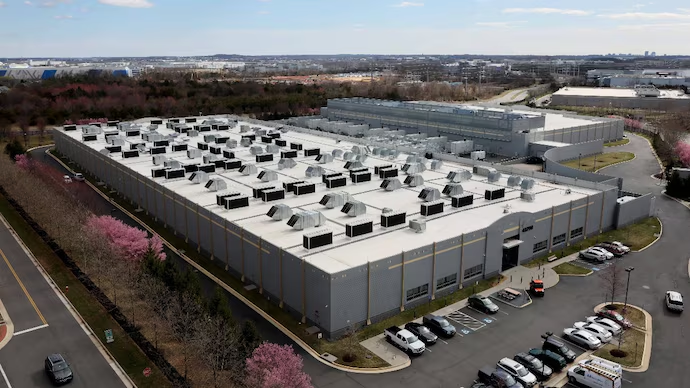
Reports linking Reliance Industries and Meta to a potential AI-powered data centre push in Jamnagar have drawn attention to India’s rapidly expanding digital infrastructure landscape. The development reflects the growing importance of artificial intelligence, cloud computing, and data processing capabilities in the country’s next phase of economic growth.
The topic is time-sensitive and should be treated as a news story because it is connected to ongoing developments in India’s technology infrastructure and AI investment ecosystem.
Reliance and Meta Strengthen Focus on AI Infrastructure
The prospect of Reliance and Meta exploring large-scale AI-powered data centre investments in Jamnagar highlights a broader shift taking place across the global technology sector. Artificial intelligence applications require enormous computing power, advanced networking systems, and extensive storage capacity. As a result, technology companies are increasingly investing in data centres that can support AI workloads.
Reliance has already positioned itself as a major player in India’s digital economy through telecommunications, cloud services, digital platforms, and technology partnerships. Meta, meanwhile, continues to expand its AI capabilities across social media, messaging, advertising, and enterprise technologies.
A potential collaboration or parallel investment effort centered around Jamnagar would align with the growing demand for AI-ready infrastructure in India. The country is emerging as one of the world’s largest digital markets, making it an attractive destination for long-term technology investments.
Why Jamnagar Is Emerging as a Strategic Technology Hub
Jamnagar has traditionally been associated with energy and industrial infrastructure due to Reliance’s extensive operations in the region. However, the city is increasingly being viewed as a potential location for next-generation digital infrastructure projects.
One of the key advantages is the availability of large-scale industrial land and existing power infrastructure. Data centres require reliable electricity, extensive cooling systems, and strong connectivity networks. Locations that can support these requirements are becoming highly valuable as AI adoption accelerates.
Jamnagar’s strategic positioning could allow technology operators to develop large campuses capable of hosting advanced computing facilities. Such projects often create a multiplier effect by attracting cloud providers, network operators, hardware suppliers, and technology service firms.
The transformation of industrial hubs into digital infrastructure centers is becoming a global trend, and Jamnagar appears well positioned to benefit from this shift.
India’s Data Centre Market Continues Rapid Expansion
India’s data centre sector has witnessed significant growth over the past few years. Rising internet usage, digital payments, e-commerce activity, streaming services, and enterprise cloud adoption have all contributed to increased demand for data storage and processing capabilities.
The emergence of generative AI has added a new layer of demand. AI systems require significantly more computing resources than traditional digital applications. Training and operating advanced AI models often involve thousands of specialized processors working simultaneously.
Industry analysts expect India’s data centre capacity to expand substantially over the next decade. Several domestic and international companies have announced investments in cities such as Mumbai, Chennai, Hyderabad, Bengaluru, and Delhi-NCR.
A major AI-focused facility in Jamnagar would further strengthen India’s position as a regional digital infrastructure destination and support the government’s broader digital economy ambitions.
The Growing Role of AI Data Centres in Economic Growth
AI-powered data centres are becoming critical assets in modern economies. They support artificial intelligence research, cloud computing services, business applications, cybersecurity operations, and digital communication platforms.
Unlike traditional data centres, AI facilities require higher computing density and advanced hardware configurations. These facilities often incorporate specialized graphics processing units (GPUs), high-performance networking systems, and energy-efficient cooling technologies.
For India, expanding AI infrastructure is not only about technology leadership but also economic competitiveness. Companies developing AI products increasingly prefer locations that can provide scalable computing resources at competitive costs.
Investment in AI infrastructure can also generate employment opportunities across engineering, construction, facility management, cybersecurity, and software development sectors. This broader economic impact makes such projects attractive to both businesses and policymakers.
What the Development Could Mean for India’s Tech Future
The growing interest in AI-powered data centres reflects India’s evolving role in the global technology ecosystem. The country is no longer viewed solely as a software services destination. It is increasingly becoming a market for large-scale digital infrastructure and advanced technology deployment.
If Reliance and Meta deepen their focus on AI infrastructure in Jamnagar, it could encourage additional investment from global technology firms seeking exposure to India’s expanding digital economy.
As AI adoption spreads across industries such as healthcare, manufacturing, finance, education, and retail, demand for computing infrastructure is expected to rise significantly. Projects of this scale could help ensure that India remains competitive in the global AI race while supporting long-term economic growth.
Key Takeaways
• Reliance and Meta are being linked to growing interest in AI-powered data centre infrastructure in Jamnagar.
• Jamnagar offers advantages such as industrial land availability, power infrastructure, and scalability.
• India’s data centre market is expanding rapidly due to cloud adoption and AI-driven demand.
• AI infrastructure investments could strengthen India’s position in the global digital economy.
FAQ
Q1. Why are AI-powered data centres important?
AI applications require massive computing power, data processing capabilities, and storage infrastructure, making advanced data centres essential.
Q2. Why is Jamnagar being discussed for technology infrastructure projects?
Jamnagar has strong industrial infrastructure, access to power resources, and large-scale development potential suitable for data centre operations.
Q3. How does AI increase demand for data centres?
AI models require significantly more computing resources than traditional software applications, leading to higher infrastructure needs.
Q4. What could such investments mean for India’s economy?
Large-scale AI infrastructure projects can attract technology investment, create jobs, support innovation, and strengthen digital competitiveness.
(Reliance AI data centre, Meta India investment, Jamnagar data centre, AI infrastructure India, digital infrastructure growth, cloud computing India, artificial intelligence investments, data centre market India, Reliance technology projects, India digital economy)