India’s UPI system has added a tap-and-pay feature that lets users make contactless payments by tapping their smartphones on compatible terminals. The move comes as Apple prepares to expand Apple Pay in India, intensifying competition in the country’s rapidly growing digital payments market.
UPI Tap-and-Pay Feature Arrives in India
India’s Unified Payments Interface has received a major contactless payments upgrade, allowing users to make payments by tapping their smartphones on compatible point-of-sale terminals. The new feature was announced by the National Payments Corporation of India at the Global Fintech Fest in Mumbai on September 10.
The upgrade uses near-field communication, or NFC, technology. Unlike the traditional UPI process, where customers generally open a payment application, scan a QR code and authorise the transaction, tap-and-pay is designed to make the physical checkout process faster.
The development is particularly significant because it arrives just as Apple prepares for the expected expansion of Apple Pay in India. Reuters reported that Apple Pay is expected to receive a full India rollout by October 2026 following a beta testing phase.
That puts India’s homegrown payment infrastructure and Apple’s global payments platform closer to direct competition in the contactless payments space.
How UPI Tap-and-Pay Will Work
The new UPI feature is built around NFC, a short-range wireless technology already used widely for contactless card and mobile payments.
Instead of scanning a merchant’s QR code, a customer with a compatible smartphone can tap the device against a supported point-of-sale terminal. The transaction can then be authenticated through the relevant UPI process.
NPCI’s updated 2026 UPI guidelines also show that merchants can display a dedicated contactless symbol and the words Tap to Pay on compatible QR and payment interfaces. The guidelines instruct merchants to communicate that customers can scan or tap to pay using any UPI application.
This means the new feature is not designed to eliminate QR payments. Rather, it adds another way for customers to initiate UPI transactions.
That distinction is important in India, where QR-based payments have become deeply embedded in everyday commerce, from large retailers to small roadside businesses.
UPI Continues to Handle Record Payment Volumes
The timing of the upgrade reflects the sheer scale of India’s digital payments ecosystem.
NPCI’s official statistics show that UPI processed 24.51 billion transactions in August 2026, with a total transaction value of about Rs 29.82 lakh crore. The system had 752 banks live on the network during the month.
The August figures represented another increase in transaction volume from July, when UPI processed around 23.66 billion transactions worth nearly Rs 29.88 lakh crore.
That scale gives UPI a significant advantage as new payment formats are introduced.
Instead of building a completely separate payment ecosystem for contactless transactions, NPCI can add new functionality on top of a network that already has hundreds of participating banks and millions of users.
For consumers, that could mean more flexibility at checkout. QR scanning remains available, while compatible devices and terminals can support tap-based payments.
Apple Pay India Rollout Raises Competition
Apple’s expected India rollout adds a major international player to the country’s mobile payments landscape.
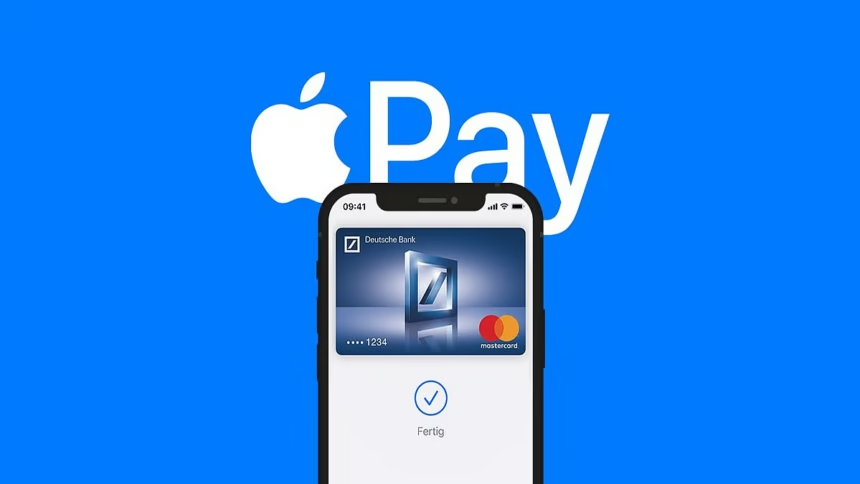
Apple Pay allows users to add eligible credit and debit cards to Apple Wallet and use an iPhone or Apple Watch for contactless payments. Apple’s global platform is already accepted across millions of websites and apps and supports contactless transactions on compatible payment terminals.
Apple has not publicly confirmed an October 2026 launch date for India on its current official India website. The expected timing comes from Reuters’ reporting on the company’s India rollout and beta testing.
India already supports UPI payments on Apple’s own online store. Apple’s India payment page lists UPI alongside net banking and cards as payment options for purchases, subscriptions and adding funds.
The expected Apple Pay expansion would be different from simply accepting UPI on Apple’s website. It would bring Apple’s Wallet-based contactless payment experience into the wider Indian retail environment.
Why NFC Payments Could Change Checkout Habits
QR codes have been one of the defining features of India’s digital payment revolution. Customers can point a smartphone camera at a merchant QR code and complete a transaction without needing a card terminal.
Tap-and-pay takes a different approach.
The payment interaction can be completed by bringing the phone close to the terminal. For consumers who already use contactless cards or mobile wallets in other markets, the experience is familiar.
The biggest potential advantage is speed at physical checkout. There is no need to open the camera, locate a QR code or position the phone to scan it.
However, adoption will depend on more than the technology itself. Consumers need compatible smartphones, merchants need compatible terminals and payment applications need to support the feature properly.
India’s existing QR infrastructure will also remain important because it works across a much broader range of devices and merchant setups.
Tap-and-Pay Does Not Replace QR Payments
The arrival of NFC-based UPI payments should not be interpreted as the end of QR payments.
UPI’s strength has partly come from its ability to work across different types of merchants and smartphones. A small business can accept payments through a QR code without necessarily investing in a traditional card terminal.
Contactless payments, by contrast, depend on NFC-enabled devices and compatible acceptance infrastructure.
NPCI’s updated guidelines explicitly provide for both scanning and tapping, indicating that the two payment methods are expected to coexist.
This gives consumers more choice rather than forcing merchants or users to switch from one system to another.
For businesses, the change could also encourage more investment in modern point-of-sale terminals that can accept multiple forms of payment.
India Is Expanding UPI Beyond QR Payments
The tap-and-pay rollout is part of a broader push to expand what UPI can do.
NPCI has already introduced multiple ways of accessing the payment network, including voice-based payments through Hello! UPI. The system allows users to navigate payment functions using regional languages and can work through telecom calls, UPI applications and supported devices.
NPCI has also been expanding authentication options. Its UPI guidelines provide for on-device biometric authentication as an additional option to the UPI PIN for eligible transactions, subject to security and device requirements.
These developments show that UPI’s evolution is moving beyond the basic scan-and-pay model.
The broader strategy is to make digital payments work across different user preferences, devices and transaction environments while maintaining the underlying bank-to-bank infrastructure.
Apple Pay Could Reshape India’s Mobile Wallet Market
Apple Pay’s potential India rollout comes into an unusually mature payments market.
In many countries, Apple Pay entered markets where card payments and mobile wallets already dominated retail transactions. India is different because UPI has become the primary digital payments rail for a huge number of everyday transactions.
That means Apple’s challenge will not simply be convincing consumers to use mobile payments. Millions of Indian consumers already do.
The competition will instead be over the payment experience, device integration, cards, security, merchant acceptance and convenience.
For iPhone users, Apple Pay could offer a more familiar Wallet-based contactless experience. For UPI users, the new NFC functionality provides a competing tap-based route without requiring them to abandon India’s existing payment network.
The result could be greater competition around how digital payments are initiated at physical stores.
What the New UPI Upgrade Means for Businesses
For merchants, the contactless UPI rollout could create another opportunity to modernise payment acceptance.
Businesses that already have compatible NFC-enabled terminals may be able to support tap-based UPI transactions alongside existing contactless card payments, depending on their acquiring bank and payment setup.
The development could be particularly relevant for organised retail, restaurants, transport, entertainment venues and other businesses where checkout speed matters.
However, smaller merchants may continue to prefer QR payments because of their low infrastructure requirements.
The coexistence of both systems could therefore produce a two-tier payment environment. QR codes may remain dominant among smaller merchants, while larger retailers and businesses with established point-of-sale infrastructure may increasingly support NFC payments.
UPI and Apple Pay Enter a New Phase
The introduction of UPI tap-and-pay marks an important change in India’s digital payments competition.
UPI is no longer limited to QR-based transactions at physical stores. NFC gives the system a contactless option that brings it closer to the experience offered by international mobile wallets.
At the same time, the expected Apple Pay rollout could give iPhone users another major option for making contactless payments in India.
The important point is that these developments are not necessarily about one system replacing another. India’s payment market is large enough for QR payments, UPI, contactless cards, UPI NFC payments and mobile wallets to operate alongside each other.
With UPI processing more than 24 billion transactions a month, the addition of tap-and-pay could give India’s payment infrastructure another route for growth while increasing competition around the mobile checkout experience.
Key Takeaways
- NPCI has introduced a UPI tap-and-pay feature using NFC technology for compatible point-of-sale terminals.
- UPI processed 24.51 billion transactions worth about Rs 29.82 lakh crore in August 2026.
- The upgrade arrives ahead of the expected full Apple Pay rollout in India, reportedly targeted for October 2026.
- Tap-and-pay is designed to complement, rather than replace, India’s existing QR-based UPI payments.
FAQ
What is UPI tap-and-pay?
UPI tap-and-pay is a contactless payment feature that allows users with compatible smartphones to tap against supported payment terminals to initiate a UPI transaction using NFC technology.
Will UPI tap-and-pay replace QR payments?
No. NPCI’s updated guidelines specifically support both QR scanning and tap-to-pay. QR payments are expected to remain important, particularly for merchants that do not use traditional point-of-sale terminals.
When will Apple Pay launch fully in India?
Reuters reported that Apple Pay is expected to receive a full India rollout by October 2026 following a beta testing phase. Apple has not publicly confirmed that specific launch date on its official India website.
How big is India’s UPI payment network?
UPI processed 24.51 billion transactions worth approximately Rs 29.82 lakh crore in August 2026, according to NPCI’s official statistics. The network had 752 banks live on UPI during that month.
(Internal keywords: UPI tap and pay, UPI NFC payments, Apple Pay India, Apple Pay India launch, UPI contactless payments, NPCI tap to pay, UPI August 2026, digital payments India, NFC payments India, Apple Pay rollout India, UPI QR payments, mobile payments India)