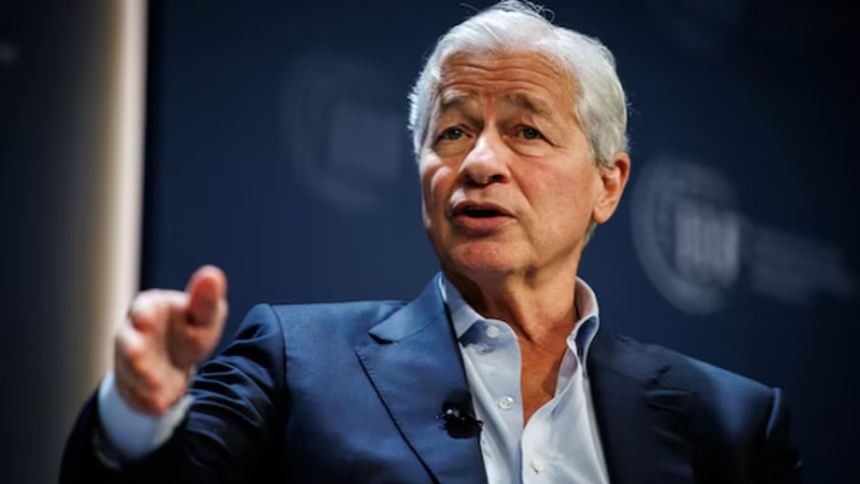
JPMorgan Chase CEO Jamie Dimon has urged Washington to consider India’s refinery requirements and wider oil-market impact before imposing further measures on Russian crude buyers. His comments come as the US weighs stronger pressure on countries continuing to purchase Russian oil.
Jamie Dimon raises concerns over Russian crude tariffs
JPMorgan Chase Chairman and CEO Jamie Dimon has urged the United States to carefully consider India’s Russian crude refining needs before imposing additional tariffs or restrictions on countries purchasing Russian oil.
Speaking during JPMorgan’s India Investor Conference in Mumbai, Dimon said Washington should understand how Russian crude is used by Indian refineries before taking further action. His remarks come amid continuing US efforts to put economic pressure on Russia over its war in Ukraine.
Dimon said the US should engage with India and consider the broader consequences for global oil markets. He specifically questioned whether tariffs on Russian oil would achieve their intended objective without creating unintended effects for countries such as India.
The comments add a major Wall Street voice to an increasingly important debate around Russian crude, Indian refining and the potential impact of new US measures on global energy markets.
India’s refinery requirements at centre of debate
A key point raised by Dimon was that crude oil cannot always be treated as an interchangeable commodity.
Indian refineries are configured to process different grades of crude, and changing suppliers can involve operational and commercial considerations. Dimon argued that if Indian refiners are prevented from buying a particular source of crude, they may have to look elsewhere for supplies that may not necessarily be suitable for their refinery configurations.
That distinction is important because restrictions aimed at Russian oil could have consequences beyond Russia itself.
India has become a significant buyer of Russian crude, particularly since global energy markets were disrupted following Russia’s invasion of Ukraine. Indian refiners have purchased Russian barrels while supplying refined petroleum products to domestic and international markets.
Dimon’s argument is therefore focused on the practical functioning of the oil market. His concern is that a measure intended to increase pressure on Moscow could also affect Indian refiners and global crude prices.
Dimon questions tariffs on Russian oil
Dimon was particularly critical of the idea of imposing tariffs on Russian oil.
He said he was not convinced that tariffs on oil were the appropriate approach, while also making clear that he supports stronger efforts to assist Ukraine. His comments therefore separated the broader objective of putting pressure on Russia from the question of which economic measures should be used.
This distinction is important for understanding his remarks.
Dimon did not argue that the United States should simply ignore Russian oil purchases. Instead, he called for Washington to understand the effects of any measures on India and the wider oil market before implementing them.
For policymakers, that creates a difficult balance. Restrictions on Russian oil could be designed to reduce Moscow’s energy revenues, but aggressive measures could also affect crude supply, refinery economics and prices in other markets.
US pressure on Russian oil has wider implications
The issue comes at a time when Washington continues to examine ways to increase economic pressure on Russia.
India’s role makes the debate particularly significant. The country has maintained strong commercial ties with Russia’s energy sector while also developing deeper economic and strategic relationships with the United States and other Western economies.
Any new US action targeting Russian crude buyers could therefore have implications for India’s energy procurement strategy and its broader trade relationship with Washington.
Dimon’s intervention highlights the importance of looking beyond the direct relationship between Russia and the United States. Oil moves through a global market involving producers, refiners, traders, shipping companies and consumers across multiple countries.
A restriction imposed in one part of that system can therefore produce effects elsewhere, depending on how supply and demand respond.
Jamie Dimon highlights global oil-market risk
Dimon’s comments also point to the possibility of market disruption if Russian crude becomes harder to access.
Russia remains a major participant in the global energy system. If significant volumes of its crude are restricted or become more difficult to trade, buyers may seek alternative supplies. That can alter shipping patterns, refinery economics and regional crude-price differences.
For India, the issue is particularly relevant because refiners need reliable access to crude grades compatible with their facilities.
Dimon said Washington should understand those practical considerations before deciding on further action. He argued that the US should work with India rather than risk measures that could unintentionally affect Indian refiners or the wider oil market.
The comments come as Dimon is visiting India for JPMorgan’s annual India Investor Conference, where global investors, corporate executives and policymakers are discussing the country’s economic and investment outlook.
Dimon’s India visit comes amid deeper investment focus
Dimon’s remarks on Russian crude were delivered during a broader period of increased attention on India’s economy and investment prospects.
The JPMorgan chief has been in Mumbai for the bank’s India Investor Conference, which began on September 21 and continues through September 22. The event has brought together global investors, business leaders and policymakers.
Union Finance Minister Nirmala Sitharaman also met Dimon in Mumbai during the conference on September 21, according to the Finance Ministry.
In separate comments reported on September 22, Dimon described India as a fast-growing major economy but also pointed to taxation and regulatory consistency as areas that could influence foreign investment.
His comments on Russian crude therefore form part of a wider conversation about India’s position in the global economy, including energy security, foreign investment and its relationship with major economic powers.
What the Russian crude debate means for India
The immediate question is whether Washington will take further action against countries purchasing Russian oil and, if so, how those measures will be structured.
Dimon’s comments do not represent a US government policy decision. They are the views of the head of one of the world’s largest financial institutions. The final approach will depend on decisions by US policymakers.
For India, however, the issue has direct economic relevance. Crude oil remains central to the country’s energy system, while refinery operations depend on a steady and commercially viable supply of crude.
Any major change in the availability or cost of Russian crude could affect refinery procurement strategies and the broader economics of India’s petroleum sector.
At the same time, India’s energy relationship with Russia exists alongside its growing economic relationship with the United States. That makes the issue more complex than a simple oil trade dispute.
Dimon’s message to Washington is essentially that policy toward Russian oil should account for those interconnected interests. His comments put India’s refinery requirements and potential global market effects directly into the discussion over how the US should respond to Russian crude purchases.
Key Takeaways
- Jamie Dimon urged the US to consider India’s refinery requirements before imposing additional measures on Russian crude buyers.
- He questioned whether tariffs on Russian oil would be the right policy instrument.
- Dimon warned that restrictions could have consequences for Indian refiners and wider global oil markets.
- His comments came during JPMorgan’s India Investor Conference in Mumbai, where he also discussed India’s investment environment.
FAQs
Why did Jamie Dimon mention India’s Russian crude purchases?
Dimon said US policymakers should consider how Indian refineries use Russian crude and what could happen if those supplies were restricted or replaced. He argued that alternative crude may not always be suitable for particular refinery configurations.
Does Jamie Dimon oppose pressure on Russia?
Dimon said he believes the US should do more to help Ukraine. His criticism was directed specifically at the potential use of tariffs on Russian oil and the possible consequences for India and global oil markets.
Why is Russian crude important to India?
Russian crude has become an important part of India’s oil procurement mix since disruptions to global energy trade following Russia’s invasion of Ukraine. Indian refiners have used Russian supplies while continuing to serve domestic and international petroleum markets.
What could happen if the US imposes tougher measures on Russian oil buyers?
The consequences would depend on the design and enforcement of the measures. Potential effects could include changes in crude sourcing, refinery procurement costs, shipping flows and global oil-market prices. The actual impact would depend on how buyers, sellers and other governments respond.