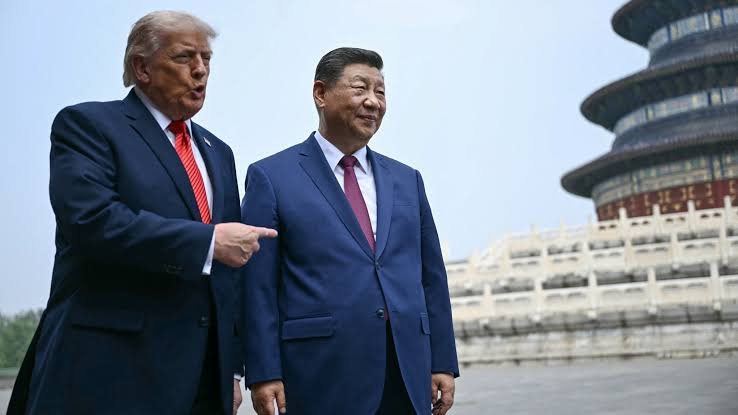
India is closely watching the Trump-Xi talks as the US and China seek to manage trade, technology and critical mineral tensions. Any improvement in their economic relationship could affect the China+1 strategy that has encouraged companies to diversify supply chains toward India.
Trump-Xi Summit Brings China+1 Strategy Into Focus
US President Donald Trump and Chinese President Xi Jinping are meeting in Washington from September 23 to 25, with trade, technology, artificial intelligence, rare earths and wider geopolitical issues expected to feature prominently. The meeting comes after months of negotiations aimed at keeping the US-China trade relationship from deteriorating further.
For India, the talks carry an additional business dimension. Global companies have increasingly looked at alternatives to China for manufacturing and sourcing as US-China trade tensions have raised concerns about tariffs, export controls and supply-chain disruption.
India has been one of the countries seeking to attract some of this investment through manufacturing incentives, infrastructure expansion and policies aimed at strengthening domestic production.
The latest Trump-Xi meeting raises a straightforward question for companies that have been diversifying away from China: how much will a more stable US-China relationship change the economics of that strategy?
Trade Truce Could Change Supply Chain Calculations
The US and China have spent much of 2026 trying to stabilize their trade relationship after the sharp tariff tensions of the previous year.
The current tariff arrangement is due for review, while negotiators have also discussed broader economic mechanisms and reciprocal trade measures. US officials have sought greater Chinese purchases of American goods, while Beijing has pushed for better access to advanced US technology and relief from certain restrictions.
The two sides have also discussed issues including rare earths, agricultural products, energy and aircraft purchases.
For businesses, the significance is less about one particular tariff rate and more about predictability. Companies planning factories and supply networks typically make decisions years ahead. A reduction in the perceived risk of operating in China could influence how aggressively some businesses pursue alternative production locations.
That does not necessarily mean existing China+1 investments will be reversed. Building new factories, supplier networks and logistics infrastructure outside China involves substantial time and capital.
Why India Has Benefited From China Diversification
The China+1 strategy has become an important part of India’s manufacturing and investment narrative.
Under this approach, companies continue to operate in China while adding production capacity in another country. The objective is generally to reduce dependence on a single manufacturing base rather than immediately abandon China.
India has attracted investment in sectors such as electronics, smartphones, automobiles, components and other manufacturing activities. The country has also sought to expand its role in global supply chains through production-linked incentives and other industrial policies.
The US-China relationship is one factor behind these decisions, but it is not the only one.
Companies also consider labour costs, infrastructure, domestic demand, access to skilled workers, logistics, taxation, government incentives and proximity to customers.
This means a change in Washington-Beijing relations could influence the pace of new investment without automatically eliminating India’s supply-chain opportunity.
Rare Earths Add Another Layer For Indian Industry
Rare earths are another major issue being watched ahead of the Trump-Xi meeting.
The United States and China have been negotiating over critical minerals and supply restrictions, making rare earths an important part of the broader economic relationship. US officials have pressed China on reliable access to these materials, while China has sought concessions on technology and trade restrictions.
Rare earth elements are used in products ranging from electronics and electric vehicles to renewable energy equipment and advanced defence systems.
For India, changes in the global critical-minerals market matter because manufacturers need reliable access to inputs even when their final production is located outside China.
A more predictable US-China supply arrangement could reduce some immediate supply-chain uncertainty. At the same time, continued competition could encourage companies to diversify mineral sourcing further.
India’s own efforts to build domestic critical-mineral capabilities could therefore remain relevant regardless of what happens at the summit.
AI And Chips Could Reshape Technology Supply Chains
Artificial intelligence is emerging as another major issue in the Trump-Xi discussions.
The United States and China are competing intensely over advanced computing, semiconductors and AI capabilities. At the same time, officials from both countries have discussed mechanisms for managing AI-related risks and maintaining communication.
The technology relationship matters to India because global semiconductor and electronics supply chains are being reorganised around national security, export controls and access to advanced computing technology.
A reduction in US-China technology tensions could make some supply chains less fragmented. Continued restrictions, however, could push companies to maintain separate technology ecosystems.
India is attempting to position itself within this changing environment by expanding semiconductor manufacturing, electronics production and technology infrastructure.
The outcome of US-China technology discussions could therefore influence how multinational companies structure their future production and sourcing decisions.
China+1 Does Not Depend Only On US-China Tensions
The China+1 strategy existed before the latest Trump-Xi talks and is unlikely to depend entirely on the relationship between Washington and Beijing.
Supply-chain diversification has also been driven by the pandemic-era disruptions, rising geopolitical risks and companies’ efforts to avoid excessive dependence on a single country.
China continues to have advantages that are difficult for other manufacturing destinations to replicate quickly. These include a large supplier ecosystem, established logistics networks, manufacturing capacity and deep industrial expertise.
A US-China trade thaw could therefore make China more attractive in some areas without eliminating the reasons companies maintain additional production bases elsewhere.
For India, the challenge is to make its own manufacturing ecosystem competitive enough that investment decisions remain attractive even if geopolitical tensions between the US and China ease.
Indian Companies Could Face Both Opportunities And Risks
Indian businesses could see different effects depending on their sector.
Export-oriented manufacturers could benefit if global companies continue adding production capacity in India. Electronics, components, pharmaceuticals, automotive manufacturing and industrial goods are among the areas where supply-chain diversification can create opportunities.
However, greater stability between the world’s two largest economies could also increase competition.
If Chinese manufacturers gain easier access to markets, technology or critical inputs, Indian companies may face stronger competition from established Chinese businesses.
Currency movements could also matter. China’s yuan recently reached its strongest level against the US dollar in more than three and a half years, after the People’s Bank of China eased some resistance to yuan appreciation ahead of the summit.
For Indian exporters and importers, changes in the yuan, dollar and rupee can influence the relative cost of products and components.
Investors Are Watching The Summit Through A Supply Chain Lens
Financial markets are also paying attention to the Trump-Xi meeting.
Investors have been assessing whether the two governments can maintain a stable trade environment while managing disagreements over technology, rare earths and national security. Reuters reported that investors are positioning around competing US and Chinese AI ecosystems as the two countries pursue separate technology supply chains.
The business impact will depend heavily on what is actually agreed rather than the diplomatic tone of the meeting.
A continuation of the existing trade truce could provide greater certainty for companies. New restrictions or disagreements over technology and critical minerals could have the opposite effect.
For India, that uncertainty means the China+1 opportunity remains linked to a wider question: whether companies view diversification as a temporary response to geopolitical tensions or as a permanent part of supply-chain planning.
What The Trump-Xi Talks Mean For India
India is not a direct participant in the Trump-Xi negotiations, but the outcome could influence the competitive environment in which Indian businesses operate.
A stable US-China relationship could reduce some of the disruption that encouraged companies to diversify production. At the same time, structural factors such as China’s manufacturing scale and India’s expanding domestic market will continue to shape corporate decisions.
The most important developments for Indian businesses will likely be concrete changes involving tariffs, technology restrictions, rare earth exports, investment arrangements and supply-chain rules.
The summit is therefore being watched not simply as a diplomatic meeting but as another signal for global companies deciding where to manufacture, source components and invest.
For India, the China+1 story is entering a phase where geopolitical advantage may matter less than the country’s ability to compete on manufacturing capacity, infrastructure, skills, costs and market access.
Key Takeaways
- Trump and Xi are meeting in Washington from September 23 to 25, with trade, AI, technology and rare earths among the key issues.
- A more stable US-China trade relationship could influence how multinational companies assess supply-chain diversification.
- India remains a potential manufacturing and sourcing destination, but its appeal also depends on domestic competitiveness rather than geopolitics alone.
- Critical minerals, semiconductor restrictions and AI supply chains will remain important factors for global businesses even if US-China trade tensions ease.
FAQ
Why is India watching the Trump-Xi talks?
India has a significant interest in global supply-chain diversification. Changes in US-China trade and technology relations could influence investment decisions by companies considering manufacturing locations outside China.
Could a US-China trade deal hurt India’s China+1 opportunity?
It could affect some investment decisions if companies perceive China as less exposed to trade disruption. However, China+1 decisions also depend on manufacturing costs, infrastructure, supplier networks, domestic markets and geopolitical risk.
What are the main business issues at the Trump-Xi summit?
Trade tariffs, technology restrictions, AI, rare earths and critical minerals are among the major economic issues under discussion. US-China negotiators have also discussed agricultural purchases, energy and aircraft-related trade.
Will India benefit if US-China tensions continue?
Continued tensions can encourage companies to diversify supply chains, potentially creating opportunities for India. However, the outcome depends on India’s ability to provide competitive costs, infrastructure, skilled labour, reliable suppliers and efficient logistics.