
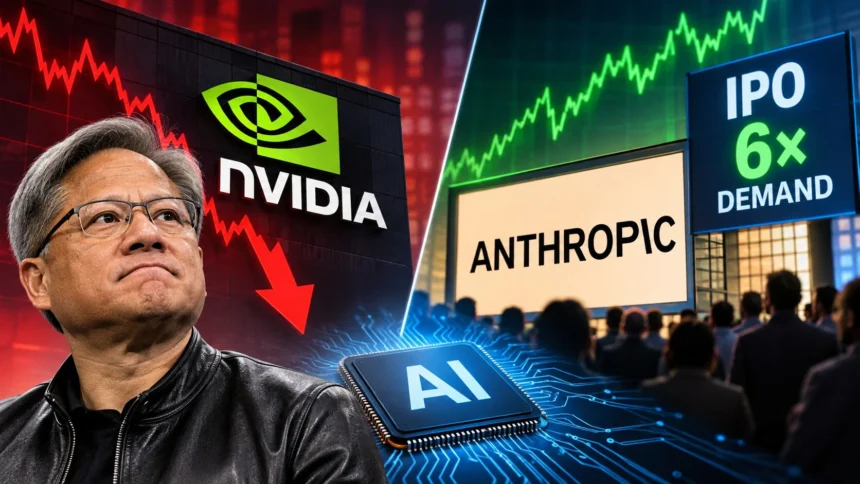
Nvidia and Anthropic shares came under renewed pressure on Wall Street as investors questioned whether the enormous spending on artificial intelligence can generate sustainable returns. The latest decline reversed much of the optimism that had driven a sharp rally in technology stocks a day earlier.
Nvidia Shares Fall After Sharp One-Day Rally
Nvidia shares dropped 5.9% to close at $155.38 on Tuesday, November 24, 2026, giving back a substantial portion of the previous session’s gains. The decline followed an extraordinary 31.5% rally on Monday, which marked the company’s strongest single-day advance in more than two decades.
The earlier surge had added hundreds of billions of dollars to Nvidia’s market value and helped lift broader technology stocks. However, the positive sentiment proved short-lived as investors returned their attention to concerns surrounding the artificial intelligence industry.
Nvidia remains one of the biggest beneficiaries of global AI investment. Its graphics processing units and data centre systems are widely used to train and operate advanced AI models. The company’s performance is therefore closely watched by investors seeking to understand the direction of the wider AI market.
The latest share-price movement suggests that even strong demand for AI infrastructure may not be enough to support valuations if investors become uncertain about future growth and profitability.
Anthropic Shares Slip Below Their IPO Price
Anthropic, the company behind the Claude family of artificial intelligence models, also experienced a sharp decline. Its shares fell 6.5% on November 24 to close at $81.91, moving below the initial public offering price of $83.
The fall is significant because Anthropic had attracted considerable investor attention during its stock market debut on November 19. The shares opened at $111.50, considerably above the IPO price, before closing their first trading session at $97.17.
The subsequent decline highlights the volatility that can follow a high-profile public listing, particularly when a company enters the market with ambitious growth expectations.
Investors are assessing whether Anthropic can translate its growing presence in the AI market into sustainable revenue and cash generation. The company operates in a competitive industry that requires substantial computing resources, investment in model development and access to expensive data centre infrastructure.
Its future valuation will depend not only on demand for Claude and its enterprise products but also on its ability to manage operating costs and demonstrate a credible path towards profitability.
Nasdaq Falls as AI Stocks Drag Technology Markets
The weakness in Nvidia and Anthropic contributed to a broader decline in US technology shares. On Tuesday, the Nasdaq Composite fell approximately 1.5%, while the S&P 500 declined 0.5%. The Dow Jones Industrial Average moved in the opposite direction, gaining around 0.9%.
The difference between the major indexes indicated that the selling pressure was concentrated in technology and AI-linked companies rather than being spread evenly across the entire market.
The Philadelphia Semiconductor Index also recorded a significant decline, falling 7.6%. Other semiconductor companies, including Micron Technology and Advanced Micro Devices, faced selling pressure. Micron dropped more than 10%, while AMD declined approximately 9%.
This wider movement suggests that investors are reassessing valuations across the AI supply chain, from chip manufacturers to companies developing AI models and businesses building the infrastructure needed to operate them.
For investors, the latest session was a reminder that enthusiasm surrounding a particular company or executive cannot necessarily protect an entire sector from broader market concerns.
Why Investors Are Questioning AI Valuations Again
Artificial intelligence has become one of the most important investment themes in global markets. Technology companies have committed substantial resources to developing advanced models, purchasing specialised chips and expanding data centre capacity.
These investments have supported strong expectations for companies associated with AI. However, the financial returns from such spending remain a major question.
Building and operating data centres requires significant capital expenditure. Companies must purchase expensive computing equipment, secure electricity supplies, develop cooling systems and maintain specialised infrastructure. AI developers also face continuing costs related to research, training models and serving customers.
Investors are increasingly asking how quickly these investments can generate revenue and whether the resulting profits will justify the valuations attached to AI-related businesses.
Another concern is the possibility that the pace of infrastructure spending may eventually slow. If technology companies reduce their investment plans or take longer to recover their costs, suppliers of chips and data centre equipment could face weaker growth expectations.
The debate does not necessarily mean that demand for artificial intelligence is disappearing. Instead, the market is becoming more selective about the financial value of that demand.
Nvidia and Anthropic Face Different Business Challenges
Although Nvidia and Anthropic are both central to the AI industry, their business models are different.
Nvidia supplies the computing hardware and systems required by companies developing and operating AI applications. Its business benefits from demand for advanced processors, networking equipment and data centre infrastructure.
Anthropic develops AI models and related software products. Its commercial prospects depend on businesses and individuals adopting its technology, paying for access and increasing their usage over time.
This distinction matters when investors assess their valuations. Nvidia has an established hardware business and a track record of generating substantial revenue from the semiconductor market. Anthropic, as a newly listed AI developer, faces the additional challenge of establishing its financial performance in public markets.
Both companies are exposed to the wider AI investment cycle, but the risks affecting their share prices are not identical. Nvidia’s performance is linked to continued demand for computing infrastructure, while Anthropic must demonstrate that its model development and commercial expansion can support its market valuation.
What the AI Stock Sell-Off Means for Global Markets
The latest decline could influence investor sentiment beyond the two companies. Nvidia is a major component of global technology investment portfolios, while AI-related companies have attracted substantial capital from institutional and individual investors.
A prolonged correction in the sector could affect semiconductor manufacturers, cloud computing providers, data centre operators and companies supplying supporting infrastructure.
It could also encourage investors to reconsider how much of their portfolios is concentrated in AI-related businesses. Some may shift towards companies with more established earnings, stronger cash flows or lower exposure to high capital expenditure.
However, one session of falling prices does not establish that the AI industry is entering a long-term downturn. Technology adoption, enterprise demand and infrastructure expansion will continue to influence the sector’s prospects.
The key issue is whether the financial returns from AI investment can keep pace with the expectations already reflected in company valuations.
What Investors Will Watch Next
Investors are likely to focus on upcoming corporate earnings, capital expenditure announcements and management guidance from major technology companies. These updates can provide clues about whether spending on AI infrastructure is continuing at its current pace.
They will also monitor revenue growth, operating costs and customer demand among AI developers. For newly listed companies such as Anthropic, several quarters of public financial results may be needed before investors can form a clearer view of their long-term performance.
For Nvidia, future demand for advanced chips and the spending plans of major cloud and technology companies will remain important indicators.
The latest declines show that the AI investment story is entering a more demanding phase. Investors are no longer looking only at technological breakthroughs and growth potential. They increasingly want evidence that the money being invested today can produce sustainable earnings tomorrow.
Key Takeaways
- Nvidia shares fell 5.9% on November 24 after rising 31.5% in the previous trading session.
- Anthropic shares dropped 6.5% to $81.91, moving below their $83 IPO price.
- The Nasdaq declined around 1.5%, while the Philadelphia Semiconductor Index fell 7.6%.
- Investors are questioning whether heavy AI infrastructure spending will generate returns that justify current company valuations.
Frequently Asked Questions
1. Why did Nvidia shares fall on November 24, 2026?
Nvidia shares declined as investors reconsidered the sustainability of the AI investment boom. The stock also gave back part of its sharp 31.5% gain from the previous trading session.
2. Why did Anthropic shares fall below their IPO price?
Anthropic shares closed at $81.91, below their $83 IPO price. Investors are assessing the company’s valuation, future revenue growth, computing costs and ability to generate sustainable profits.
3. Does the decline mean the AI industry is losing demand?
Not necessarily. The decline reflects concerns about valuations, investment costs and future profitability. Demand for AI technology may continue growing even as investors become more cautious about individual companies.
4. Which sectors could be affected by a wider AI stock correction?
Semiconductors, cloud computing, data centres, networking equipment and AI software companies could face pressure if investors reduce their exposure to the AI investment theme.
(Internal keywords: Nvidia share price, Anthropic stock price, AI stock sell-off 2026, artificial intelligence valuations, AI investment concerns, semiconductor stocks, Nasdaq market decline, global technology stocks)