
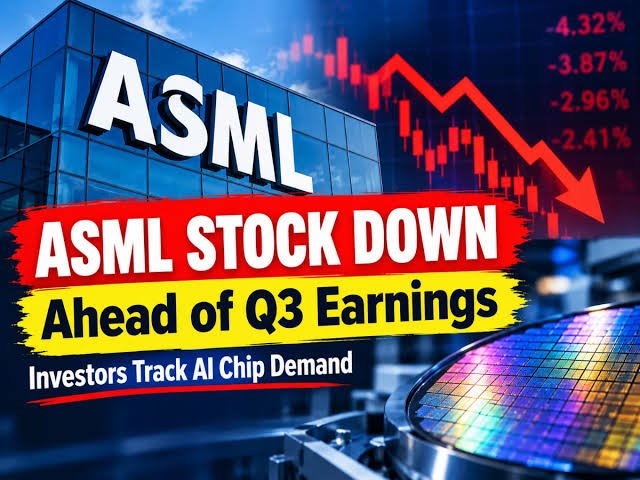
ASML earnings are drawing global attention after the Dutch semiconductor equipment maker reported record third-quarter 2026 revenue and raised its annual sales forecast. Strong demand linked to artificial intelligence is encouraging chipmakers to expand production capacity, although supply constraints and global trade restrictions remain important risks.
ASML Reports Record Third-Quarter Revenue
ASML Holding NV reported net sales of €11.66 billion for the third quarter of 2026, up from €9.33 billion in the previous quarter. Net income climbed to €4.96 billion from €2.92 billion, while gross margin improved from 54% to 57.5%.
The results, announced on October 14, 2026, reflect strong demand for the company’s semiconductor manufacturing equipment and services. ASML also reported that installed base management sales, which include servicing equipment and providing productivity upgrades, reached €3.29 billion during the quarter.
The company sold 113 new lithography systems during the period, compared with 86 in the second quarter. These systems are essential for manufacturing advanced integrated circuits used in data centres, smartphones, computers and other electronic devices.
ASML’s latest performance provides an important signal for the global semiconductor industry. As manufacturers invest in more advanced chips, demand for the specialised machinery required to produce them becomes increasingly important. <Cite refs={[“turn846245view0”]}/>
AI Spending Drives Semiconductor Equipment Demand
Artificial intelligence has become a major driver of investment across the semiconductor industry. Technology companies are expanding data centre infrastructure to support AI models, cloud computing services and increasingly demanding workloads.
These investments require advanced processors, high-bandwidth memory and other specialised chips. Producing such components involves complex manufacturing processes, creating demand for sophisticated equipment from suppliers such as ASML.
In its earnings announcement, ASML said customers were increasing their short-term and medium-term equipment demand forecasts, primarily because of their expectations for the size and duration of AI-related investments.
The company also reported that some customers had expressed interest in placing equipment orders for 2029 and 2030. This suggests that parts of the semiconductor industry are planning capacity well beyond the immediate investment cycle.
However, expressions of interest do not automatically translate into confirmed orders or future revenue. Actual spending will depend on business conditions, technology requirements and whether customers can generate sufficient returns from their AI investments.
ASML Raises Full-Year 2026 Sales Forecast
Alongside its quarterly results, ASML raised its full-year 2026 net sales outlook to between €44 billion and €45 billion, with gross margin expected to be around 56%.
This represents an improvement from the company’s previous forecast of €43 billion to €45 billion in annual sales and a gross margin of 54% to 56%. The revised outlook reflects stronger business momentum and demand for equipment-related services.
ASML also expects fourth-quarter 2026 net sales to reach between €14.2 billion and €15.2 billion, with gross margin projected at around 57%.
The fourth-quarter forecast indicates that the company expects revenue to increase further from its third-quarter performance. If achieved, this would provide additional evidence that semiconductor manufacturers are continuing to invest in production capacity.
For investors, the revised forecast is an important measure of management’s confidence in the business. However, projections remain subject to changes in customer orders, delivery schedules, export restrictions and broader economic conditions. <Cite refs={[“turn846245view0″,”turn860291view1”]}/>
Semiconductor Capacity Expansion Faces Supply Constraints
Despite strong demand, expanding semiconductor manufacturing capacity is not straightforward. Advanced chipmaking equipment involves highly specialised engineering, complex components and long production timelines.
ASML said its customers’ equipment demand forecasts had strengthened enough that the supply capacity currently planned for 2027 and 2028 would not fully meet expected demand. The company is therefore investigating ways to increase capacity for 2028 beyond the previously communicated expansion plans.
Earlier, ASML had outlined plans to increase capacity for certain extreme ultraviolet lithography and deep ultraviolet immersion systems by 30% in 2027 compared with 2026 levels. It was also examining further capacity increases for 2028.
These plans matter because chipmakers cannot rapidly increase production without access to the necessary machinery. Even when manufacturers have the financial resources to build new facilities, equipment availability can affect the pace at which additional production comes online.
For ASML, the challenge will be to expand manufacturing capacity while maintaining quality, delivery schedules and profitability. Strong demand creates an opportunity, but the company’s ability to fulfil orders will determine how much of that demand converts into revenue.
What ASML Earnings Mean for Global Technology Companies
ASML occupies a strategically important position in the semiconductor supply chain. Its lithography systems help chipmakers transfer intricate circuit patterns onto silicon wafers, a critical step in producing advanced microchips.
The company’s results therefore offer insight into investment plans across the wider technology industry. Strong equipment demand can indicate that semiconductor manufacturers expect continued requirements for computing power, memory and advanced processing capabilities.
Companies involved in semiconductor manufacturing, equipment supply and data centre infrastructure will be watching ASML’s outlook closely. Its results may also influence investor assessments of businesses exposed to AI-related capital expenditure.
Nevertheless, ASML’s performance should not be treated as proof that every AI-focused company will deliver strong financial results. Equipment suppliers, chip manufacturers and software businesses operate under different cost structures and face different competitive pressures.
Investors must also consider the possibility that AI infrastructure spending could slow if customers struggle to justify the cost of new facilities or if returns fall short of expectations.
Export Controls and Market Risks Remain Important
ASML’s growth outlook comes with several risks. Restrictions on exports of advanced semiconductor equipment, particularly to China, can affect which customers the company is permitted to serve and which systems it can supply.
The semiconductor industry is also sensitive to geopolitical tensions, interest rates, currency movements and shifts in technology spending. Changes in any of these factors could influence customer investment plans.
Another concern is whether the rapid expansion of AI infrastructure will continue at its current pace. If technology companies reduce capital expenditure, demand for semiconductor equipment could eventually weaken. Conversely, sustained AI adoption and increasing computing requirements could support further investment.
ASML’s latest results show that demand remains strong, but future performance will depend on the company’s ability to manage production capacity, fulfil customer orders and navigate international trade regulations.
For now, the results strengthen the case that AI investment is having a measurable impact on the semiconductor equipment business. The next important indicator will be whether customer commitments translate into sustained orders and revenue over the coming quarters.
Key Takeaways
- ASML reported third-quarter 2026 net sales of €11.66 billion and net income of €4.96 billion.
- The company raised its full-year 2026 sales outlook to €44 billion to €45 billion.
- AI-related investment is encouraging chipmakers to increase equipment demand and plan future capacity expansion.
- Export restrictions, manufacturing constraints and uncertainty around future AI spending remain key business risks.
Frequently Asked Questions
1. What did ASML report in its third-quarter 2026 earnings?
ASML reported net sales of €11.66 billion, net income of €4.96 billion and a gross margin of 57.5% for the third quarter of 2026.
2. Why is AI increasing demand for ASML equipment?
AI applications require substantial computing power, advanced processors and specialised memory. Semiconductor manufacturers are expanding production capabilities to meet these requirements, increasing demand for the equipment used to manufacture advanced chips.
3. What is ASML’s revenue forecast for 2026?
ASML expects full-year 2026 net sales between €44 billion and €45 billion, with a gross margin around 56%, according to its October 14 earnings announcement.
4. What risks could affect ASML’s future growth?
Potential risks include export restrictions, supply chain constraints, geopolitical tensions, changes in semiconductor demand and a slowdown in AI infrastructure investment.