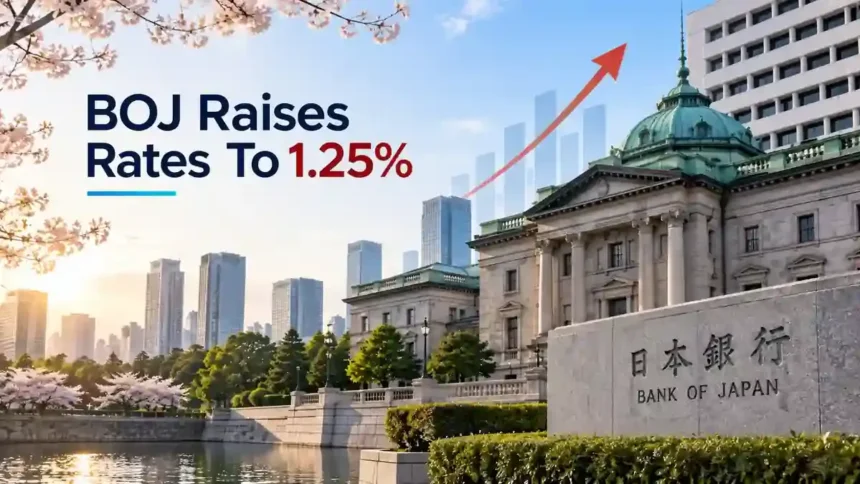
The Bank of Japan raised its policy rate to 1.25% on September 18, 2026, taking borrowing costs to their highest level in 31 years. The move comes as inflation risks persist, oil prices remain elevated and policymakers face renewed pressure over the weak yen.
BOJ Raises Interest Rate to 1.25%
The Bank of Japan raised its benchmark interest rate to 1.25% on Friday, September 18, marking the first rate increase in three months and taking Japanese borrowing costs to their highest level in 31 years. The decision was approved by a 7-2 vote.
The move was widely anticipated by financial markets before the meeting. The BOJ had previously raised rates to 1% in June and kept policy unchanged at its July meeting. The September increase brings Japan’s interest-rate policy further away from the ultra-low-rate environment that defined much of the previous decade.
The decision also signals that inflation has become a more persistent concern for Japanese policymakers. Rising energy costs, higher import prices and domestic price pressures are complicating the central bank’s effort to keep inflation close to its 2% target without tightening policy too quickly.
The BOJ’s decision was therefore not simply about the latest inflation reading. It also reflected a broader shift in how the central bank assesses Japan’s economic and price outlook.
Yen Weakens Despite Higher Japanese Rates
One of the most notable reactions came from the foreign-exchange market. Instead of strengthening after the rate increase, the Japanese yen weakened against the US dollar.
The yen fell to around 157.1 per dollar after the decision, with Reuters reporting a decline of about 0.7%. It later traded near its weakest level since early September.
Normally, higher interest rates can make a country’s currency more attractive because they can improve returns on assets denominated in that currency. But currency markets respond to expectations as well as the actual rate decision.
In this case, investors focused on the BOJ’s relatively cautious signals and the fact that two policymakers opposed the increase. That reduced expectations of a rapid series of additional hikes.
The market reaction highlights a key issue for Japan. Raising rates does not automatically produce a stronger yen if investors believe future increases will be gradual or limited.
Two BOJ Members Oppose the Rate Increase
The 7-2 vote provided an important signal about the debate within the central bank.
Two BOJ board members voted against the 1.25% increase and favoured a more cautious approach. Their dissent became an important part of the market’s interpretation of the decision.
The disagreement matters because investors are now looking beyond the September increase to the pace of any future tightening.
BOJ Governor Kazuo Ueda has previously indicated that monetary policy would remain dependent on economic and inflation developments. The latest decision maintains that data-dependent approach while moving the policy rate higher.
The central bank therefore faces a delicate balance. Moving too slowly could allow inflationary pressures to become more entrenched. Moving too quickly could put unnecessary pressure on households, businesses and financial markets.
The split vote shows that policymakers do not necessarily have identical views about how quickly Japan should move towards a higher-rate environment.
Japan’s Inflation Remains Close to Target
Japan’s latest inflation data provides part of the explanation for the BOJ’s decision.
Core consumer inflation rose 1.7% year-on-year in August, compared with 1.8% in July. The reading was slightly below the market expectation of 1.8%. A BOJ-focused measure that excludes fresh food and fuel increased 1.9%, indicating that underlying price pressures remained close to the central bank’s 2% target.
Although the headline core inflation rate remained below 2%, the BOJ has been paying attention to risks that inflation could rise again because of higher energy costs.
Oil prices have increased sharply during the recent Middle East conflict, creating additional pressure on countries that rely heavily on imported energy. Japan is particularly exposed to global energy prices because it imports most of its fossil-fuel requirements.
A weaker yen can add to that pressure by making imported energy and other goods more expensive in local-currency terms.
This creates a feedback mechanism that the BOJ needs to monitor closely.
Energy Costs Complicate BOJ Policy
The recent rise in oil prices has changed the inflation environment facing Japan.
Higher crude prices can raise transportation and electricity costs and increase expenses for businesses that depend on imported energy. Companies may then pass part of those costs to consumers through higher prices.
The BOJ is also watching whether those increases remain limited to imported costs or begin to influence broader domestic inflation.
Reuters reported that inflation risks have been strengthened by soaring energy prices associated with the conflict in Iran, expansionary fiscal policies and strong global demand related to artificial intelligence investment.
This combination creates a complicated policy environment.
If energy-driven inflation is temporary, aggressive monetary tightening could unnecessarily weaken economic activity. If higher costs feed into wages, services and consumer expectations, the central bank may need to respond more firmly.
That distinction will be important when the BOJ considers its next policy decisions.
Yen Stability Is Now a Bigger Policy Issue
The yen’s performance has become increasingly important for Japan’s economic policy.
Japan’s government has repeatedly expressed concern about excessive currency volatility. Officials have also maintained close communication with US authorities over foreign-exchange developments.
Japan and the United States conducted a joint yen-buying intervention in July after the yen had fallen to around 164 per dollar. Japanese officials have since reiterated their intention to respond to excessive and disorderly currency movements.
The latest BOJ rate increase therefore comes alongside a broader government effort to manage currency pressures.
However, monetary policy and foreign-exchange intervention operate differently. The BOJ uses interest rates and other monetary tools to influence financial conditions, while the Ministry of Finance can intervene directly in currency markets through foreign-exchange operations.
A higher policy rate can support the yen over time, but the immediate market reaction shows that expectations about future policy can be just as important.
Global Rate Decisions Add More Pressure
The BOJ is also making decisions within a broader global monetary-policy environment.
The US Federal Reserve and other major central banks have been dealing with inflation risks linked partly to energy prices and global economic conditions. Japan’s policy rate remains substantially lower than rates in several other advanced economies even after Friday’s increase.
That difference matters because international investors compare returns across currencies and markets.
If US interest rates remain significantly higher than Japanese rates, the incentive to hold dollar-denominated assets can remain strong. That can limit the yen’s ability to strengthen even when the BOJ raises rates.
The BOJ therefore has to consider both domestic conditions and the international interest-rate environment.
The relationship between Japanese rates, US Treasury yields and the yen will remain closely watched by investors.
Japanese Bonds React to Rate Decision
The rate increase also affects Japan’s government bond market.
Higher policy rates generally increase borrowing costs across the financial system and can influence yields on government securities. Japanese government bond yields therefore remain an important indicator of how investors are interpreting the BOJ’s policy direction.
However, the initial market reaction was not a straightforward rise in Japanese bond yields. Reuters reported that Japanese bond yields fell after the decision as investors focused on the cautious tone surrounding future tightening.
This again reflects the importance of expectations.
Financial markets do not respond only to what central banks do today. They respond to what investors believe central banks are likely to do over the coming months.
The September decision has therefore shifted attention towards Governor Ueda’s communication and the BOJ’s future policy guidance.
Businesses Face a New Interest-Rate Environment
The higher BOJ rate has implications for Japanese companies and households.
Businesses that borrow money can face higher financing costs as interest rates rise. Companies considering new investment may need to reassess the cost of capital, while households with variable-rate loans could also face higher borrowing expenses over time.
At the same time, savers can benefit from higher interest income on some deposits and financial products.
The broader economic effect depends on how quickly higher rates pass through to borrowing and saving decisions.
For companies operating internationally, the yen’s movement adds another variable. A weaker yen can support exporters by increasing the value of overseas revenue when converted into yen, while making imported inputs more expensive.
That creates different effects across industries.
Japanese manufacturers, retailers, energy-intensive businesses and financial institutions can therefore experience the rate and currency changes in different ways.
What Comes Next for the BOJ
The next phase of Japan’s monetary policy will depend heavily on inflation, wages, economic growth, energy prices and currency movements.
Friday’s decision takes the policy rate to 1.25%, but the BOJ has not committed to a predetermined schedule of future increases. Investors will therefore focus on Governor Ueda’s comments and subsequent economic data for clues about the pace of tightening.
Markets have already started adjusting expectations. Reuters reported that investors were cautious about pricing in aggressive future rate increases, with attention turning towards the possibility of another move later in the year rather than an immediate series of hikes.
The BOJ’s challenge is now to manage inflation without creating unnecessary economic stress while also preventing excessive yen weakness from adding to imported inflation.
The September rate hike marks another step away from Japan’s long period of ultra-loose monetary policy. What matters next will be how quickly, and under what conditions, the central bank continues that transition.
Key Takeaways
- The Bank of Japan raised its policy rate to 1.25% on September 18, 2026, the highest level in 31 years.
- The decision passed 7-2, with two board members opposing the increase and favouring a more cautious approach.
- The yen weakened after the announcement, showing that markets were more focused on future policy expectations than the rate increase itself.
- Japan’s core inflation remained close to the BOJ’s 2% target in August, while higher energy costs continue to create inflation risks.
FAQ
Why did the Bank of Japan raise rates to 1.25%?
The BOJ raised rates as inflation risks remained significant and the central bank assessed that higher borrowing costs were appropriate to prevent price pressures from becoming excessive. Energy costs and imported inflation have added to those risks.
Why did the yen fall after the BOJ rate hike?
The yen weakened because investors interpreted the decision and the two dissenting votes as signs that future rate increases may be gradual. Currency markets respond to expectations about future interest-rate differences, not just the current rate.
What is Japan’s current policy rate?
Following the September 18 decision, the BOJ’s policy rate is 1.25%. This is the highest level in 31 years.
What will determine the BOJ’s next rate decision?
Future decisions will depend on inflation, wages, economic activity, energy prices, financial conditions and developments in the foreign-exchange market. The BOJ has not announced a fixed timetable for additional increases.
(Internal keyword suggestions: Bank of Japan rate hike, BOJ interest rate September 2026, Japan interest rates, yen today, Japanese yen dollar rate, BOJ policy rate, Kazuo Ueda, Japan inflation 2026, Japan monetary policy, yen weakness, Bank of Japan news)