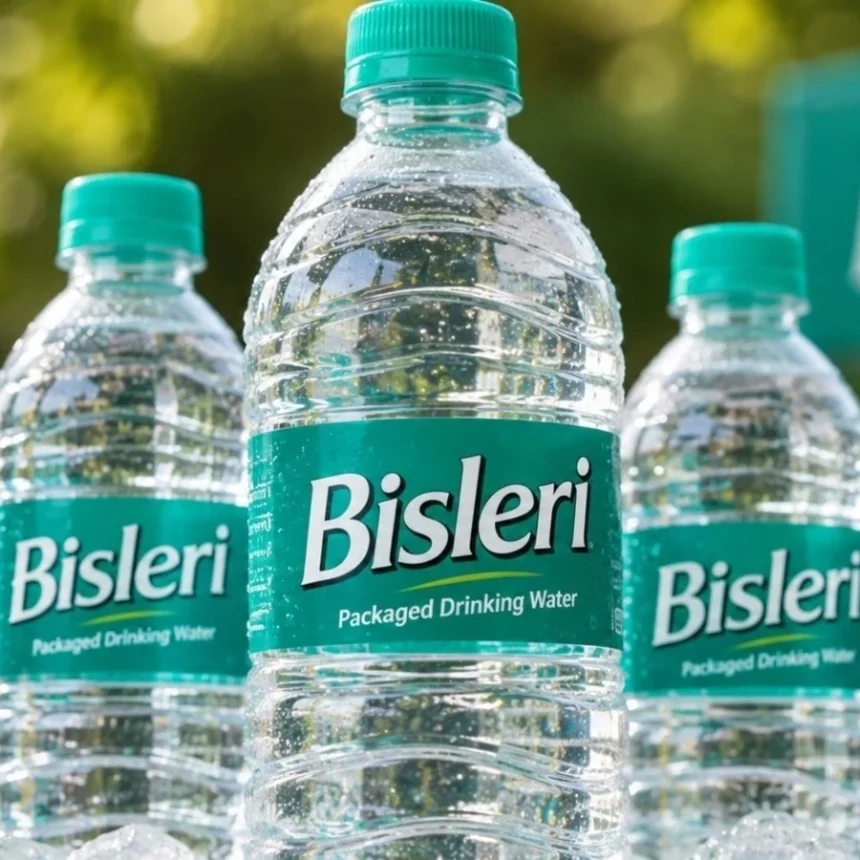
Bisleri International is disputing food safety findings by the Food Safety and Standards Authority of India (FSSAI) concerning packaged drinking water manufactured at its Goa facility. The controversy involves alleged chemical contamination in one batch, conflicting laboratory findings and regulatory action against the company.
FSSAI Takes Action Against Bisleri Over Goa Water Sample
Bisleri International has come under regulatory scrutiny after the FSSAI sanctioned prosecution against the company over a packaged drinking water sample collected from its manufacturing facility in Goa.
The matter relates to Batch GO 270, manufactured on September 27, 2025, at Bisleri’s facility in Verna Electronic City, South Goa.
The controversy emerged after laboratory testing identified bromate levels above the prescribed limit in one water sample. Following an appeal by the company, the sample was sent to a referral laboratory for further examination.
The referral laboratory subsequently detected polycyclic aromatic hydrocarbons (PAHs), leading to another food safety concern.
FSSAI issued an order prohibiting the sale of the affected batch under the Food Safety and Standards Act, 2006.
However, the company has challenged aspects of the laboratory findings, arguing that the test results showed discrepancies and that subsequent testing did not establish a wider quality problem across its manufacturing operations.
The dispute has attracted attention because Bisleri is one of India’s largest packaged drinking water brands, with a substantial distribution network across the country.
What Did the Laboratory Tests Find in Bisleri Water?
The laboratory findings are central to the dispute between Bisleri and the food safety regulator.
According to FSSAI’s clarification issued on November 23, 2026, the original sample was tested by Envirocare Labs in Mumbai.
The primary laboratory detected bromate at 0.012 milligrams per litre, exceeding the prescribed limit of 0.01 milligrams per litre under the applicable food safety standards.
The sample was subsequently referred to the National Food Laboratory in Navi Mumbai after Bisleri challenged the initial findings.
The referral laboratory reported bromate levels below the limit of quantification, indicating that the chemical was not detected at a quantifiable level within the laboratory’s testing parameters.
However, the referral laboratory also reported the presence of PAHs at 0.000144 milligrams per litre, equivalent to 0.144 micrograms per litre.
This finding became the basis for the regulator’s unsafe food determination.
Under the applicable testing procedure, the referral laboratory’s findings are treated as final when a food business operator appeals against the primary laboratory’s report.
Consequently, FSSAI prohibited the sale of Batch GO 270 and directed Bisleri to conduct a root cause analysis to identify the reason for the reported non-compliance.
Bisleri Questions Testing Results and Cites Conflicting Findings
Bisleri has disputed the laboratory findings and maintained that its packaged drinking water meets the required safety standards.
According to the company’s statement, FSSAI collected six samples from its Goa manufacturing facility on September 30, 2025.
The company said all six samples initially cleared the applicable quality parameters. However, subsequent testing reportedly detected PAHs in one of the six samples from Batch GO 270.
Bisleri also stated that another sample from the same batch cleared all the tested parameters.
The company questioned the difference between the laboratory results and requested another examination of the PAH findings in February 2026.
It said that the independent testing it subsequently arranged at an FSSAI-approved laboratory found bromate levels within the prescribed limit.
Bisleri submitted the independent laboratory results to FSSAI’s Western Regional Office through a letter dated February 2, 2026.
The company also claimed that it received no further communication after submitting the results and understood the matter to be closed.
However, FSSAI’s subsequent clarification maintained that the referral laboratory’s findings were final under the applicable regulatory procedure.
The disagreement now centres on the PAH detection, the interpretation of the laboratory findings and the regulatory action taken against the company.
Why Bromate and PAHs Matter in Drinking Water Safety
The controversy has brought attention to two chemical substances associated with water quality monitoring: bromate and polycyclic aromatic hydrocarbons.
Bromate can form as a by-product when ozone is used during water treatment, particularly when bromide is present in the source water.
Its concentration is regulated because prolonged exposure to elevated levels can pose health risks.
Under India’s applicable packaged drinking water standards, the prescribed bromate limit is 0.01 milligrams per litre.
The initial Bisleri sample reportedly recorded 0.012 milligrams per litre, slightly exceeding that threshold. The referral laboratory, however, reported bromate below its quantification limit.
The second concern involves PAHs, a group of chemical compounds that can enter the environment through incomplete combustion of organic materials and certain industrial processes.
Some PAHs are associated with serious health risks, including cancer, depending on the specific compound and level of exposure.
Their detection in drinking water therefore requires careful scientific assessment.
In this case, the referral laboratory reported PAHs at 0.144 micrograms per litre in the disputed sample. The company has questioned the findings and requested further testing.
It is important to distinguish between the detection of a chemical compound and the assessment of its actual health risk. That assessment depends on the specific compound, concentration, applicable standards and exposure conditions.
FSSAI Clarifies Action Applies Only to One Batch
Following the controversy, FSSAI issued a clarification on November 23, 2026, explaining that its action was restricted to one sample from one production batch at the Goa facility.
The regulator identified the affected product as Batch GO 270, with the sample collected under the relevant food safety inspection process.
FSSAI also clarified that the bromate level recorded by the referral laboratory was below the prescribed limit.
However, the PAH finding remained relevant to its final assessment of the sample.
The regulator directed Bisleri to undertake a root cause analysis to determine how the reported non-compliance occurred.
This clarification is important because the action does not amount to a nationwide ban on Bisleri products or a declaration that every batch manufactured by the company is unsafe.
The regulator’s decision concerns the specific batch identified during testing.
FSSAI has also sanctioned prosecution under the Food Safety and Standards Act, 2006. This is a legal step that allows proceedings to be initiated, rather than a final court judgment establishing the company’s liability.
Bisleri Says Disputed Water Batch Is No Longer Available
In its latest response on November 24, Bisleri reiterated that the regulatory action concerns a single batch manufactured more than a year ago.
The company said Batch GO 270 was produced on September 27, 2025, and that no stock from the affected batch was currently available in the market.
Bisleri also stated that all its 143 manufacturing plants remain operational and compliant with applicable FSSAI regulations.
The Goa facility has not received any direction to suspend operations, according to the company.
It further maintained that samples from subsequent production at the Goa plant met the applicable food safety standards.
Bisleri said it produces more than 50,000 batches annually, arguing that the findings involving one batch should not be treated as representative of its entire manufacturing network.
The company also stated that subsequent FSSAI testing across its facilities had not identified further adverse PAH findings.
It has reiterated its willingness to cooperate with the regulator and defend its position in any proceedings related to the matter.
Goa FDA Increases Surveillance of Packaged Drinking Water
The Bisleri controversy has also prompted increased attention towards packaged drinking water quality in Goa.
The state’s Food and Drugs Administration has intensified surveillance of packaged drinking water brands manufactured and sold in the state.
According to Goa FDA Director Shweta S Dessai, the department analysed more than 80 packaged drinking water samples between April 1, 2025, and November 2026.
Following the developments involving Bisleri, food safety officers were directed to collect additional samples from different packaged drinking water brands for laboratory analysis.
The increased surveillance reflects the importance of regular quality checks in a state with substantial tourism activity and demand for packaged water.
For consumers, the development also highlights the role of regulatory sampling, independent laboratory testing and compliance monitoring in maintaining drinking water safety.
The action is not limited to examining one company’s manufacturing practices. It also brings attention to the need for consistent quality monitoring across the packaged water industry.
What the Bisleri Controversy Means for Consumers and the Company
The dispute presents challenges for both Bisleri and food safety authorities.
For Bisleri, the immediate concern is protecting consumer confidence while addressing the regulator’s findings through the appropriate legal and technical processes.
The company has emphasised that the affected batch is no longer available and that subsequent production has met applicable standards.
For FSSAI, the priority is ensuring that the findings are addressed through established food safety procedures and that the reasons behind the reported non-compliance are identified.
For consumers, the most important distinction is that the regulatory action applies to Batch GO 270, not every Bisleri product sold across India.
The development also reinforces the importance of checking product labels, manufacturing details and batch information when concerns about a packaged food or beverage product emerge.
The outcome of the regulatory proceedings and any further testing will determine the next stage of the dispute.
Until then, the issue remains a case involving a specific product batch, contested laboratory findings and an ongoing regulatory process.
Key Takeaways
- FSSAI prohibited the sale of Bisleri’s Goa-manufactured Batch GO 270 after laboratory testing identified food safety non-compliance.
- The primary laboratory detected bromate at 0.012 mg/l, while the referral laboratory found bromate below the quantification limit but reported PAHs at 0.000144 mg/l.
- Bisleri has challenged the findings, stating that the disputed batch is no longer available and subsequent production samples met applicable standards.
- FSSAI’s action is limited to one batch, while the Goa FDA has increased surveillance of packaged drinking water brands.
Frequently Asked Questions
1. Why has FSSAI taken action against Bisleri?
FSSAI sanctioned prosecution against Bisleri after a packaged drinking water sample from its Goa facility was declared unsafe following laboratory testing. The referral laboratory detected PAHs in the sample after the company appealed against the initial bromate findings.
2. Is all Bisleri water banned in India?
No. FSSAI’s sale prohibition applies specifically to Batch GO 270 manufactured at the company’s Goa facility on September 27, 2025. The regulator clarified that the action does not extend to all Bisleri products or manufacturing batches.
3. What did Bisleri say about the disputed water sample?
Bisleri questioned the laboratory findings, citing discrepancies between test results. The company said the affected batch is no longer available in the market and that subsequent testing found bromate levels within permissible limits.
4. Is the Bisleri Goa manufacturing plant closed?
No. Bisleri stated that its Goa facility continues to operate and has not received any direction to suspend operations. The company also said all 143 of its manufacturing plants remain operational.
(Internal Keywords: Bisleri FSSAI controversy 2026, Bisleri Goa water batch, Bisleri water safety news, FSSAI action against Bisleri, Bisleri Batch GO 270, packaged drinking water safety India, bromate in drinking water, PAH contamination water, FSSAI food safety regulations, Bisleri company response, Goa FDA water testing, packaged water quality standards India)