
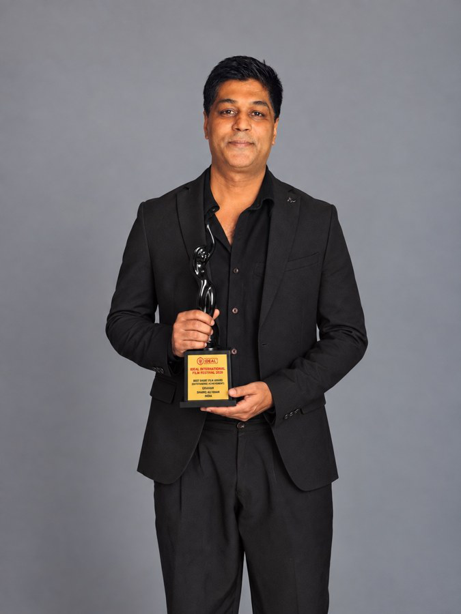
How Shariq Ali Khan is exploring independent cinema, mobile filmmaking and new screen formats through projects shaped by creative initiative.
The Indian film industry is often associated with large productions, established studios and substantial budgets.
Yet alongside mainstream cinema, independent filmmakers continue to create work through personal initiative, small teams and alternative production methods.
For Mumbai-based filmmaker Shariq Ali Khan, this independent approach is not simply a practical choice; it is a way to develop stories while retaining creative involvement across the filmmaking process.
A writer, director, actor and independent producer, Shariq has built his creative practice through theatre, short films and screenwriting.
Originally from Dehradun, Uttarakhand, he moved to Mumbai in 2016.
His experience in the performing arts began with formal training at the Shri Ram Centre for Performing Arts in Delhi and continued through theatre performances, including approximately 70 plays at Mumbai’s Prithvi Theatre.
Theatre gave him an understanding of character, dialogue, timing and collaboration.
It also taught him that a story depends on the people interpreting it, not only on the resources surrounding it.
That perspective has informed his transition into filmmaking, where he has taken on several responsibilities, from developing scripts to directing performances and coordinating production.
One of his key projects is Grahan (The Eclipse), a Hindi-language short film completed in 2025.
The psychological relationship drama follows Agni and Sowmya, a married couple whose relationship is unsettled when Purvaja returns and rekindles unresolved emotions.
As Sowmya’s bond with Purvaja deepens, Agni confronts jealousy and insecurity.
The film explores intimacy, suspicion, emotional control and the gradual erosion of trust.
Grahan was produced independently and shot using an iPhone.
Mobile filmmaking can be an accessible production approach, but it does not remove the need for planning, visual judgement, sound, performance or editing.
It offers a compact way to capture images, particularly for creators working with limited resources.
For Shariq, the production was an exercise in focusing on the essentials of filmmaking: the story, the actors, the framing and the emotional experience of the audience.
Making a film with limited resources also requires practical problem-solving.
Independent teams often need to plan carefully, use available locations and equipment efficiently, and make creative decisions that fit the scale of the production.
The film subsequently received recognition at international festivals and competitions.
Grahan received Award Winner distinctions in the Asian Filmmaker category at The IndieFEST Film Awards and the Accolade Global Film Competition in the United States.
It also received an Honourable Mention at Nassau Film Festival 2026 in the USA and an Honourable Mention in the International Mobile Film category at Guatemala Film Week 2026.
The film was officially selected for Jagran Film Festival 2026 and screened during its Mumbai edition on October 31 at Cinépolis, Fun Republic Mall, Andheri West.
Shariq’s interests also extend to formats beyond the conventional short film.
His 2026 project Lafda Unlimited is a vertical micro-drama series designed for mobile-first viewing.
Vertical storytelling requires filmmakers to think carefully about composition, close-ups, movement and the placement of visual information within a tall frame.
It also encourages concise scenes and clear narrative turns.
Another project, Between the Trees, is a coming-of-age screenplay centred on Basheer, a twelve-year-old boy.
The project demonstrates a different side of Shariq’s writing interests, moving from relationship-driven psychological drama to a story about childhood and personal growth.
Together, these projects show his interest in working across genres and formats rather than limiting himself to a single kind of story.
The media landscape offers creators new possibilities, but it also brings challenges.
Discoverability, audience attention, financing, rights management and reliable distribution remain important considerations.
A completed film must still find the right viewers, and online visibility is not the same as sustainable income.
For filmmakers building careers independently, creative ambition needs to be accompanied by realistic planning, professional materials and careful choices about where and how a project is presented.
Shariq’s approach combines practical experimentation with a commitment to performance and storytelling.
His background in theatre informs his work with actors, while his experience producing an iPhone-shot short film has encouraged him to find solutions within available means.
His film and screenplay projects have received more than 400 awards.
As Shariq continues developing projects in Mumbai, his work reflects the varied routes available within independent Indian cinema.
His journey is still unfolding through new scripts, collaborations and experiments with screen formats.
By remaining involved in multiple stages of production, he is building a practice in which creative control, resourcefulness and the desire to tell human stories remain closely connected.