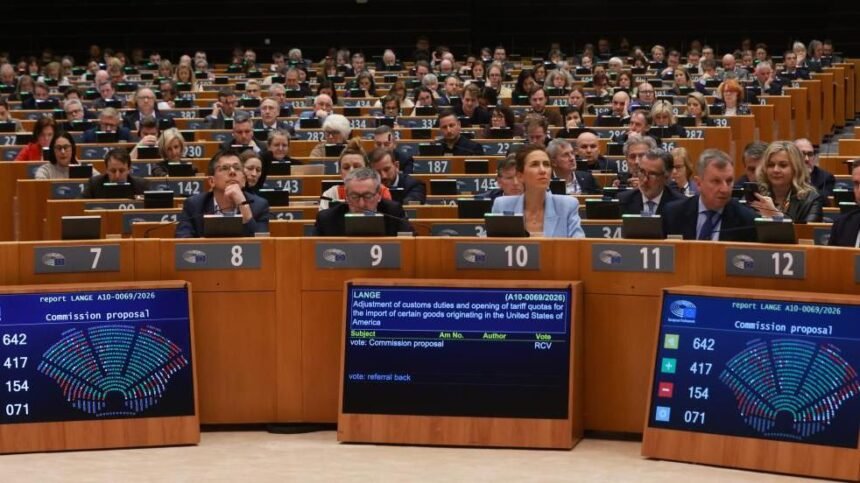
The European Parliament has approved a long-delayed trade agreement with the United States, clearing a major hurdle in transatlantic trade relations. The move is expected to prevent a fresh tariff dispute and provide greater certainty for businesses operating across the world’s largest trading corridor.
The EU-US trade deal moved closer to full implementation after the European Parliament voted in favor of legislation designed to fulfill the European Union’s commitments under a trade framework agreed with the United States. The decision comes amid concerns that failure to act could have triggered a new round of tariffs and heightened trade tensions between the two economic powers.
The agreement aims to stabilize commercial relations that have experienced periods of uncertainty over tariffs, market access, and industrial trade. European lawmakers approved measures that would reduce or eliminate duties on a range of American goods entering the EU while preserving mechanisms that allow the bloc to respond if the United States fails to honor its commitments.
Key Elements of the EU-US Trade Agreement
The trade framework originated from negotiations conducted in 2025 and seeks to establish a more predictable environment for transatlantic commerce. Under the arrangement, the European Union agreed to remove tariffs on many U.S. industrial goods and expand access for certain agricultural and seafood products. In return, the United States maintains a tariff structure on most EU exports under the broader framework.
One notable feature of the legislation is the continuation of duty-free imports of U.S. lobster into European markets. The agreement also contains review mechanisms and safeguard provisions intended to protect European industries if trade conditions change significantly.
Lawmakers approved the measure by a substantial margin, signaling broad support for avoiding a potentially damaging trade confrontation despite political disagreements surrounding some aspects of the deal.
Why Europe Moved Quickly Before the Deadline
The parliamentary vote gained urgency after repeated warnings from the United States that higher tariffs could be imposed if the European Union did not implement its side of the agreement by early July. European policymakers feared that failure to act could disrupt trade flows and create uncertainty for exporters and manufacturers on both sides of the Atlantic.
European Commission President Ursula von der Leyen emphasized that honoring negotiated commitments was essential for maintaining credibility in international trade relations. Business groups, particularly in export-oriented economies such as Germany, welcomed the vote because it provides greater predictability for companies involved in cross-border commerce.
Supporters argue that stable trade rules are especially important at a time when global supply chains continue to face geopolitical risks and shifting economic conditions.
Safeguards Added to Protect European Industries
Although the agreement received parliamentary approval, European lawmakers added several protective provisions before giving their consent. A sunset clause means the tariff preferences will automatically expire in 2029 unless renewed. Additional review requirements were included to assess the impact of the deal on industry, agriculture, and small businesses.
The legislation also allows the European Commission to suspend tariff concessions if the United States maintains tariff levels above agreed thresholds on certain products, including some steel and aluminum derivatives. These safeguards were introduced in response to concerns that future U.S. policy changes could undermine the agreement.
Many lawmakers described these provisions as necessary insurance against future trade disruptions while still allowing the broader agreement to proceed.
Impact on Global Trade and Businesses
The EU and the United States together account for one of the world’s largest trading relationships, representing trillions of dollars in annual economic activity. Any escalation in tariffs between the two sides could have affected manufacturers, exporters, logistics providers, and consumers across multiple industries.
By approving the deal, European lawmakers have reduced the immediate risk of a new tariff battle and provided businesses with a clearer framework for planning investments and supply chain strategies. Analysts believe the agreement may help improve investor confidence at a time when companies are navigating economic uncertainty and changing trade policies around the world.
However, some uncertainty remains because several trade-related disputes between the two sides have not been fully resolved. Future negotiations will likely determine whether the current framework evolves into a more comprehensive and durable transatlantic trade arrangement.
What Happens Next
Following parliamentary approval, the agreement moves closer to full implementation, though additional procedural steps involving EU member states remain. Businesses will now monitor how both sides execute their commitments and whether existing disagreements over tariffs and market access can be addressed through continued dialogue.
For now, the vote represents a significant step toward preserving stability in transatlantic trade and avoiding a fresh cycle of tariff escalation that could have affected industries across Europe and the United States.
Key Takeaways
- The European Parliament approved legislation supporting the EU-US trade agreement.
- The vote helps prevent a potential new tariff conflict between the two economies.
- Safeguards allow the EU to suspend concessions if agreed trade conditions are violated.
- Businesses expect greater certainty in transatlantic trade following the approval.
FAQ
Q1. Why did the European Parliament approve the trade deal?
The approval helps fulfill EU commitments under the trade framework and reduces the risk of new tariffs between the EU and the United States.
Q2. What products are affected by the agreement?
The deal covers many industrial goods, selected agricultural products, seafood products, and other traded items between the two economies.
Q3. Does the agreement include safeguards?
Yes. The legislation includes suspension mechanisms, review requirements, and a sunset clause that expires in 2029 unless renewed.
Q4. What is the significance of the deal for global trade?
It reduces the immediate threat of a tariff escalation between two of the world’s largest trading partners and provides greater predictability for businesses.
(Keywords: EU US trade deal, European Parliament trade vote, transatlantic trade relations, tariff dispute, global trade news, EU tariffs, US tariffs, international trade policy, trade agreement 2026, global business news)