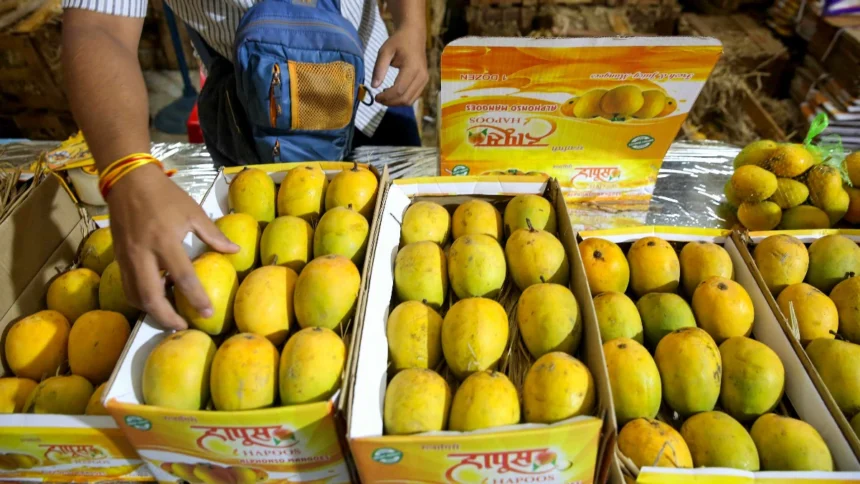
India’s Alphonso mango exports are facing severe disruption after extreme weather conditions damaged large parts of the crop across Maharashtra. Farmers, exporters, and traders are reporting lower yields, inconsistent fruit quality, and rising financial pressure during one of the most important export seasons.
India’s Alphonso mango exports have sharply declined this season as unseasonal rains, heat fluctuations, and humidity damaged mango orchards across Maharashtra’s key growing regions. Exporters say the reduced supply has affected shipments to Gulf countries, Europe, and premium international markets that rely heavily on Alphonso mangoes from western India.
Why Alphonso Mango Exports Are Falling
Alphonso mangoes, often called the “King of Mangoes,” are among India’s most premium fruit exports. The fruit is mainly cultivated in Maharashtra’s Ratnagiri, Devgad, Sindhudurg, and parts of Raigad districts. These coastal belts depend heavily on stable weather conditions during flowering and fruit development stages.
This year, growers faced repeated climate disruptions. Early heatwaves were followed by unexpected humidity spikes and scattered untimely rainfall during sensitive crop phases. Farmers say the changing weather reduced flowering consistency and increased fungal infections in orchards.
Several orchards also experienced fruit drop before maturity. In some areas, mango size and appearance failed to meet export quality standards, reducing the amount eligible for international shipments.
Exporters estimate that overall Alphonso availability for overseas markets has declined significantly compared to previous strong production years. Domestic prices have also risen because of lower supply.
Maharashtra Farmers Face Heavy Crop and Income Losses
Mango farming supports thousands of farmers, transport workers, traders, packaging units, and export-linked businesses across Maharashtra’s Konkan region. For many small growers, Alphonso mango sales provide the majority of annual income.
This season’s crop damage has created serious financial uncertainty. Farmers invested heavily in irrigation systems, fertilizers, labor, and orchard maintenance expecting stable export demand. However, lower yields and quality rejection rates have reduced earnings sharply.
Some growers are also facing additional post-harvest losses due to irregular ripening patterns caused by temperature stress. Export-grade Alphonso mangoes require strict quality checks related to color, texture, sweetness, and shelf life. Even small weather-related defects can reduce international acceptance.
Local agricultural experts believe climate variability is becoming a recurring challenge for mango cultivation in western India. Over the past few years, orchard owners have repeatedly faced irregular flowering cycles linked to changing temperature patterns.
Export Markets Feeling the Impact
India exports Alphonso mangoes to several international destinations, including the United Arab Emirates, Saudi Arabia, Qatar, the United Kingdom, and parts of Europe. Demand for premium Indian mangoes remains extremely strong among overseas Indian communities and high-end fruit buyers.
However, exporters say shipment volumes have dropped this season because of reduced export-quality stock. Air freight costs and international packaging expenses have also increased, making the situation more difficult for traders already dealing with limited supply.
Some exporters are prioritizing long-term international clients while reducing smaller market commitments. Others are shifting focus toward domestic premium sales where demand remains high despite rising prices.
Fruit traders believe export losses may temporarily increase prices in international markets due to scarcity. Premium Alphonso varieties are already being sold at higher-than-normal rates in several Gulf markets.
Experts Warn Climate Risks Are Growing
Agricultural economists and climate experts have increasingly warned about the vulnerability of high-value fruit crops to changing weather conditions. Mango cultivation is highly sensitive to temperature consistency, humidity balance, and seasonal rainfall timing.
Even small deviations during flowering periods can affect pollination and fruit formation. Excess moisture during later growth stages can increase pest attacks and fungal diseases that reduce fruit quality.
Researchers believe coastal fruit-growing belts in Maharashtra may require stronger climate adaptation strategies in the coming years. These could include advanced irrigation management, weather forecasting systems, disease monitoring programs, and more resilient farming techniques.
Some farmer groups are also requesting government support measures such as compensation schemes, crop insurance improvements, and export assistance for affected growers.
Domestic Mango Prices Rise Across India
The reduced Alphonso supply has also affected retail markets across major Indian cities. Consumers in Mumbai, Pune, Delhi, Bengaluru, and Hyderabad are seeing higher prices for premium Alphonso varieties this season.
Retail traders say demand remains strong despite price increases because Alphonso mangoes hold strong cultural and seasonal importance for Indian consumers. However, middle-income buyers are purchasing smaller quantities due to elevated rates.
Wholesale market arrivals have also remained inconsistent because of uneven production across orchards. Traders expect prices to stay high until the season stabilizes or alternative mango varieties enter markets in larger volumes.
Industry experts believe the situation highlights the broader economic risks climate disruptions can create for agriculture-linked export sectors. Premium fruit exports generate important foreign exchange earnings while supporting regional rural economies.
What Happens Next for the Mango Industry
The mango export industry is now closely watching weather conditions for the next cultivation cycle. Farmers and exporters hope more stable monsoon and winter patterns may help improve flowering and production next season.
Government agricultural agencies are expected to review the scale of crop damage in affected districts. Some experts also believe long-term investment in climate-resilient horticulture will become increasingly necessary for protecting India’s premium fruit export markets.
For now, Maharashtra’s Alphonso mango sector is dealing with one of its most difficult seasons in recent years as extreme weather reshapes agricultural and export realities across the region.
Key Takeaways
• Extreme weather conditions damaged Alphonso mango crops across Maharashtra this season
• Export-quality mango supply has fallen sharply due to reduced yields and quality issues
• Farmers and exporters are facing financial losses because of lower shipment volumes
• Climate experts warn that weather volatility is becoming a major risk for fruit agriculture
FAQ
Q1. Why are Alphonso mango exports declining this year?
Unseasonal rains, heat stress, humidity fluctuations, and crop damage reduced export-quality mango production across Maharashtra.
Q2. Which regions are most affected?
Major Alphonso-growing districts such as Ratnagiri, Sindhudurg, Devgad, and Raigad have reported production challenges.
Q3. Are mango prices increasing in India?
Yes. Lower supply has pushed up retail and wholesale prices for premium Alphonso mangoes in several cities.
Q4. Which countries import Indian Alphonso mangoes?
Major export destinations include the UAE, Saudi Arabia, Qatar, the UK, and other international premium fruit markets.
(Alphonso mango exports, Maharashtra mango crop, extreme weather India, mango farmers Maharashtra, Alphonso mango prices, Indian fruit exports, Ratnagiri mango news, climate impact agriculture, Konkan mango season, India agriculture exports)