
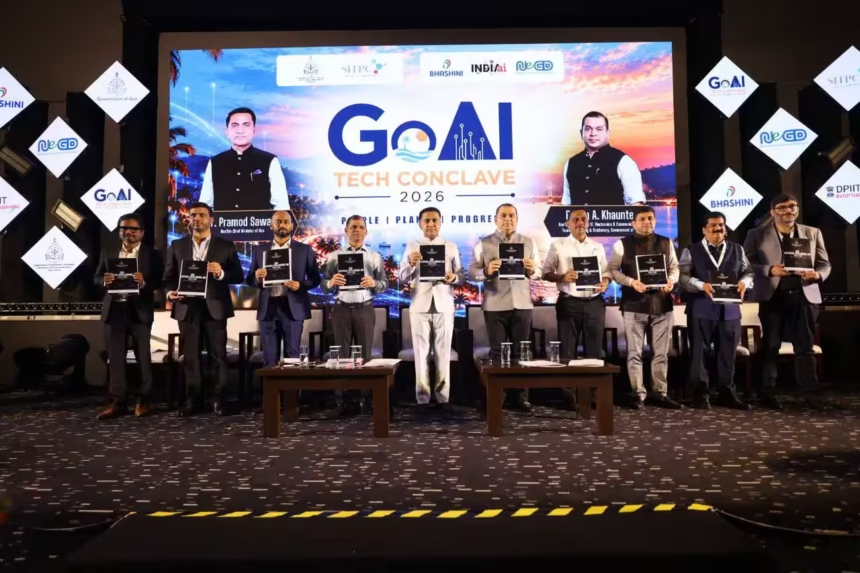
Goa’s AI Policy 2026 has received support from the Goa Chamber of Commerce and Industry (GCCI), as the state looks to diversify beyond tourism and expand its technology-driven economy. The policy proposes a ₹250 crore innovation fund over five years and aims to prepare 50,000 AI-ready professionals by 2030.
Goa AI Policy 2026 Gains Support From Industry
The Goa Chamber of Commerce and Industry has welcomed the state’s Artificial Intelligence Policy 2026, describing it as an important step towards building a knowledge-based economy. In a statement reported on October 25, GCCI president Pratima Dhond said the initiative could help Goa develop new opportunities in research, innovation and technology-led businesses.
The state government unveiled the policy on October 22 during the Goa AI Tech Conclave 2026. The three-year framework, covering 2026 to 2029, focuses on developing AI skills, supporting startups, attracting investment, improving digital infrastructure and promoting responsible AI adoption.
For Goa, the initiative represents an effort to expand its economic base beyond tourism. The state wants to attract businesses that depend on skilled professionals, research capabilities and digital innovation, while building on existing strengths in tourism, healthcare, environmental systems and creative industries.
GCCI has also indicated that it will work with the government to encourage AI adoption among micro, small and medium enterprises (MSMEs), facilitate industry testing environments and strengthen connections between startups and established businesses. These partnerships could play an important role in translating the policy’s goals into practical business outcomes.
₹250 Crore Innovation Fund Targets Technology Investment
One of the key proposals highlighted by GCCI is a ₹250 crore innovation fund over five years. The fund is intended to support Goa’s broader ambitions in artificial intelligence, innovation and technology-led enterprise development. The policy also sets a target of preparing 50,000 AI-ready professionals by 2030.
For startups and emerging technology companies, access to capital can influence whether an idea progresses from early development to a commercially viable product. Funding support, industry partnerships and access to specialised facilities could help businesses test solutions and develop products suited to local and wider markets.
However, the proposed fund should not be interpreted as an automatic grant available to every company. The availability of financial support will depend on the relevant schemes, eligibility conditions and implementation arrangements.
GCCI’s support signals interest from the business community in working with the government on these priorities. The impact will ultimately depend on how funding is allocated, how easily eligible businesses can access support and whether investments lead to measurable commercial activity.
AI Adoption Could Reshape Goa’s Traditional Industries
Goa’s existing industries offer several potential applications for artificial intelligence. Tourism and hospitality businesses could use AI tools to improve customer service, analyse demand and personalise visitor experiences. Healthcare providers could explore suitable applications for administrative efficiency and data analysis, subject to patient privacy and clinical safeguards.
Environmental management is another potential area. AI-based systems can help analyse environmental data, identify patterns and support planning when they are built on reliable information and used with appropriate oversight.
GCCI president Pratima Dhond highlighted tourism, healthcare, environmental systems and creative industries as sectors that align with the state’s AI ambitions. The approach suggests that Goa can build new technology capabilities around industries already operating in the state instead of relying exclusively on entirely new sectors.
For smaller businesses, the challenge will be identifying where AI can deliver practical value. A hotel may benefit from better demand forecasting, while a small manufacturer may explore inventory management or quality-control applications. The most useful projects will be those that address a defined business problem rather than adopting AI simply because the technology is attracting attention.
AI Skills and Education Form a Major Policy Pillar
Goa’s plan to develop 50,000 AI-ready professionals by 2030 places workforce development at the centre of the initiative. The state has also announced plans to introduce AI fundamentals for students in Classes VI to XII from the 2027-28 academic year and establish AI laboratories in up to 50 government schools in phases.
These measures could help students gain early exposure to AI concepts and digital tools. For businesses, a larger pool of trained workers may improve access to talent for software development, data analysis, automation and other technology-related roles.
GCCI has welcomed the proposed education and skills initiatives, including efforts to strengthen connections between educational institutions and industry. Such collaboration can help ensure that training programmes reflect actual workplace requirements.
The target will require more than classroom instruction. Practical projects, access to suitable tools, qualified trainers and opportunities to apply newly acquired skills will be important to achieving meaningful outcomes. The state will also need to measure whether training leads to employment, improved productivity or the creation of new businesses.
The policy sets an ambitious direction, but its long-term value will depend on the quality and accessibility of the training delivered across Goa, including in smaller towns and communities outside major commercial centres.
Responsible AI and Industry Collaboration
Alongside investment and skills development, the Goa AI Policy 2026 places emphasis on responsible and ethical AI. The proposed framework includes a four-tier, risk-based approach designed to match safeguards with the potential impact of different AI applications. The policy also envisages AI impact assessments for relevant uses.
This is significant for businesses handling personal information, financial records, healthcare data or public services. AI adoption can improve efficiency, but organisations must also consider privacy, security, transparency and accountability.
The government has also announced plans for a Centre of Excellence in collaboration with BITS Pilani Goa. Such institutional partnerships could encourage applied research and help connect academic expertise with industry requirements.
For GCCI and its member businesses, the next stage will involve turning policy commitments into workable initiatives. Industry testing environments, startup partnerships and support for MSME adoption could help identify solutions that are commercially useful and suitable for Goa’s needs.
Implementation Will Determine Goa’s AI Economy
Goa’s AI Policy 2026 provides a framework for expanding beyond a tourism-dependent economic model. Its focus on innovation funding, professional training, startup development and responsible AI offers several potential routes towards a knowledge-based economy.
The state’s ambitions will need to translate into measurable results, including productive technology investments, sustainable business growth and employment opportunities for local residents. Smaller enterprises will also need practical support to adopt AI without facing excessive costs or technical barriers.
GCCI’s endorsement provides an encouraging signal of industry interest. The larger test, however, will be whether government programmes and private-sector participation produce solutions that businesses actually use.
If implementation remains focused on measurable outcomes, Goa could strengthen its position as a destination for applied AI, research and specialised technology services while building on its existing economic strengths.
Key Takeaways
- GCCI has backed Goa’s AI Policy 2026 and pledged to support industry participation.
- The state proposes a ₹250 crore innovation fund over five years and targets 50,000 AI-ready professionals by 2030.
- Tourism, healthcare, environmental systems and creative industries are among the priority areas for AI adoption.
- Effective implementation, industry partnerships and practical workforce training will determine the policy’s economic impact.
Frequently Asked Questions
1. What is Goa’s AI Policy 2026?
It is a state policy framework for 2026 to 2029 aimed at promoting AI adoption, developing skills, supporting startups, attracting investment and establishing responsible AI governance.
2. Why has GCCI welcomed the policy?
The Goa Chamber of Commerce and Industry believes the policy can diversify the state’s economy, encourage innovation and research, create skilled employment and expand technology adoption among businesses.
3. How much funding is proposed under the policy?
The policy’s initiatives include a proposed ₹250 crore innovation fund over five years. Access to specific support will depend on the applicable funding arrangements and eligibility criteria.
4. How could the policy benefit local businesses?
Businesses could benefit from AI adoption support, access to skilled professionals, startup collaborations and opportunities to develop technology solutions for tourism, healthcare, environmental management and other industries.