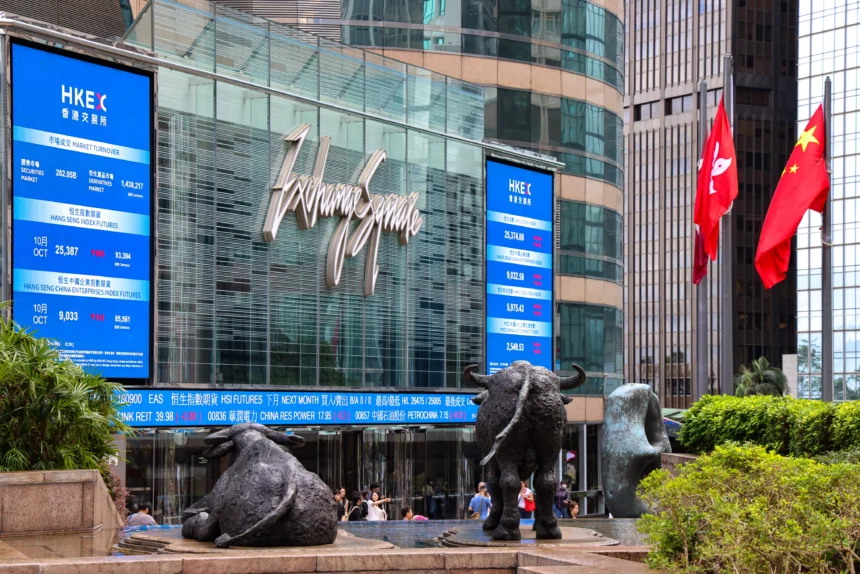
Asian markets are back in focus after the Hang Seng surge approached the 50 percent mark, signalling a sharp shift toward risk on sentiment across emerging markets. The rally reflects renewed confidence in China linked assets, improving liquidity conditions, and rising global appetite for higher growth opportunities.
The move has repositioned Asia at the centre of global capital flows after a prolonged period of underperformance.
Hang Seng surge reshapes Asia market narrative
The Hang Seng rally has become one of the strongest equity performances in Asia this cycle. After months of weak sentiment driven by China slowdown fears, regulatory uncertainty, and capital outflows, investors have aggressively re entered Hong Kong listed stocks.
The rally has been broad based, with gains across technology, financials, property linked names, and consumer discretionary stocks. Heavyweight tech companies and banks have led the charge, supported by improving earnings visibility and policy stability signals.
For markets, a near 50 percent rise marks a decisive break from the bearish structure that defined Asian equities over the past two years.
What is driving the risk on shift in Asian markets
Several macro and policy factors are aligning behind the Hang Seng surge. Global financial conditions have eased as interest rate expectations stabilised in major economies. Lower volatility and a softer dollar environment have improved risk appetite for emerging markets.
China specific factors are equally important. Authorities have taken steps to support growth, stabilise property sector stress, and improve confidence among private enterprises. While structural challenges remain, investors are pricing in reduced downside risk rather than outright recovery optimism.
The combination of global liquidity comfort and local policy reassurance has created conditions for a sharp valuation rerating.
EM capital flows respond to Asia leadership
The Hang Seng rally is influencing broader emerging market flows. Historically, strong performance in Hong Kong and China equities acts as a signal for global funds to increase EM allocation.
Portfolio managers who were underweight Asia are now forced to rebalance to avoid tracking error. This has led to spillover buying in markets such as South Korea, Taiwan, and parts of Southeast Asia.
Emerging market ETFs and Asia focused funds have also seen improved inflows, reinforcing momentum driven strategies. The result is a feedback loop where price action itself attracts more capital.
Sector leadership offers clues to sustainability
Technology and financial stocks have been at the core of the Hang Seng surge. Internet platforms benefited from regulatory clarity and improving advertising and consumption trends. Banks gained on expectations of balance sheet stabilisation and improved credit outlook.
Property linked stocks also rebounded sharply, though from deeply depressed levels. Investors remain selective here, favouring names with stronger balance sheets and government backing.
The sector mix suggests this rally is driven by valuation normalisation and sentiment recovery rather than speculative excess, which improves its durability in the near term.
How global investors are positioning around the rally
Global investors are treating the Hang Seng surge as a tactical re risk rather than a full structural shift. Allocations are rising, but positioning remains cautious compared to previous cycles.
Hedge funds and active managers are leading participation, while long only institutional flows are building gradually. Investors are focused on earnings delivery, policy follow through, and macro data consistency.
This measured approach indicates that while confidence has improved, markets are still sensitive to negative surprises, particularly around growth data or geopolitical developments.
Implications for India and other Asian markets
The Hang Seng rally has indirect implications for India and regional peers. Strong EM sentiment generally supports risk assets across Asia, including equities, currencies, and corporate bonds.
However, India remains a relative outperformer driven by domestic growth, policy stability, and earnings momentum. Some rotation risk exists if global funds rebalance toward beaten down China linked assets, but structural India flows remain intact.
For Asian markets overall, leadership from Hong Kong improves the case for regional diversification rather than single market concentration.
What could challenge the rally going forward
Despite the strong surge, risks remain. Any reversal in global liquidity conditions, resurgence of inflation pressures, or policy missteps could quickly cool risk appetite.
China specific risks such as weak consumption recovery or renewed property stress could also test investor confidence. Markets are pricing improvement, not perfection.
The next phase of the rally will depend less on sentiment and more on earnings, data consistency, and credible policy execution.
Takeaways
- Hang Seng rally nearing 50 percent signals strong risk on shift in Asia
- Global liquidity comfort and China policy signals are driving the surge
- EM capital flows are responding to Hong Kong leadership
- Sustainability depends on earnings delivery and macro stability
FAQs
Is the Hang Seng surge a short term bounce or a trend change?
It reflects a meaningful sentiment shift, but durability will depend on earnings and policy follow through.
Why does the Hang Seng matter for emerging markets?
Hong Kong acts as a gateway for China exposure and often leads EM flow direction.
Does this rally threaten India market inflows?
Short term rotation is possible, but India’s structural investment case remains intact.
What risks could derail the rally?
Tighter global liquidity, weak China data, or policy reversals could challenge momentum.