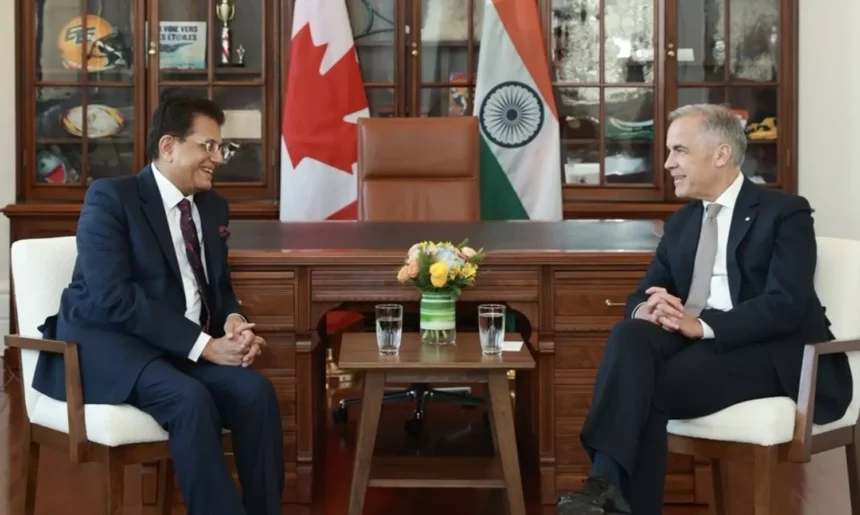
India-Canada trade talks are gaining momentum again as Commerce Minister Piyush Goyal engages with top business leaders and industry stakeholders to revive economic cooperation between the two countries. The renewed focus comes as both nations explore ways to expand bilateral trade toward the ambitious $50 billion mark.
India and Canada are once again moving toward deeper economic engagement after months of diplomatic uncertainty. The latest push comes as Union Commerce and Industry Minister Piyush Goyal held meetings with leading CEOs and trade representatives to strengthen commercial ties and accelerate discussions around bilateral trade expansion.
The India-Canada trade relationship has remained important despite political tensions over the past year. Trade volumes between the two countries have steadily grown in sectors such as agriculture, pharmaceuticals, clean energy, education, technology, and critical minerals. Now, policymakers and industry leaders are attempting to shift the focus back toward economic cooperation and long-term business opportunities.
India-Canada Bilateral Trade Back in Focus
The renewed momentum around India-Canada trade talks reflects a broader strategy from both governments to diversify trade partnerships in a changing global economy. Officials and business groups have reportedly discussed increasing bilateral trade volumes to nearly $50 billion over the coming years through stronger investment flows and sector-specific partnerships.
At present, total bilateral merchandise trade between India and Canada remains significantly below that target. However, both countries see substantial growth potential, especially in industries linked to energy transition, artificial intelligence, food processing, infrastructure, fintech, and higher education.
India has emerged as one of the fastest-growing major economies in the world, while Canada continues to position itself as a reliable partner for clean energy resources, pension investments, and technology collaboration. This complementary economic structure is one reason business communities on both sides are pushing for improved engagement despite political headwinds.
Piyush Goyal Meets CEOs to Rebuild Investor Confidence
A key development in the latest round of discussions has been Piyush Goyal’s interaction with senior corporate leaders and investors. These meetings are aimed at restoring business confidence and encouraging companies to explore cross-border investments again.
Indian policymakers are particularly interested in attracting Canadian pension funds, institutional investors, and infrastructure capital into sectors such as logistics, renewable energy, manufacturing, and digital services. Canadian companies, meanwhile, continue to view India as a major long-term market due to its expanding middle class, manufacturing ambitions, and rapidly digitizing economy.
Several Canadian pension funds already have exposure to Indian infrastructure and real estate assets. Analysts believe renewed diplomatic engagement could further improve investor sentiment and encourage larger capital commitments.
Trade experts also point out that business communities in both countries have consistently advocated for stability in economic relations, regardless of temporary political disagreements.
Early Progress Around Trade Negotiations
India and Canada had earlier been negotiating an Early Progress Trade Agreement, often referred to as an interim trade pact. Discussions slowed amid diplomatic tensions, but recent signals suggest both countries may gradually reopen channels for economic negotiations.
The proposed trade framework is expected to focus on tariff reductions, market access, investment protection, and mobility for professionals. Sectors like agriculture, clean technology, pharmaceuticals, and information technology are likely to remain central to future negotiations.
For India, Canada also represents a strategic source of critical minerals such as lithium and cobalt, which are essential for electric vehicle batteries and clean energy infrastructure. As India pushes aggressively into EV manufacturing and renewable energy expansion, access to these resources has become increasingly important.
Canada, on the other hand, sees India as a high-growth destination for exports and long-term investments at a time when global supply chains are undergoing major restructuring.
Global Economic Shifts Driving New Partnerships
The renewed India-Canada trade discussions are also taking place against a larger backdrop of global economic realignment. Countries worldwide are seeking more resilient supply chains, diversified sourcing networks, and trusted investment destinations after years of geopolitical disruptions.
India’s manufacturing push under initiatives like Make in India and Production Linked Incentive schemes has attracted growing global attention. Canada’s expertise in natural resources, sustainable technologies, and institutional finance complements many of India’s long-term growth priorities.
Business leaders believe stronger India-Canada economic ties could create opportunities across sectors including aerospace, agri-tech, semiconductors, green hydrogen, digital infrastructure, and advanced manufacturing.
Economists say achieving the $50 billion trade target will require policy stability, smoother regulatory coordination, and sustained political dialogue. However, the latest meetings between government officials and industry leaders indicate that both sides are attempting to move in that direction.
What This Means for Businesses and Investors
For businesses, the renewed trade momentum could eventually open access to larger markets, investment partnerships, and reduced trade barriers. Indian exporters may gain better access to Canadian consumers, while Canadian firms could benefit from India’s scale and rising domestic demand.
The discussions are also important for startups and technology companies exploring cross-border collaborations in artificial intelligence, fintech, cybersecurity, and clean technology solutions.
Market observers believe economic pragmatism is increasingly becoming the driving force behind the latest engagement efforts. While challenges remain, the current signals from policymakers and business leaders suggest that trade and investment cooperation may once again become a priority area in India-Canada relations.
Key Takeaways
- India and Canada are attempting to revive economic engagement after diplomatic tensions
- Piyush Goyal held meetings with CEOs and investors to strengthen bilateral business confidence
- Both countries are exploring pathways toward a $50 billion trade relationship
- Critical minerals, clean energy, technology, and infrastructure are emerging as key sectors
FAQs
Why are India-Canada trade talks important right now?
The talks are important because both countries are looking to expand trade partnerships and strengthen economic cooperation amid changing global supply chains and geopolitical uncertainty.
What is the $50 billion trade target?
The target refers to a long-term ambition to significantly increase bilateral trade and investment flows between India and Canada across multiple sectors.
Which sectors could benefit the most from stronger India-Canada ties?
Key sectors include clean energy, technology, pharmaceuticals, infrastructure, agriculture, critical minerals, and digital services.
Did political tensions affect trade discussions earlier?
Yes, diplomatic tensions slowed trade negotiations in recent months, but both countries are now signaling renewed interest in economic cooperation.