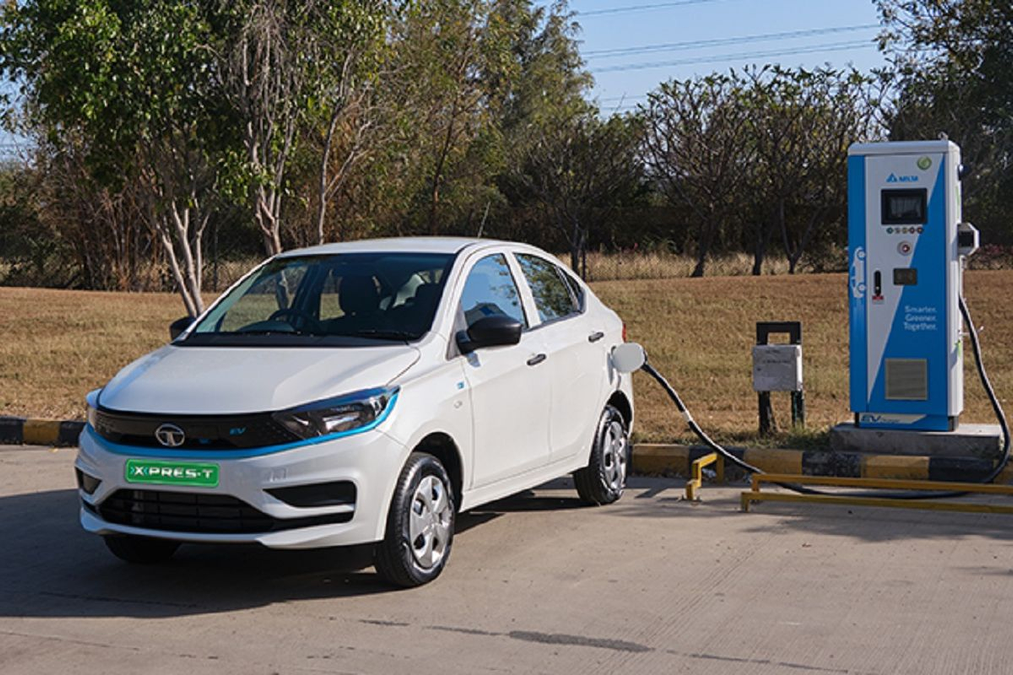
India’s EV policy update is intensifying competition between Tata Motors and Ola Electric as both companies reposition strategies to capture the next phase of electric vehicle adoption. The shift reflects policy-driven momentum in India’s fast-evolving EV market.
India’s EV policy update has become a critical catalyst for competition in the domestic electric mobility space. With incentives, localization mandates, and infrastructure focus evolving, automakers and new-age EV players are accelerating investments to secure market leadership.
India EV Policy Update Reshapes Electric Vehicle Market Dynamics
The latest developments in India’s EV policy framework are focused on increasing local manufacturing, reducing import dependency, and expanding charging infrastructure. Government schemes such as FAME and production-linked incentives have already laid the foundation, but the current push is more execution-driven.
Policy signals indicate stronger support for domestic value chains, including battery production and component sourcing. This directly impacts how companies design pricing strategies and scale operations. For established players like Tata Motors, this reinforces their early investment advantage in local manufacturing.
For newer entrants like Ola Electric, the policy environment creates both opportunity and pressure. While incentives support growth, compliance requirements and cost structures demand rapid scaling and operational efficiency.
Tata Motors Strengthens Position in Electric Passenger Vehicles
Tata Motors has emerged as a dominant player in India’s electric passenger vehicle segment. Models like the Nexon EV and Tiago EV have gained traction due to competitive pricing and early mover advantage.
The company has focused on building a strong supply chain, investing in battery technology, and expanding its charging network partnerships. Its strategy aligns closely with policy goals around localization and affordability.
Tata Motors is also leveraging its broader ecosystem, including financing options and after-sales service, to strengthen customer trust. This becomes critical as EV adoption moves beyond early adopters to mainstream buyers.
With policy support reinforcing domestic production, Tata’s existing infrastructure positions it well to scale further without major structural shifts.
Ola Electric Expands Aggressively in Two Wheeler EV Segment
Ola Electric is taking a different approach, focusing heavily on the electric two-wheeler market. The company has built a large-scale manufacturing facility and is pushing for rapid adoption through pricing and digital-first sales.
Ola’s strategy relies on vertical integration and direct-to-consumer distribution. This allows tighter control over costs and customer experience, but also requires continuous investment in service networks and reliability improvements.
The EV policy update adds urgency to Ola’s expansion plans. To fully benefit from incentives, the company needs to increase localization levels and stabilize supply chains. Any delays or operational gaps could impact competitiveness in a price-sensitive market.
Ola is also investing in battery innovation and software integration, aiming to differentiate beyond hardware.
Charging Infrastructure and Localization Drive Competition
A key battleground emerging from the policy update is charging infrastructure. Both Tata Motors and Ola Electric are investing in expanding charging networks, though their approaches differ.
Tata is working through partnerships and public infrastructure integration, while Ola is building its own fast-charging network tailored to its vehicle ecosystem. The success of these strategies will influence consumer confidence and adoption rates.
Localization is another critical factor. Policy incentives are increasingly tied to domestic value addition, which means companies must invest in local manufacturing capabilities. This impacts cost structures, pricing flexibility, and long-term sustainability.
Companies that can achieve higher localization without compromising quality are likely to gain a competitive edge.
India EV Market Enters High Growth Competitive Phase
India’s EV market is transitioning from early adoption to competitive scaling. Policy clarity is reducing uncertainty, encouraging both incumbents and startups to accelerate investments.
The rivalry between Tata Motors and Ola Electric reflects broader market dynamics. Established automakers bring manufacturing experience and brand trust, while new entrants focus on innovation and speed.
Consumer expectations are also evolving. Buyers are now evaluating not just price, but range, charging convenience, and long-term reliability. This pushes companies to improve across multiple dimensions simultaneously.
The next phase of growth will depend on execution. Policy support provides a framework, but market leadership will be determined by how effectively companies scale operations, manage costs, and deliver consistent user experience.
Takeaways
• India’s EV policy update is accelerating competition across vehicle segments
• Tata Motors leads in electric passenger vehicles with strong localization
• Ola Electric is expanding aggressively in the two-wheeler EV space
• Charging infrastructure and cost efficiency are key competitive factors
FAQs
What is driving competition between Tata Motors and Ola Electric?
The updated EV policy is pushing both companies to scale faster, improve localization, and compete on pricing and infrastructure.
Which segment does Tata Motors dominate?
Tata Motors currently leads in the electric passenger vehicle segment in India.
What is Ola Electric’s core strategy?
Ola focuses on electric two-wheelers with a vertically integrated and digital-first business model.
How important is charging infrastructure in this competition?
It is critical, as availability and speed of charging directly influence consumer adoption and satisfaction.