
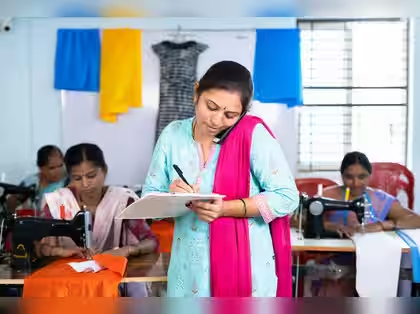
India is planning to expand its official survey of informal businesses to identify the specific challenges faced by women entrepreneurs. The proposed changes aim to improve economic data, examine barriers to business growth and help policymakers design better-targeted support for women-led enterprises.
Government Plans Gender-Specific Questions in Business Survey
The Ministry of Statistics and Programme Implementation (MoSPI) has proposed new questions in the Annual Survey of Unincorporated Sector Enterprises (ASUSE) to better understand the difficulties faced by women running informal businesses.
Announced on October 26, 2026, the proposal marks a change in how the government collects information about India’s informal business sector. The revised questionnaire for ASUSE 2027-28 is expected to examine gender-specific constraints affecting the operation and management of women-led establishments.
The proposed questions cover challenges such as limited time for business activities, restricted mobility outside the home and household or caregiving responsibilities. These factors can influence how much time women entrepreneurs have to manage operations, meet customers, pursue new orders and expand their businesses.
The ministry has invited public feedback on the proposed questionnaire until November 15, 2026. The changes are proposals at this stage, rather than a completed survey exercise or a new enforcement programme.
Women-Led Informal Businesses Form a Significant Economic Segment
India’s informal economy includes a wide range of businesses, from home-based tailoring units and food-processing operations to small retail shops, handicraft producers and neighbourhood service providers.
Many operate without the corporate structures associated with larger companies. Their contribution is nevertheless important because they support household incomes, provide employment and supply goods and services within local markets.
According to the Annual Survey of Unincorporated Sector Enterprises 2025, women headed approximately 27% of India’s unincorporated establishments. The figure highlights the scale of women’s participation in a segment of the economy that often receives less attention than registered companies and high-profile startups.
However, the presence of women in business ownership does not necessarily mean that they have equal access to finance, markets, technology or growth opportunities.
A woman operating a home-based food business, for example, may have a steady customer base but limited time to pursue institutional orders. A small garment manufacturer may have the skills and equipment to increase production but face difficulties travelling to meet suppliers or buyers.
The proposed survey questions could help capture these operational realities more systematically.
Household Responsibilities and Mobility Can Affect Business Growth
One of the notable features of the proposed ASUSE questionnaire is its focus on the relationship between household responsibilities and entrepreneurship.
Women running informal enterprises may need to divide their time between production, sales, bookkeeping, customer communication and unpaid domestic work. Caring for children, older family members or other dependants can further restrict the hours available for business activities.
Mobility can also affect commercial opportunities. Attending trade fairs, visiting wholesale markets, meeting suppliers or travelling to deliver orders may be difficult for entrepreneurs who have limited transport options or substantial responsibilities at home.
These constraints can affect business performance in several ways. They may limit the number of orders an entrepreneur can accept, reduce opportunities to find new customers and make it harder to maintain consistent operating hours.
The proposed questions would not automatically establish the cause of every business difficulty. Instead, they could help the government collect more detailed information about the conditions under which women operate their enterprises.
Better data could allow researchers and policymakers to examine whether these constraints vary by industry, location or type of establishment.
Digital Payments, Marketing and Competition Also Under Focus
The proposed survey changes extend beyond household responsibilities. They also seek to capture business challenges involving digital payments, increasing competition and inadequate marketing strategies.
Digital transactions have become an important part of commercial activity, but the ability to accept digital payments does not by itself guarantee business growth. Entrepreneurs may also need reliable internet access, suitable devices, transaction records and the knowledge to use digital tools effectively.
Marketing presents another challenge for smaller businesses. A home-based food producer or handicraft seller may depend heavily on local customers and word-of-mouth recommendations. Reaching buyers in other cities can require product photography, online listings, packaging, delivery arrangements and consistent customer service.
Competition can place additional pressure on margins, particularly when small producers compete with larger retailers or sellers operating through established online marketplaces.
Collecting information about these challenges could help policymakers understand where businesses require assistance. Depending on the findings, potential areas for future policy attention could include digital skills, market access, business training and access to suitable finance.
However, the proposed questionnaire does not itself announce new financial benefits or guarantee that additional support programmes will be introduced.
ASUSE Survey Changes to Include Investment and Electricity Data
The government has proposed several other changes to ASUSE 2027-28 alongside the questions on women entrepreneurs.
One is the introduction of a question designed to track investment in fixed assets over a longer period. This could provide a clearer picture of how unincorporated businesses invest in equipment, machinery and other assets required for their operations.
Investment information matters because business expansion often depends on the ability to purchase productive equipment, improve facilities or increase capacity. Better data could help distinguish businesses that are expanding from those that are operating with limited capital.
The revised questionnaire is also expected to collect information about electricity sources used by establishments and identify businesses operating in handloom, powerloom and handicraft activities.
These additions could improve the understanding of differences between industries and the resources required to operate them.
The government has also proposed shifting ASUSE from a calendar-year schedule to an April-March financial-year cycle beginning with the 2027-28 survey. The change is intended to improve the usefulness of survey data for national accounting and economic analysis.
What the Proposed Changes Could Mean for Women Entrepreneurs
The immediate impact of the proposal will be better measurement rather than an automatic change in the conditions faced by business owners.
More detailed information could help the government identify where women-led enterprises encounter the greatest obstacles. For instance, survey findings could reveal whether time constraints, mobility, marketing difficulties or access to digital payments are more significant in particular industries.
Such evidence can support the design and evaluation of policies. It may also help researchers compare the experiences of women entrepreneurs across regions and business categories.
The quality of the outcome will depend on how the final questionnaire is designed, how accurately respondents report their experiences and how the resulting data is analysed.
It will also be important to distinguish between identifying a problem and resolving it. A survey can establish the scale and nature of a challenge, but addressing it may require changes in access to finance, market infrastructure, training, childcare or other forms of support.
For women operating small businesses in cities, towns and rural communities, the proposal is significant because it places gender-specific business constraints more directly within the government’s economic data collection process.
The next steps will be the completion of the consultation process and the finalisation of the questionnaire for ASUSE 2027-28.
Key Takeaways
- MoSPI has proposed new ASUSE questions to identify gender-specific challenges faced by women entrepreneurs.
- ASUSE 2025 reported that women headed approximately 27% of India’s unincorporated establishments.
- The proposed survey will also examine digital payment barriers, marketing challenges, competition, electricity sources and investment in fixed assets.
- Public feedback on the proposed questionnaire is invited until November 15, 2026, with the revised survey planned for 2027-28.
Frequently Asked Questions
1. What is the ASUSE survey?
The Annual Survey of Unincorporated Sector Enterprises is a government survey that collects information about businesses operating outside the incorporated sector. It helps measure the structure, employment and economic activity of India’s informal non-agricultural business sector.
2. Why is the government adding questions about women entrepreneurs?
The proposed questions aim to identify gender-specific barriers affecting women who operate and manage businesses. These include time limitations, restricted mobility, caregiving responsibilities and other operational challenges that may influence business performance.
3. Will the proposed survey changes provide new financial benefits to women business owners?
Not automatically. The changes concern data collection rather than the announcement of a new financial assistance scheme. The information gathered could help policymakers assess business challenges and consider more targeted interventions in the future.
4. When will the revised ASUSE survey take effect?
The proposed changes are intended for ASUSE 2027-28. The government has invited feedback on the draft questionnaire until November 15, 2026, before finalising the survey arrangements.