
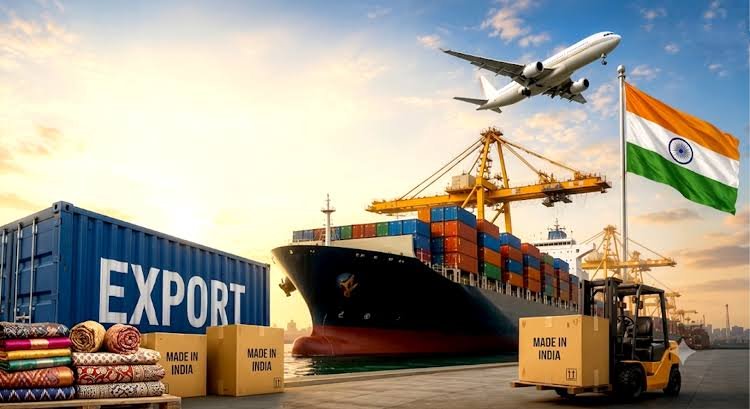
India is targeting $1 trillion in total exports during the financial year 2026-27, supported by rising overseas demand for Indian goods and services. Latest government figures show exports growing strongly through October, although the country will need to maintain momentum to achieve its ambitious annual target.
India Sets Ambitious $1 Trillion Export Target for FY27
India has set an ambitious target of achieving $1 trillion in total exports during FY 2026-27, as the government looks to strengthen the country’s position in international trade. Union Commerce and Industry Minister Piyush Goyal announced the target in July 2026, highlighting the need for stronger merchandise shipments and continued growth in services exports.
The target represents a significant increase from India’s total exports of approximately $863.1 billion in FY 2025-26. The government aims to raise merchandise exports to around $530 billion and services exports to approximately $470 billion during the current financial year.
The latest figures indicate that export activity has gained momentum. According to the Ministry of Commerce and Industry, India’s cumulative merchandise and services exports reached an estimated $568.84 billion between April and October 2026, compared with $487.59 billion during the corresponding period last year. This represents year-on-year growth of 16.66%.
The figures suggest that Indian businesses are finding opportunities across several international markets, although the remaining months will be important in determining whether the country can meet its target.
October Export Data Shows Strong Growth in Overseas Shipments
October 2026 delivered a particularly strong performance for India’s export sector. The country’s combined merchandise and services exports were estimated at $89.99 billion, registering growth of 29.90% compared with October 2025.
Merchandise exports stood at $49.47 billion, significantly higher than $34.11 billion recorded in the same month last year. Services exports were estimated at $40.51 billion, compared with $35.17 billion in October 2025.
However, the government has clarified that October services figures are estimates because the latest available Reserve Bank of India data at the time covered September 2026.
The merchandise export performance is particularly significant because it reflects stronger overseas demand for several categories of Indian products. Petroleum products, electronic goods, engineering products, chemicals, and gems and jewellery contributed to the increase.
The growth also indicates that India’s export performance is not dependent on a single industry. A broader range of products is contributing to the country’s international trade activity.
Electronics and Engineering Goods Strengthen India’s Export Performance
Electronics have emerged as an important contributor to India’s merchandise export growth. The country’s expanding electronics manufacturing ecosystem, supported by domestic production and international supply chain opportunities, is helping Indian manufacturers increase their overseas presence.
During April-September FY 2026-27, electronic goods exports reached approximately $31.97 billion, registering year-on-year growth of 44%, according to government figures.
Smartphones, electronic components, circuit boards, memory chips and networking equipment are among the products contributing to this expansion.
Engineering goods are another important segment of India’s export economy. These include industrial machinery, automotive components, equipment and other manufactured products supplied to international markets.
During April-October FY 2026-27, engineering goods exports recorded growth of 22%. In October alone, exports of engineering goods increased by 36.01% to $12.74 billion compared with the corresponding month last year.
Petroleum products also recorded substantial growth, with exports increasing 47.71% during April-October. Other categories showing encouraging performance included chemicals, marine products, plastics, handicrafts, meat, dairy and poultry products.
These developments highlight the importance of manufacturing diversification as India works towards its larger export ambitions.
Services Exports Continue to Support India’s Global Trade Position
While manufactured products attract significant attention, services exports remain an equally important part of India’s international trade performance.
India has established a strong presence in information technology services, software development, business process management, consulting, financial services and other professional activities.
Technology companies and service providers serve clients across North America, Europe, Asia and other international markets. Their overseas operations generate foreign exchange earnings without requiring the physical shipment of products.
During April-October FY 2026-27, services exports were estimated at $259.78 billion, compared with $234.18 billion during the same period last year. This represents growth of approximately 10.93%.
Services contributed around 45.7% of India’s combined exports during the seven-month period.
The sector is particularly important because it allows Indian companies to participate in global business operations through skilled professionals, digital platforms and specialised services.
For the government, maintaining this growth will be essential to achieving the $470 billion services export target announced for FY27.
Global Markets Create New Opportunities for Indian Exporters
India’s export growth is also being supported by increasing trade activity across different international destinations.
Government data for April-October FY 2026-27 shows that several major export destinations recorded strong growth. Singapore, Malaysia, Spain, South Africa, Sri Lanka, Hong Kong, Japan and China were among the markets reporting notable increases in imports from India.
Exports to Singapore increased by 107.50%, while shipments to Malaysia grew by 106.87%. Spain recorded growth of 88.38%, and South Africa registered an increase of 62.20%.
India’s exports to Japan and China also recorded growth of 41.02% and 37.71%, respectively.
These figures indicate that Indian businesses are expanding their reach beyond traditional markets. Greater access to overseas buyers can help manufacturers diversify their customer base and reduce excessive dependence on a limited number of trading partners.
Free trade agreements are also an important part of India’s export strategy. Such agreements can improve market access by reducing tariffs and easing certain trade restrictions. However, their actual benefits depend on businesses meeting product standards, regulatory requirements and other conditions in overseas markets.
MSMEs and Export Promotion Measures Remain Important
Small and medium-sized businesses are expected to play an important role in India’s export ambitions.
Many Indian MSMEs operate in sectors such as textiles, engineering components, processed food, handicrafts, pharmaceuticals and specialised manufacturing. Expanding their international presence could create additional employment opportunities and strengthen industrial activity beyond major metropolitan centres.
The government’s Export Promotion Mission, supported by an allocation of ₹25,000 crore, is intended to improve export competitiveness, particularly among smaller businesses.
Measures focusing on market access, export financing, branding, certification and logistics can help businesses overcome some of the challenges associated with international trade.
The Districts as Export Hubs initiative is another effort to identify products with export potential across different regions. This approach could help businesses in smaller cities connect with international buyers and develop stronger supply chains.
However, access to affordable credit, reliable transportation, quality certifications and timely payments remains important for smaller exporters.
Can India Achieve the $1 Trillion Export Target in FY27?
Despite the positive figures, achieving the $1 trillion target will require continued growth during the remaining five months of FY 2026-27.
India recorded estimated combined exports of $568.84 billion between April and October. This means approximately $431.16 billion in additional exports will be required between November 2026 and March 2027 to reach the target.
That translates into average monthly exports of around $86.23 billion during the remaining period. The average monthly export figure for April-October was approximately $81.26 billion.
The gap is achievable in mathematical terms, but maintaining the required pace will depend on several factors.
International demand, commodity prices, geopolitical developments, trade restrictions, shipping costs and currency movements can influence export performance. Indian exporters must also compete with manufacturers from other major exporting economies.
The composition of export growth will matter as well. Higher merchandise shipments can support manufacturing activity, while services exports can provide additional strength through technology and professional services.
The government will therefore need continued coordination with industry bodies, state governments, financial institutions and exporters to sustain the current momentum.
India’s latest export figures offer encouraging signs for its international trade ambitions. However, the final outcome will depend on whether businesses can convert rising overseas demand into consistent shipments over the coming months.
Key Takeaways
- India has set a target of $1 trillion in combined merchandise and services exports for FY 2026-27.
- Total exports reached an estimated $568.84 billion during April-October 2026-27, registering 16.66% year-on-year growth.
- Electronics, petroleum products, engineering goods and services are among the major contributors to export expansion.
- India needs approximately $431.16 billion in additional exports during the remaining five months to achieve its annual target.
Frequently Asked Questions (FAQs)
1. What is India’s export target for FY 2026-27?
India is targeting $1 trillion in combined merchandise and services exports during FY 2026-27. The government has outlined merchandise exports of approximately $530 billion and services exports of around $470 billion.
2. How much did India export between April and October 2026?
India’s combined merchandise and services exports were estimated at $568.84 billion during April-October 2026-27, representing growth of 16.66% compared with the corresponding period last year.
3. Which sectors are driving India’s export growth?
Electronics, petroleum products, engineering goods, chemicals, gems and jewellery, pharmaceuticals, and services are among the important contributors to India’s export performance.
4. Can India achieve the $1 trillion export target?
India has recorded encouraging growth during the first seven months of FY27. However, achieving the target will require approximately $431.16 billion in additional exports during the remaining five months, making sustained growth across merchandise and services essential.
(Internal keywords: India $1 trillion export target, India exports FY 2026-27, Indian merchandise exports, services exports India, India export growth 2026, Ministry of Commerce export data, Indian electronics exports, engineering goods exports, India global trade, Export Promotion Mission)