
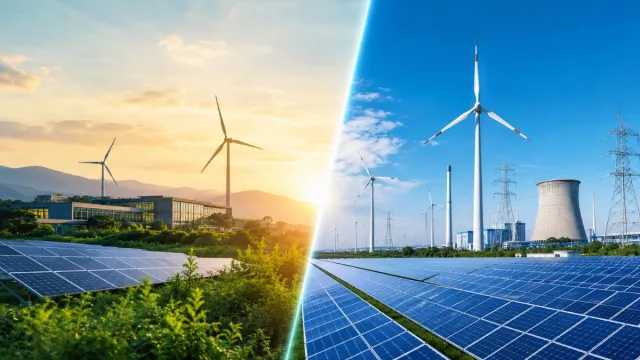
Indian industries are accelerating their shift towards captive renewable energy as electricity costs, supply risks and emissions targets reshape corporate energy strategies. Companies across steel, cement, automobiles and commercial real estate are investing in solar and wind power to improve cost control and strengthen long-term energy security.
India Inc Accelerates the Shift to Captive Green Power
Indian companies are increasingly turning to captive renewable energy to reduce dependence on electricity supplied entirely through distribution companies. The trend has gained attention in October 2026 as businesses seek greater control over operating costs and more predictable electricity supplies.
Captive power refers to electricity generated for a company’s own consumption. Businesses can develop renewable energy installations on their premises or invest in off-site solar and wind projects through captive and group-captive arrangements.
The shift is particularly important for industries that consume large quantities of electricity, including steel, cement, aluminium and automobile manufacturing. For these businesses, power costs directly affect production expenses, operating margins and competitiveness.
Recent industry reports identify companies such as UltraTech Cement, JSW Steel, Ambuja Cements, Hindalco and Tata Steel among the major industrial players expanding their renewable energy capacity.
The change also reflects a broader business calculation. Renewable power is no longer viewed only as a way to meet environmental commitments. Companies are increasingly treating it as a strategic investment in cost management and operational resilience. <Cite refs={[“turn216621search1″,”turn216621search5”]}/>
Why Companies Are Investing in Solar and Wind Power
Electricity is a significant operating expense for energy-intensive manufacturers. When grid tariffs rise or power availability becomes uncertain, businesses may face higher production costs and pressure on profitability.
Captive renewable energy can help address these concerns by providing an additional source of electricity at a more predictable cost. Solar power is particularly attractive to businesses with substantial daytime consumption, including factories, warehouses and commercial buildings.
According to recent industry reporting, renewable energy tariffs for some corporate procurement arrangements can range from ₹4.50 to ₹6 per unit, compared with grid electricity costs of around ₹7 to ₹8 per unit in the cited examples. Actual savings vary by state, consumer category, transmission charges, open-access fees, financing costs and the terms of individual power agreements.
Businesses must also account for the initial investment required to develop solar installations, purchase a stake in a renewable project or sign a long-term power purchase agreement.
Despite these considerations, companies with substantial and consistent electricity demand may find renewable power financially attractive over the life of a project. Greater predictability in energy costs can also help businesses plan future expansion and protect themselves against fluctuations in conventional electricity prices. <Cite refs={[“turn216621search0″,”turn216621search1”]}/>
UltraTech Cement and JSW Steel Expand Renewable Capacity
Cement and steel manufacturers are among the prominent participants in India’s captive green power transition because their production processes require substantial amounts of energy.
UltraTech Cement has developed a renewable energy portfolio of around 2 GW, according to recent industry reporting. JSW Steel has approximately 1 GW of green energy capacity, with a further 1.5 GW in development. Tata Steel is also developing nearly 800 MW of renewable energy capacity.
These investments illustrate how large manufacturers are approaching clean electricity as part of their long-term operational planning. Rather than depending entirely on conventional electricity procurement, businesses are building portfolios that include renewable power to support production and emissions-reduction objectives.
The financial benefits can extend beyond electricity bills. Companies that increase their use of renewable energy may also make progress towards emissions targets and respond to the expectations of customers, investors and international buyers seeking lower-carbon supply chains.
However, renewable electricity cannot replace every energy requirement in heavy industry. Steelmaking and cement production involve complex processes that may require thermal energy, specialised equipment and continuous power. Companies therefore need a combination of renewable generation, conventional supply and suitable backup arrangements.
The scale of investment by these manufacturers suggests that captive renewable energy is becoming a longer-term component of industrial strategy rather than a limited sustainability initiative. <Cite refs={[“turn216621search0″,”turn216621search1”]}/>
Automobile Manufacturers and Commercial Buildings Join In
The shift towards green electricity is spreading beyond traditional heavy industry. Automobile manufacturers and commercial real estate operators are also exploring renewable power to reduce operating expenses and meet sustainability objectives.
Maruti Suzuki and Tata Motors are among the companies expanding their use of in-house solar installations and captive renewable energy arrangements. For automobile manufacturers, electricity is required across assembly lines, component production, paint shops, warehouses and supporting facilities.
A reliable source of lower-cost electricity can help these companies manage production expenses while reducing emissions associated with their operations.
Commercial real estate is another emerging area of demand. Office operators and property owners need electricity for lighting, air conditioning, lifts, security systems and other building services. Large office campuses can therefore benefit from rooftop solar or electricity purchased through off-site renewable projects.
Embassy REIT and WeWork India have been identified among commercial property players investing in solar infrastructure.
For these businesses, renewable electricity can support both cost management and sustainability reporting. The potential benefits depend on building design, available rooftop space, consumption patterns and the rules governing the procurement of power from outside the premises. <Cite refs={[“turn216621search0″,”turn216621search5”]}/>
Government Rules Support Captive Renewable Energy
Policy changes are helping shape India’s captive power market. In March 2026, the Ministry of Power announced amendments to the Electricity Rules, 2005, relating to captive generating plants.
The changes were intended to address interpretational ambiguities, improve the ease of doing business and provide greater clarity for companies generating electricity for their own consumption.
The government has described captive generation as an important mechanism for improving industrial competitiveness and managing electricity cost volatility. The framework also supports the development of non-fossil fuel-based captive projects.
Captive and group-captive arrangements are governed by specific legal requirements, including conditions relating to ownership and consumption. Businesses must assess these requirements before choosing a project structure.
Solar projects also face rules concerning equipment sourcing. In July 2026, the Ministry of New and Renewable Energy extended a limited exemption from the Approved List of Models and Manufacturers List-II requirements for solar cells for eligible net-metering and open-access renewable energy projects commissioned by December 31, 2026. The decision did not provide a blanket exemption for all solar projects.
These policy details matter because regulatory compliance, equipment costs and project timelines can influence the financial viability of corporate renewable energy investments. <Cite refs={[“turn216621search3″,”turn216621search4”]}/>
Why Grid Independence Remains Difficult
Although captive renewable energy can reduce dependence on conventional electricity procurement, it does not automatically make an industrial facility independent of the grid.
Solar generation fluctuates with sunlight, weather and seasonal conditions. Wind power also varies according to local wind conditions. A factory operating around the clock may therefore need electricity from the grid, battery storage or other generation sources when renewable output falls.
India’s recent power supply challenges highlight this limitation. In October 2026, industry and energy reports pointed to tighter nighttime electricity availability, lower hydropower output and the need for additional power in several states.
The challenge is not simply generating more renewable electricity. Power systems must also deliver electricity when and where it is required.
Energy storage can help businesses use surplus daytime solar generation during evening hours. Batteries, pumped-storage hydropower and better forecasting can support the integration of variable renewable power, although each option has its own costs and technical requirements.
Companies must also consider grid charges, backup arrangements, transmission constraints and the reliability requirements of their production processes.
For many industrial users, the practical goal is therefore to reduce dependence on grid electricity rather than eliminate it completely. <Cite refs={[“turn216621news32″,”turn216621news24”]}/>
What the Green Power Shift Means for Indian Businesses
The expansion of captive renewable energy creates opportunities across the energy value chain. Solar equipment manufacturers, project developers, engineering companies, battery suppliers and energy management businesses may benefit as corporate demand increases.
It could also encourage companies to review their electricity procurement strategies. Businesses with high power consumption may compare rooftop installations, off-site renewable projects, group-captive investments and conventional electricity contracts before making a decision.
The economics will differ across industries and locations. A factory with substantial daytime electricity consumption may benefit from a different arrangement than a facility that operates continuously through the night.
Companies will also need to evaluate financing costs, project development timelines, equipment performance and regulatory requirements. An attractive quoted tariff does not guarantee savings if the project has high capital costs or cannot deliver electricity when required.
For investors, the trend offers a reason to examine how energy-intensive companies are managing their power costs and emissions exposure. However, renewable capacity alone should not be treated as proof of stronger profitability. Project execution, financing, utilisation and long-term operating performance remain important.
India’s move towards captive green power reflects a changing approach to industrial energy management. Companies are seeking a balance between affordability, reliability and sustainability, with renewable electricity becoming an increasingly important part of that strategy.
Key Takeaways
- Indian companies are investing in captive solar and wind power to manage electricity costs, improve supply resilience and reduce emissions.
- UltraTech Cement, JSW Steel and Tata Steel are among the major industrial players developing substantial renewable energy capacity.
- Government amendments to captive power rules and changes to selected solar project requirements are influencing corporate investment decisions.
- Renewable power can reduce grid dependence, but storage, backup supply, transmission access and regulatory compliance remain important.
Frequently Asked Questions
1. What is captive renewable energy?
Captive renewable energy is electricity generated from sources such as solar and wind for a company’s own consumption. Businesses can develop their own facilities or participate in qualifying captive and group-captive projects.
2. Why are Indian industries shifting towards green power?
Companies are seeking more predictable electricity costs, greater control over energy supply and lower emissions. Renewable energy can help businesses manage operating expenses, although actual savings depend on project costs and local electricity regulations.
3. Which Indian companies are investing in captive green power?
Recent industry reporting identifies UltraTech Cement, JSW Steel, Tata Steel, Hindalco, Ambuja Cements, Maruti Suzuki and Tata Motors among companies expanding or developing renewable energy arrangements.
4. Can captive solar power eliminate a factory’s dependence on the grid?
Not necessarily. Solar generation varies with weather and daylight hours. Many factories continue to rely on grid electricity, energy storage or other backup sources to maintain reliable operations.