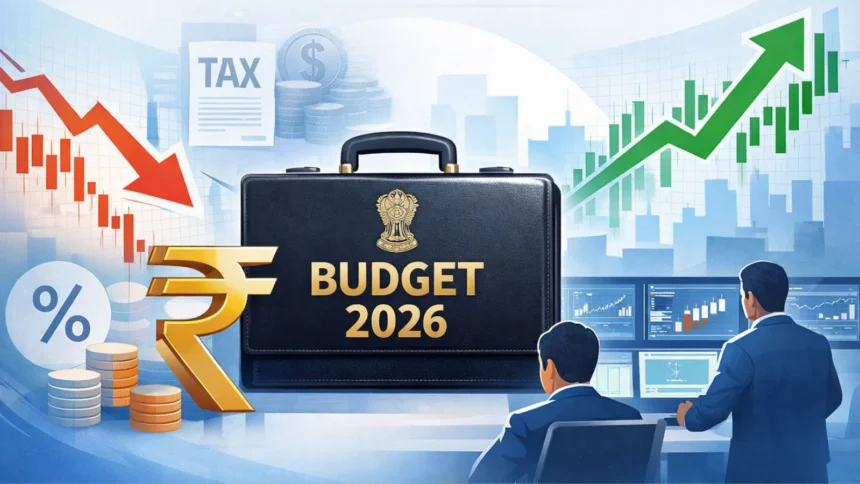
The Union Budget 2026 sent shockwaves through Dalal Street as the Sensex plunged over 700 points in a single session, driven largely by a surprise hike in Securities Transaction Tax. The market reaction underlined investor anxiety around trading costs, liquidity, and near term earnings visibility.
Budget Day Turns Volatile for Indian Markets
India’s Union Budget 2026 was expected to be market friendly after weeks of policy signaling around growth, capital expenditure, and fiscal discipline. Instead, equity markets reacted sharply as traders digested a sudden increase in Securities Transaction Tax, triggering aggressive profit booking across frontline indices.
The Sensex fell more than 700 points intraday, while the Nifty slipped below key technical support levels. Volatility spiked immediately after the budget speech, reflecting how sensitive market participants remain to transaction cost changes. The selling pressure was broad based, with heavyweights in banking, IT, and capital markets leading the decline.
For active traders and institutional desks, the STT revision altered short term cost structures overnight. This recalibration played out quickly, with intraday positions unwound and derivatives activity cooling sharply.
Why the STT Hike Hit Sentiment So Hard
The Securities Transaction Tax hike was not widely anticipated. Markets had priced in stability on the taxation front, especially after recent efforts to deepen retail participation and position India as a competitive global capital market.
Higher STT directly impacts high frequency trading, options turnover, and short term strategies that rely on thin margins. Brokerages, proprietary trading firms, and retail derivatives traders were the first to react. Volumes dipped as participants reassessed risk reward equations under the new cost regime.
From a sentiment perspective, the move raised questions about policy predictability. Even long term investors responded cautiously, fearing knock on effects on liquidity and valuation multiples, particularly in stocks with elevated speculative activity.
Sectoral Impact and Stock Level Damage
Financial services stocks bore the brunt of the sell off, with brokerages and exchange linked businesses witnessing sharp declines. Banking stocks also came under pressure, not due to fundamentals, but because they are heavily traded counters affected by transaction costs.
IT and new age tech stocks saw selling as global risk appetite remained fragile, amplifying domestic triggers. Midcap and smallcap stocks underperformed the benchmarks, highlighting how quickly risk moves out of higher beta segments when uncertainty rises.
Interestingly, defensive sectors such as FMCG and select pharma stocks showed relative resilience, indicating early signs of sector rotation rather than outright panic.
What the Budget Signals Beyond the Market Crash
Beyond the immediate market chaos, the Union Budget 2026 signals a policy balancing act. On one hand, the government reaffirmed its commitment to fiscal consolidation and revenue mobilization. On the other, the STT hike suggests a willingness to lean on capital markets for incremental tax collection.
This raises a broader policy debate. India wants deeper markets, higher participation, and global capital inflows. At the same time, transaction taxes risk dampening trading enthusiasm if not calibrated carefully.
The budget also reinforced spending priorities in infrastructure, manufacturing, and domestic value creation. However, markets tend to react first to what directly affects pricing and liquidity, which explains why the STT announcement overshadowed longer term growth measures on day one.
What to Watch in the Coming Sessions
Market chaos after budget announcements is not new, but sustainability of the sell off depends on follow through. If volumes normalize and institutional flows stabilize, the sharp decline could remain a short term adjustment.
Key variables to watch include FII behavior, derivatives volumes post STT hike, and any clarifications from the finance ministry. Historically, markets have recovered once cost related shocks are fully priced in, provided earnings visibility remains intact.
For investors, the next few sessions will reveal whether this was a knee jerk reaction or the start of a broader repricing of Indian equities.
Takeaways
- The Sensex slump was driven primarily by the unexpected STT hike, not earnings or macro stress
- Trading intensive sectors like brokerages and banks faced the sharpest selling pressure
- Policy predictability emerged as a concern despite long term growth commitments
- Market recovery will depend on liquidity response and institutional flow stability
FAQs
Why did the Sensex fall over 700 points after Budget 2026?
The fall was triggered by a surprise increase in Securities Transaction Tax, which raised trading costs and led to immediate profit booking across major indices.
What is Securities Transaction Tax and why does it matter?
STT is a tax levied on equity and derivatives trades. Even small changes impact high volume trading strategies and overall market liquidity.
Will the market recover from this budget day crash?
Recovery depends on how quickly the new tax structure is absorbed and whether institutional investors continue allocating to Indian equities.
Which investors are most affected by the STT hike?
Active traders, derivatives participants, brokerages, and high frequency trading firms are most directly impacted due to higher transaction costs.