
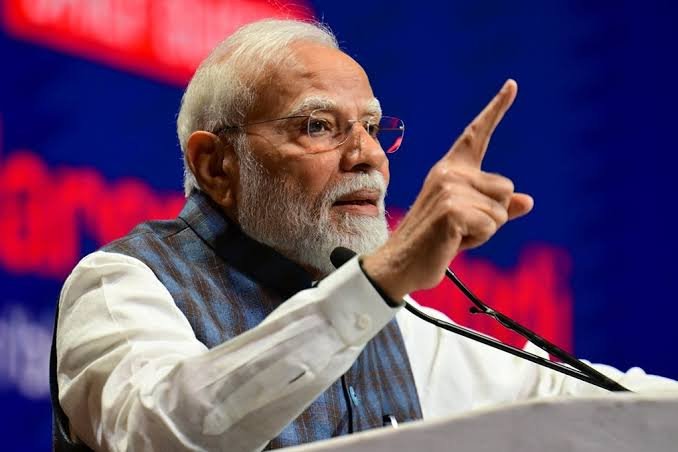
Prime Minister Narendra Modi has questioned Indian companies over sluggish hiring and limited salary growth despite years of government tax concessions and business reforms. His remarks have brought corporate profitability, employee compensation, manufacturing investment and India’s employment outlook back into focus.
Modi Questions Corporate India Over Salaries and Job Creation
Prime Minister Narendra Modi has put India’s corporate sector under scrutiny, asking business leaders why government tax relief and policy support have not translated into stronger hiring and higher employee salaries.
Speaking at the Federation of Indian Chambers of Commerce and Industry (FICCI) Annual General Meeting and Annual Convention in New Delhi on November 19, 2026, Modi questioned whether companies had increased their workforce or improved employee compensation after benefiting from successive government initiatives.
The Prime Minister pointed to the reduction in the corporate tax rate from 30% to 22% under the concessional tax regime introduced in 2019. He also referred to income tax relief for individuals earning up to ₹12 lakh under the new tax regime.
His central question was whether businesses had used the benefits of these policy measures to support employees, expand operations and create additional employment opportunities.
The remarks represented a direct challenge to corporate leaders at a time when employment generation and household purchasing power remain important concerns for the Indian economy.
Corporate Profits Rise Faster Than Employee Compensation
The debate surrounding Modi’s remarks has gained attention because financial data indicates a significant difference between corporate profit growth and employee compensation.
According to data reported by Reuters, factory profits grew at an annual rate of approximately 17% between 2020-21 and 2024-25. During the same period, employee compensation increased by around 13.5%, while employment growth remained below 7%.
Another analysis published by The Financial Express highlighted the difference between corporate profitability and wage expenditure among 4,046 companies.
For FY26, the combined wage bill of these companies increased by approximately 9%, while net profits grew by nearly 19%. In FY24, profits increased by 32%, compared with 12.5% growth in wage expenditure.
The figures suggest that employee-related spending has not increased at the same pace as corporate earnings.
However, profit growth and wage expenditure are different financial indicators. Higher profits do not automatically translate into equivalent salary increases because companies also consider capital expenditure, debt obligations, operating costs, technology investments and future business requirements.
Nevertheless, the difference has intensified discussions about how economic growth is being distributed between businesses and workers.
Real Wage Growth Remains a Concern for Factory Workers
The discussion is not limited to corporate salary structures. India’s manufacturing workforce has also faced challenges in maintaining purchasing power.
According to the latest Annual Survey of Industries data for 2024-25, average wages for factory workers increased by 5.3% to approximately ₹2.28 lakh annually.
However, household inflation stood at around 4.6% during the same period. After adjusting for inflation, real wage growth was just 0.7%.
This distinction is important because nominal salary increases do not always improve the financial position of employees.
For example, when a worker receives a 5% salary increase but household expenses rise by a similar percentage, the actual improvement in purchasing power remains limited.
The data also indicates that real wage growth has remained below 1% in five of the previous six years covered in the analysis.
For employees working in manufacturing, construction, retail and other labour-intensive sectors, limited real wage growth can affect household consumption, savings and financial stability.
The issue is particularly relevant for India’s middle-income households, where salary increases often need to keep pace with rent, education, healthcare, transportation and food expenses.
India’s Hiring Challenges Extend Beyond Manufacturing
Employment generation remains a broader challenge for India, particularly as millions of young people enter the workforce every year.
Although the services sector has become an increasingly important source of employment, manufacturing has struggled to significantly increase its share of total jobs.
According to CareEdge data cited by The Financial Express, the services sector’s share of employment increased from 22.9% in 2000 to 31.8% in 2025.
Manufacturing’s share, meanwhile, has remained broadly within the 10% to 12% range.
This creates an important challenge for policymakers and businesses. Manufacturing has traditionally been viewed as a major source of large-scale employment, particularly for workers who may not have access to specialised professional or technical education.
India has introduced several initiatives to strengthen domestic manufacturing, attract investment and expand industrial capacity. However, investment announcements and production growth do not always result in employment at the same pace.
Automation, changing skill requirements, higher productivity targets and uncertainty surrounding future demand can also influence companies’ hiring decisions.
For businesses, expanding the workforce requires confidence that additional production and services will generate sufficient revenue over time.
Government Tax Concessions and Corporate Investment Debate
The corporate tax reduction introduced in September 2019 remains central to the discussion.
Under Section 115BAA, eligible domestic companies can opt for a concessional corporate income tax rate of 22%, subject to specified conditions, including restrictions on certain exemptions and deductions.
The measure was introduced to improve India’s investment environment, encourage business expansion and strengthen the competitiveness of domestic companies.
The government has also introduced manufacturing incentives, infrastructure investment programmes and changes aimed at improving the ease of doing business.
However, tax concessions alone cannot guarantee higher private investment or employment generation.
Companies make investment decisions based on several factors, including consumer demand, infrastructure availability, financing costs, regulatory requirements, access to skilled workers and the expected return on capital.
Weak demand can discourage businesses from expanding factories or increasing recruitment, even when corporate taxes are lower.
This is one reason why the relationship between tax policy, investment and employment remains a complicated economic issue.
Modi’s remarks indicate that the government expects businesses to contribute more actively to employment generation rather than focusing primarily on policy concessions.
Why Higher Wages Matter for India’s Consumption Economy
The debate over employee salaries has implications beyond individual companies.
India’s domestic consumption market depends heavily on household spending. When workers receive meaningful salary increases, they generally have greater capacity to spend on housing, education, healthcare, transportation, consumer products and services.
Stronger consumption can support business revenues, encourage companies to expand production and create additional employment opportunities.
On the other hand, when wages remain under pressure, households may reduce discretionary spending or rely more heavily on savings and borrowing to manage expenses.
This can create difficulties for sectors that depend on regular consumer demand, including automobiles, retail, hospitality, real estate and consumer goods.
The issue also has implications for income inequality. If corporate profits increase considerably faster than employee compensation over extended periods, the distribution of economic gains can become increasingly uneven.
For India, maintaining a balance between business profitability and household income growth is important for sustaining domestic demand.
What Modi’s Message Means for Indian Businesses
Modi’s comments have placed greater attention on how Indian companies use the benefits of government policies.
Businesses are being challenged to demonstrate that economic growth is accompanied by stronger employment opportunities, improved employee compensation and greater investment in domestic capabilities.
At the same time, companies face genuine commercial considerations. They must maintain profitability, remain competitive in international markets, invest in technology and prepare for changing consumer demand.
The challenge for corporate India is to balance these priorities with long-term workforce development.
Higher wages can improve employee retention, productivity and purchasing power. Additional hiring can also help companies expand operations and reach new markets when demand supports such decisions.
For policymakers, the discussion highlights the importance of looking beyond headline GDP growth and corporate earnings.
Employment quality, real wage growth, workforce participation and private investment will remain important indicators of whether economic growth is reaching a wider section of the population.
Modi’s remarks at the FICCI convention have therefore brought an important question into the national business discussion: how can India ensure that corporate growth translates into better economic opportunities for its workforce?
Key Takeaways
- Prime Minister Narendra Modi questioned India Inc over limited salary increases and hiring despite government tax concessions.
- Data reported for FY26 showed corporate profits among 4,046 companies rising nearly 19%, while their wage bills increased approximately 9%.
- Real wages for factory workers grew just 0.7% in 2024-25 after adjusting for household inflation.
- The government expects businesses to contribute to employment generation, manufacturing expansion and stronger domestic economic activity.
Frequently Asked Questions
1. Why did Narendra Modi criticise India Inc over wage growth?
Modi questioned why Indian companies had not increased employee salaries and expanded hiring sufficiently despite receiving corporate tax concessions and other government policy support.
2. What is the corporate tax rate under India’s concessional tax regime?
Eligible domestic companies opting for Section 115BAA can pay corporate income tax at a basic rate of 22%, subject to specified conditions and applicable additional charges.
3. How much did corporate profits and wage bills grow in FY26?
According to The Financial Express analysis of 4,046 companies, net profits increased by nearly 19% in FY26, while their combined wage bills grew approximately 9%.
4. Why is real wage growth important for India’s economy?
Real wage growth measures the improvement in employee purchasing power after accounting for inflation. Stronger real wages can support household consumption, savings and demand for goods and services.
(Internal Keywords: Narendra Modi India Inc remarks, India corporate wage growth, India hiring slowdown 2026, FICCI AGM November 2026, corporate tax cuts India, Indian manufacturing employment, real wage growth India, corporate profits India FY26, private sector job creation, India economic growth, employee salary growth, Indian corporate sector news)