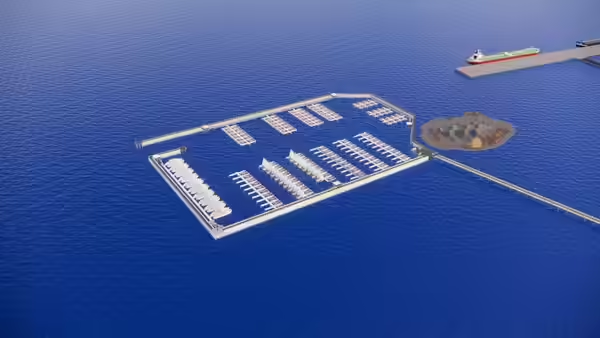
The Mumbai Marina project has received official clearance with an ₹887 crore investment, marking a significant step in positioning the city as a hub for blue economy driven tourism and coastal logistics. The Mumbai Marina project is expected to reshape the city’s eastern waterfront by unlocking maritime tourism, leisure boating, and marine linked commercial activity.
The approval signals a strategic shift toward monetising coastal assets while easing pressure on traditional land based infrastructure.
Project clearance sets stage for waterfront transformation
The greenlight for the Mumbai Marina project gives momentum to long delayed plans to redevelop the eastern waterfront into a structured marine zone. The project focuses on creating marina facilities for yachts, leisure boats, and marine services while integrating tourism infrastructure.
For a city constrained by land scarcity, the coastline offers untapped economic potential. The marina development is positioned as a multi use asset, combining recreation, commercial activity, and urban renewal. It also aligns with broader efforts to improve Mumbai’s liveability by opening up underutilised waterfront spaces to organised development.
The clearance reflects growing policy emphasis on the blue economy as a growth lever rather than a niche concept.
Blue economy focus reshapes urban planning priorities
The blue economy framework extends beyond tourism. It includes ports, logistics, fisheries, coastal transport, and marine services. The Mumbai Marina project fits into this framework by linking tourism with marine logistics and support infrastructure.
Marinas act as anchor assets that attract hospitality, retail, maintenance services, and skilled marine employment. Over time, this can create a self sustaining coastal ecosystem rather than a standalone tourism spot.
Urban planners increasingly view such projects as tools to diversify city economies, especially in metros where real estate driven growth faces saturation.
Tourism potential beyond conventional attractions
Mumbai’s tourism offering has traditionally been land centric, focused on heritage, shopping, and entertainment. The marina introduces a new dimension by enabling water based tourism experiences such as sailing, cruising, and waterfront leisure.
This diversification is aimed at attracting higher spending domestic and international tourists. Marine tourism typically supports premium hospitality, events, and lifestyle services, increasing per visitor economic impact.
The project could also position Mumbai competitively alongside global coastal cities that have successfully leveraged marina led tourism for urban renewal.
Logistics and marine services gain strategic importance
Beyond tourism, the marina is expected to support marine logistics and ancillary services. This includes vessel maintenance, refuelling, crew services, and coastal transport connectivity.
Mumbai’s eastern waterfront sits close to industrial zones and port infrastructure. Integrating marina facilities with logistics services can improve efficiency for small commercial vessels and coastal trade.
As India pushes for coastal shipping and inland waterways to reduce logistics costs, such marine infrastructure becomes increasingly relevant. The project supports this long term logistics diversification strategy.
Economic impact and job creation outlook
The ₹887 crore investment is expected to generate employment across construction, operations, hospitality, and marine services. Unlike short term real estate projects, marina infrastructure creates recurring economic activity through maintenance, services, and tourism flows.
Small businesses such as boat operators, training academies, cafes, and marine equipment suppliers are likely to benefit. Over time, the area could emerge as a specialised employment cluster for marine skills.
For the city, this means a broader tax base and incremental economic activity without heavy land acquisition.
Environmental and regulatory considerations
Coastal projects face scrutiny due to environmental sensitivity. The Mumbai Marina project has been cleared with regulatory conditions aimed at minimising ecological impact.
Sustainable design, waste management, and controlled marine traffic are expected to be integral to execution. Authorities have emphasised balancing economic development with coastal ecosystem protection.
Long term success will depend on enforcement and operational discipline. Poor execution could trigger environmental backlash and stall expansion plans.
Public private collaboration model in focus
The project reflects a growing preference for public private collaboration in large urban infrastructure. Public funding provides initial viability, while private participation brings operational expertise and efficiency.
Marinas require specialised management, international safety standards, and customer service capabilities. Private operators are better positioned to deliver these outcomes.
This model reduces fiscal burden while ensuring professional execution, provided contracts are structured with clear accountability.
Implications for Mumbai’s urban identity
The marina project has symbolic importance. It repositions Mumbai not just as a financial capital but as a maritime city reconnecting with its coastline.
For decades, large parts of the waterfront remained inaccessible or industrial. Opening them up in a planned manner reshapes how residents and visitors experience the city.
If executed well, the project could catalyse further waterfront redevelopment initiatives across the city.
Risks and execution challenges remain
Despite clearance, execution risks remain. Timelines, cost overruns, coordination among agencies, and public access concerns could affect outcomes.
Marina projects globally have seen mixed results when demand projections or management quality fall short. Sustained marketing, safety standards, and integration with city transport will be critical.
The success of the Mumbai Marina project will depend less on approval headlines and more on disciplined implementation.
What this means for India’s coastal development push
The project aligns with India’s broader push to unlock coastal economic value. As ports modernise and coastal tourism gains policy backing, cities like Mumbai become test cases.
A successful marina can demonstrate how blue economy concepts translate into tangible urban growth. Failure could reinforce scepticism around coastal monetisation.
The stakes are high, both economically and symbolically.
Takeaways
- Mumbai Marina project has been cleared with ₹887 crore investment support
- The project targets blue economy growth through tourism and marine logistics
- Marina infrastructure could create long term jobs and diversified revenue
- Execution quality will determine environmental and economic success
FAQs
What is the Mumbai Marina project?
It is a waterfront development focused on marina facilities, marine tourism, and coastal services.
Why is the blue economy important for Mumbai?
It allows the city to unlock coastal assets for growth without relying solely on land based expansion.
Will the project support logistics or only tourism?
It is designed to support both marine tourism and small scale coastal logistics services.
What are the main risks?
Environmental compliance, execution delays, and demand sustainability are key challenges.