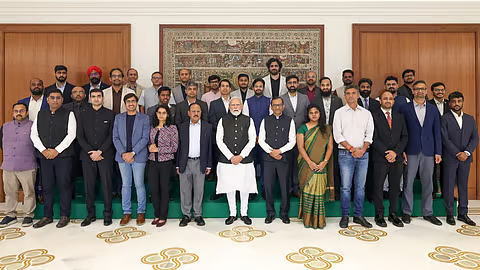
Prime Minister Narendra Modi has urged India’s space startups to build an ecosystem capable of attracting global talent, investment and businesses, as the country seeks a larger role in the international space economy. His remarks came during National Space Day discussions with private space companies.
PM Modi Calls for Global Space Talent
Prime Minister Narendra Modi has asked India’s space startups to create an ecosystem that makes the country an attractive destination for skilled professionals from around the world. The remarks came as India marked National Space Day on August 23, with the private space sector emerging as a major focus of the country’s broader space ambitions.
During his interaction with space startup CEOs, Modi said India should build an environment where people globally see the country as a place to develop their careers in space technology. He highlighted India’s cost competitiveness, talent pool and risk-taking capacity as advantages that could help Indian companies expand internationally.
The Prime Minister also stressed the importance of policy consistency. For startups operating in a capital-intensive industry where development and testing can take years, predictable regulations can influence decisions around investment, hiring and expansion.
Space Startups Asked to Build Global Businesses
Modi’s message went beyond attracting employees. He encouraged Indian space startups to think about global markets and build companies that can compete internationally.
The interaction included CEOs and founders working across different areas of space technology, including launch vehicles, satellite systems, in-space propulsion, satellite servicing, space pharmaceuticals and Earth observation. The official transcript of the discussion shows several founders describing international contracts and plans for global expansion.
One startup founder said the company had received eight launch contracts in the month following a launch, with most of those contracts being international. Another founder discussed plans to establish a global ground station network. These comments point to the commercial opportunities Indian space companies are already pursuing beyond the domestic market.
The government’s focus is therefore shifting from simply enabling private participation in space to encouraging companies that can develop scalable products and services for international customers.
Policy Stability Becomes a Key Startup Demand
A central point in Modi’s interaction was the need for consistency in government decisions. He told startup representatives that policy decisions should not be repeatedly changed, so entrepreneurs can take risks with greater confidence.
That concern is particularly relevant to space businesses. Unlike many conventional startups, space companies can require substantial investment in research, manufacturing, testing and infrastructure before generating commercial revenue.
For investors, regulatory predictability can be important because the return on capital may depend on long development cycles and government approvals. For founders, stable rules can make it easier to plan hiring, facilities, partnerships and product development.
India has already created a regulatory framework for private space activity through institutions such as the Indian National Space Promotion and Authorization Centre, or IN-SPACe. The organisation is responsible for promoting and enabling non-government entities to undertake space activities under the country’s evolving space sector framework.
India’s Private Space Sector Gains Momentum
India’s space industry has traditionally been dominated by the government and ISRO. That landscape has changed significantly with the entry of private companies into launch services, satellite manufacturing, Earth observation and other space-related technologies.
The latest interaction highlighted the range of technologies being developed by Indian startups. One company discussed robotic spacecraft designed to capture and remove inactive satellites from orbit. Another is working on docking and refuelling technologies with the longer-term objective of establishing a fuel station in space.
A separate startup described its work on space-based pharmaceutical manufacturing, with satellites designed to manufacture products in orbit before bringing them back to Earth. Other founders discussed satellite propulsion, agricultural applications and satellite-based services.
The variety of these businesses shows that India’s private space opportunity is expanding beyond rockets. Commercial opportunities are increasingly emerging across the wider space value chain.
Skyroot Highlights Investor Interest and Launch Plans
The discussion also featured Skyroot Aerospace, which described itself as India’s first space-tech unicorn. A company representative told Modi that it had successfully launched a private rocket on July 18 and deployed satellites, describing the mission as the beginning of a larger commercial programme.
The company said it already has manufacturing capacity for one rocket per month and plans to move toward one launch per month by the middle of next year. It also described a longer-term ambition of increasing launch frequency substantially.
The Skyroot representative also said the company had seen increased investor interest following its launch and noted that Indian citizens working in the United States and Europe were showing interest in returning to India to work in the space sector.
That point directly connects with Modi’s push to make India a destination for global space talent. The challenge now is to turn individual success stories into a broader ecosystem capable of attracting engineers, scientists, investors and entrepreneurs from multiple markets.
Global Capital Is the Next Test
Attracting international capital could become one of the most important tests for India’s private space industry. Space businesses require funding for specialised equipment, testing facilities, manufacturing infrastructure and research before many products can reach commercial scale.
Modi described India’s cost competitiveness and talent pool as key advantages. However, global investors will also assess factors such as regulatory certainty, technology risk, intellectual property protection, customer demand and the ability of startups to scale internationally.
The government’s role will therefore extend beyond opening the sector. Startups will need access to infrastructure, financing, skilled workers and international markets if India is to develop globally competitive space businesses.
IN-SPACe has also been supporting the startup ecosystem through initiatives such as its Seed Fund Scheme, which is aimed at supporting innovative ideas using space technology for broader economic and social applications.
Space Technology Moves Beyond Rockets
Another important theme from the interaction was the wider commercial use of space technology. Modi encouraged startups to use space capabilities to address challenges on the ground, including applications in agriculture and other sectors.
One startup discussed plans involving as many as 10 lakh farmers. Such applications could include satellite-based information and services that support agricultural decision-making, although the commercial and operational scale of these plans will depend on execution.
This broader approach could expand the market for Indian space companies. Instead of relying only on launch contracts or satellite sales, startups can potentially build recurring businesses around data, analytics, communications and specialised space-based services.
For investors, that could create a more diversified commercial space ecosystem. For the government, it could also help translate investment in space technology into applications with direct economic value.
India Wants a Larger Role in the Global Space Economy
The latest message from the government signals a more ambitious phase for India’s private space industry. The objective is no longer limited to enabling domestic startups. The focus is increasingly on creating companies that attract international talent, secure overseas contracts and compete in global markets.
The foundations are already developing. Private companies are working on launch vehicles, satellites, propulsion, orbital servicing and specialised applications, while institutions such as IN-SPACe are supporting private participation.
The next challenge will be scale. India will need to convert its cost and talent advantages into sustained commercial success, while maintaining predictable policies that encourage long-term investment.
If Indian space startups can build that combination, Modi’s call to make India a global destination for space talent and capital could become more than a policy ambition. It could shape the next stage of India’s space economy.
Key Takeaways
- PM Modi urged Indian space startups to build an ecosystem that attracts global space talent and investment.
- He highlighted India’s cost competitiveness, skilled workforce and risk-taking capacity as strategic advantages.
- The government stressed policy consistency to give private space companies greater confidence to invest and take risks.
- Indian startups are increasingly targeting international contracts and commercial opportunities across the space technology value chain.
FAQs
Why did PM Modi meet space startup CEOs?
PM Modi interacted with Indian space startup founders and CEOs around National Space Day to discuss the growth of the private space sector, innovation, investment and India’s ambitions in the global space economy.
What does PM Modi want Indian space startups to achieve?
He wants Indian space startups to build globally competitive businesses, attract international talent and investment, and expand beyond the domestic market into international opportunities.
Why is policy stability important for space startups?
Space companies often require large investments and long development timelines. Consistent policies can give entrepreneurs and investors greater confidence when making long-term decisions about technology, infrastructure and expansion.
Which areas are Indian space startups working on?
Indian startups are developing technologies across launch vehicles, satellites, propulsion, Earth observation, orbital servicing, docking and refuelling, space pharmaceuticals and agriculture-related applications.
(Internal keywords: PM Modi space startups, India space startups 2026, global space talent India, India private space sector, space startup investment India, Indian space economy, IN-SPACe startups, PM Modi National Space Day, India space technology, global space investment)