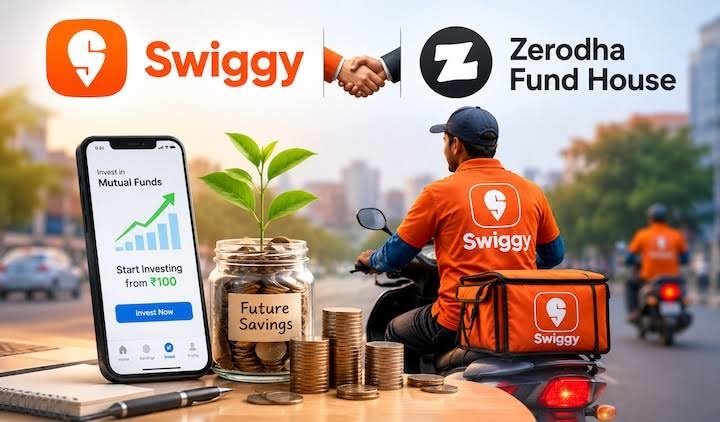
Swiggy has partnered with Zerodha Fund House to help its delivery partners invest in mutual funds directly through the Swiggy Rider App. The initiative, which allows investments starting from Rs 100, aims to improve financial inclusion and encourage long-term wealth creation for India’s growing gig workforce.
Swiggy-Zerodha Fund House Partnership Brings Investing to Delivery Partners
The Swiggy-Zerodha Fund House partnership marks a significant step in expanding financial services for gig workers in India. Announced this week, the collaboration enables Swiggy delivery partners to invest a portion of their earnings into mutual funds through the Swiggy Rider App, with investments starting at just Rs 100.
Unlike traditional investment platforms that often require multiple onboarding steps, this initiative integrates investing into an app that delivery partners already use daily. The objective is to make investing simple, accessible, and relevant for workers whose incomes are often earned in short cycles.
The move reflects a broader trend where digital platforms are expanding beyond their core businesses to offer financial wellness tools alongside employment opportunities.
Financial Inclusion for India’s Gig Economy
India’s gig economy has expanded rapidly over the past few years, driven by food delivery, ride-hailing, quick commerce, and logistics platforms. While these jobs provide flexible earning opportunities, many workers remain underserved by formal financial products such as investment plans and retirement savings.
Under the new programme, Swiggy delivery partners can invest directly in schemes managed by Zerodha Fund House. The investments can be monitored and managed through Zerodha Fund House’s WhatsApp-based service, making the experience familiar and mobile friendly.
The low minimum investment amount is designed to encourage first-time investors who may not have previously considered mutual funds due to affordability concerns. Since there is no mandatory large commitment, workers can invest according to their earnings and financial priorities.
Mutual Funds Starting From Rs 100 Lower Entry Barriers
One of the biggest highlights of the partnership is the Rs 100 starting investment.
Small-ticket investing has become increasingly popular in India’s fintech ecosystem because it allows users to begin building savings without affecting their daily cash flow. Gig workers often face fluctuating weekly incomes, making flexible investment options more practical than fixed monthly commitments.
According to the companies, delivery partners can use these investments for various financial goals, including emergency savings, education expenses, purchasing a vehicle, or building long-term wealth.
The initiative also supports financial literacy by encouraging disciplined investing rather than keeping idle balances or relying solely on short-term spending.
Why the Partnership Matters for India’s Fintech Sector
The partnership represents more than just another corporate collaboration.
It highlights the growing convergence between technology platforms and financial services in India. Food delivery apps, digital payments, lending platforms, insurance providers, and investment firms are increasingly working together to offer integrated financial products.
For Zerodha Fund House, the partnership expands access to a large base of first-time investors. For Swiggy, it strengthens delivery partner engagement by adding a financial benefit beyond earnings and insurance programmes.
Industry observers see this as part of a larger embedded finance trend, where financial products are offered within everyday digital platforms instead of requiring users to visit separate banking or investment apps.
As India’s digital economy continues to grow, similar partnerships could emerge across ride-hailing, e-commerce, logistics, and freelance work platforms.
Industry Outlook and What Comes Next
India’s fintech sector has increasingly focused on improving financial inclusion through technology. Digital KYC, UPI payments, low-cost mutual funds, and mobile investing have made wealth creation more accessible than ever before.
The Swiggy-Zerodha initiative fits into this larger transformation by bringing investing directly to workers who may have had limited exposure to formal investment products.
While the programme’s long-term success will depend on user adoption and sustained investor education, it demonstrates how platform companies are evolving beyond operational support to offer financial empowerment tools.
If successful, the partnership could become a model for other gig economy companies looking to improve the financial security of their workforce while expanding participation in India’s mutual fund ecosystem.
Key Takeaways
- Swiggy has partnered with Zerodha Fund House to enable mutual fund investments for delivery partners.
- Investments begin from Rs 100 and are integrated into the Swiggy Rider App.
- The initiative aims to improve financial inclusion and long-term savings among gig workers.
- The partnership reflects India’s growing embedded finance and fintech ecosystem.