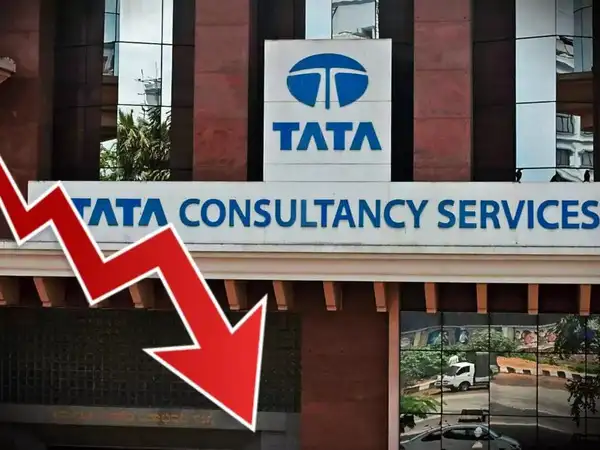
TCS shares came under pressure on Monday, August 17, as Indian IT stocks faced fresh selling amid a broader market decline. Tata Consultancy Services fell 2.04% to ₹2,312.80 in morning trade, while rising crude prices and cautious investor sentiment added to pressure on the technology sector.
TCS shares fall as IT stocks weaken
TCS shares were among the prominent large-cap stocks facing selling pressure on August 17, with the stock declining 2.04% to ₹2,312.80 at around 10:46 am. The move came as the broader Indian market also remained under pressure, with IT and PSU stocks emerging as major contributors to the decline.
The weakness was not limited to TCS. Indian technology stocks have remained sensitive to shifts in global economic expectations, technology spending and concerns about how artificial intelligence could reshape traditional IT services.
The pressure on Monday also came against a weak broader market backdrop. The Sensex and Nifty extended their declines, with crude oil prices moving toward the $90-a-barrel mark amid continuing geopolitical tensions.
Crude oil adds another layer of market pressure
Rising crude prices are an important factor for Indian equities because India remains heavily dependent on imported oil. Higher crude prices can increase concerns about inflation, corporate costs and the country’s trade balance.
On Monday, Brent crude was hovering around $89 per barrel, with prices supported by continuing geopolitical tensions. The broader market responded negatively, with the Nifty 50 falling 0.34% and the Sensex declining 0.46% in the morning session, according to market data reported on Monday.
Although higher oil prices do not directly determine the earnings of an IT services company such as TCS, they can influence overall investor risk appetite. When investors become more cautious, large and liquid stocks can also experience selling as portfolios are repositioned.
For TCS, that broader risk-off environment is arriving at a time when investors are already closely watching the outlook for global technology spending.
IT sector faces concerns over global demand
The Indian IT services industry generates a significant portion of its revenue from international markets, particularly North America and Europe. That makes companies such as TCS sensitive to changes in corporate technology budgets and economic conditions in key client markets.
Investor concerns around IT stocks have intensified during 2026 as markets assess whether companies will continue spending at the same pace while artificial intelligence changes how technology work is delivered.
Earlier in June, Indian IT stocks suffered a sharp selloff after Accenture reduced the upper end of its full-year revenue growth outlook. The Nifty IT index fell 6.5% during that episode, with TCS, Infosys, HCL Technologies and other major technology stocks declining sharply.
That episode highlighted how closely Indian IT valuations can react to signals from major global technology services companies.
TCS fundamentals remain closely watched
The latest fall in TCS shares comes despite the company reporting growth in its June quarter results.
TCS reported revenue of $7.624 billion for Q1 FY27, representing 2.7% year-on-year growth in US dollar terms. Revenue was flat sequentially in US dollar terms, while constant-currency revenue increased 0.4% quarter-on-quarter.
The company reported an operating margin of 24% and net income of $1.46 billion. Its total contract value stood at $9.5 billion for the quarter.
TCS also said its annualised artificial intelligence revenue reached $2.6 billion during the quarter, increasing 13.6% sequentially. The company highlighted AI-led transformation, cybersecurity, cloud and modernization as areas of client spending.
These numbers indicate that the company’s business continues to generate substantial deal activity even while investors remain cautious about the longer-term growth outlook.
AI remains a key concern for IT investors
Artificial intelligence has become one of the biggest themes affecting the valuation of traditional IT services companies.
The concern is not simply that companies will stop spending on technology. Instead, investors are assessing whether AI can allow businesses to complete certain technology and business-process tasks with fewer people and in less time.
That could change the traditional outsourcing model, particularly for work that has historically depended heavily on large teams and billable hours.
At the same time, IT companies argue that AI can create new demand by encouraging businesses to modernise legacy systems, implement AI applications and redesign technology infrastructure.
TCS itself has positioned AI as a growth opportunity, pointing to its growing AI revenue and several AI-led transformation contracts.
The market debate therefore remains centred on how quickly AI-driven productivity gains translate into changes in technology spending and IT services revenue.
What investors will watch next
For TCS and other Indian IT companies, investors are likely to focus on several indicators in the coming months.
One is the pace of discretionary technology spending by overseas clients. Large projects involving cloud migration, consulting, software engineering, cybersecurity and AI could provide clues about whether technology budgets are expanding or being redirected.
Margins will also remain important. If AI improves productivity, companies could potentially deliver projects with fewer resources. But investors will want to see whether those efficiency gains translate into stronger profitability or lead to pricing pressure from clients.
Deal wins will be another important signal. TCS reported $9.5 billion in total contract value during Q1 FY27, giving investors an indication of demand entering the period.
The company’s ability to convert those contracts into revenue growth will be closely watched as the year progresses.
Broader market weakness adds to volatility
Monday’s decline in TCS shares needs to be viewed within the wider market environment rather than as an isolated company-specific event.
Indian benchmark indices were under pressure for a fifth consecutive session, while IT and PSU stocks were among the leading decliners. Rising crude prices and geopolitical uncertainty were major factors affecting sentiment.
TCS had also been among the biggest market-cap losers in the previous week’s trading, highlighting the pressure that large technology stocks have faced recently.
For investors, the combination of global economic uncertainty, changing technology spending patterns, AI disruption concerns and domestic market weakness is creating a challenging environment for the IT sector.
The immediate movement in TCS shares reflects that uncertainty. Whether the pressure becomes a longer-term trend will depend on earnings growth, deal conversion, global technology demand and how effectively the company turns AI adoption into new business.
Key Takeaways
- TCS shares fell 2.04% to ₹2,312.80 in Monday morning trade.
- IT stocks faced renewed selling as Indian benchmark indices extended their decline.
- Rising crude prices and geopolitical uncertainty added to broader market pressure.
- TCS reported $9.5 billion in Q1 FY27 contract value and $2.6 billion in annualised AI revenue.
FAQ
Why are TCS shares falling today?
TCS shares fell amid broader weakness in Indian equities, with IT stocks facing renewed selling pressure. Rising crude prices, geopolitical uncertainty and concerns around the global technology spending outlook contributed to the cautious market environment.
What is affecting Indian IT stocks in 2026?
Indian IT stocks have been affected by concerns around global technology spending, AI-driven changes to traditional IT services, macroeconomic uncertainty and signals from major global technology services companies.
Is TCS still growing despite the stock-market pressure?
TCS reported year-on-year revenue growth in Q1 FY27 and recorded $9.5 billion in total contract value. The company also reported a $2.6 billion annualised AI revenue run rate, indicating continued business activity despite market concerns.
What will determine the future performance of TCS shares?
Investors are likely to watch global client spending, new deal wins, revenue conversion, operating margins and the company’s ability to turn AI adoption into sustainable business growth.