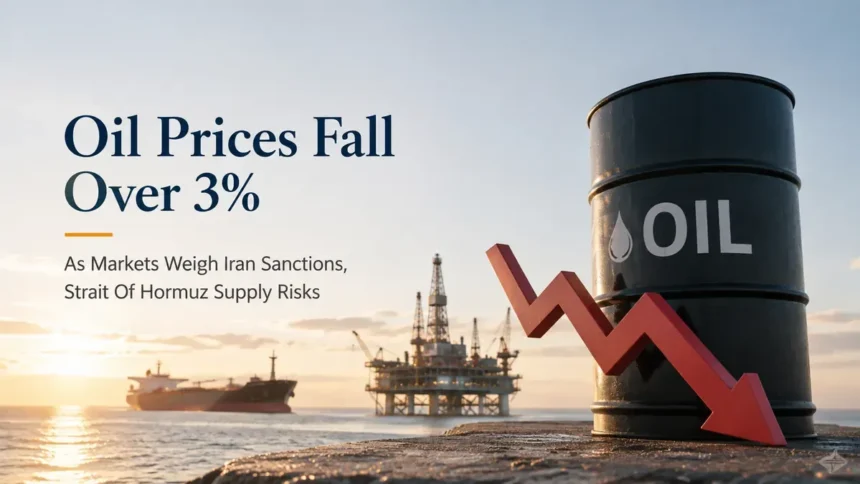
US-Iran sanctions are putting fresh pressure on Tehran, but oil prices are moving lower as traders judge that the latest measures may not significantly reduce global crude supplies. Brent crude fell below $90 as Iran-Oman talks revived hopes for a temporary Hormuz shipping corridor.
The topic is time-sensitive news. Current market reporting shows that oil prices fell for a third consecutive day on August 26 as traders focused on supply availability rather than the headline impact of new US sanctions.
New US sanctions target Iran’s oil network
The United States announced a new sanctions campaign against Iran on August 25, expanding economic pressure on Tehran and targeting parts of the network that supports Iranian oil sales.
The US Treasury said the latest measures cover nearly 60 individuals, entities and vessels. The targets include brokers, financial intermediaries and tankers linked to Iran’s oil trade, along with networks accused of supporting Iran’s military procurement and other activities.
Five tankers associated with Iran’s so-called shadow fleet were designated as blocked property. The measures also extend beyond Iran itself, with Washington threatening secondary sanctions against foreign parties that continue certain economic dealings with Tehran.
The latest action is designed to make it harder for Iran to generate revenue from international trade. Yet the immediate reaction in oil markets has been notably different from what might be expected from a major sanctions announcement.
Why oil prices are falling despite sanctions
Oil markets are ultimately focused on barrels that can actually reach consumers.
The latest US measures increase pressure on Iranian trading networks, but traders are assessing whether those restrictions will materially reduce the amount of crude available to the global market.
That distinction has helped push prices lower.
Reuters reported that Brent crude fell more than $2 a barrel on Wednesday, reaching around $86.22, while US crude also declined. The move came as traders weighed the sanctions against signs that arrangements around the Strait of Hormuz could improve.
In other words, markets are currently betting that economic pressure on Iran will not automatically translate into a major additional loss of physical oil supply.
That does not mean supply risks have disappeared. It means traders are placing greater weight on the possibility that available supplies can continue reaching major consuming markets.
Iran and Oman talks change the market mood
The biggest near-term factor behind the oil decline is not the sanctions themselves. It is the renewed discussion between Iran and Oman over managing traffic through the Strait of Hormuz.
Iran said talks with Oman had restarted, with discussions including the possibility of a temporary joint shipping corridor and mine-clearing measures.
The Strait is one of the world’s most important energy routes, so even a limited improvement in navigation can change traders’ expectations about future supply disruptions.
However, the situation remains far from normal. Reuters reported that only five commodity vessels transited the Strait on Tuesday, compared with a 10-day average of 15. Earlier in the week, traffic was similarly weak.
That means the market is responding to the prospect of improved access, not to a full restoration of normal shipping flows.
Hormuz remains the biggest oil market risk
The Strait of Hormuz continues to be the central issue for energy traders.
The waterway connects the Persian Gulf with the Gulf of Oman and is a major route for crude oil and other energy shipments. Any prolonged disruption can affect producers, refiners, shipping companies and consumers across multiple regions.
Current shipping data show that traffic remains well below normal levels. Iran has also threatened action against vessels it says have violated its rules for crossing the Strait.
On August 24, Iran said it had blacklisted 45 tankers and threatened penalties including fines, detention and cargo seizures. The development has already caused some oil companies and refiners to reconsider which vessels they use for Gulf transportation.
This creates a complicated picture for the oil market. Prices may be falling, but physical shipping risks remain elevated.
China remains crucial to Iranian oil flows
Another reason traders are questioning the impact of sanctions is Iran’s ability to continue selling crude through alternative channels.
China has been Iran’s largest oil customer in recent years. Reuters reported that Iranian shipments to China fell to about 534,000 barrels per day in August from 823,000 barrels per day in July, showing that US pressure has already affected flows.
However, Iranian oil has continued reaching Chinese buyers, particularly independent refiners that are attracted by discounted crude.
Trade networks have also used complex arrangements to disguise the origin of some Iranian shipments and settle transactions outside traditional US-dominated financial channels.
This does not make sanctions ineffective. It does show why markets are reluctant to assume that every new restriction will immediately remove Iranian barrels from global supply.
Economic pressure does not always mean fewer barrels
The central question for oil traders is whether sanctions reduce Iran’s ability to export crude enough to create a meaningful global supply shortage.
Washington’s latest measures clearly increase the cost and complexity of Iranian oil transactions. They target companies, ships and financial networks that help move Iranian petroleum products around the world.
But Iran has experience operating under sanctions, while buyers have financial incentives to seek discounted supplies.
The result is a gap between financial pressure and physical supply. Sanctions can make transactions more expensive, increase shipping risks and force traders to change routes or intermediaries without necessarily removing every barrel from the market.
That is why oil prices can fall even while Washington is announcing tougher measures against Tehran.
Global oil supply remains under pressure
The falling price should not be interpreted as evidence that the global oil market is comfortable.
Reuters reported that almost half of global oil output in 2025 came from countries affected by conflicts, highlighting how concentrated geopolitical risks have become across energy markets.
The Iran conflict has already disrupted Gulf oil flows, while other supply disruptions are affecting production and refining capacity in different parts of the world.
The Strait of Hormuz remains particularly important because the current reduction in vessel traffic has constrained the movement of commodities through the waterway.
If shipping conditions deteriorate again, the current bearish oil sentiment could change quickly.
For now, traders appear more confident that alternative supply arrangements and potential improvements in navigation can prevent the latest sanctions from triggering another immediate oil-price spike.
What lower oil prices mean for global markets
Lower crude prices are generally supportive for oil-importing economies because they can reduce energy costs and pressure on import bills.
For countries such as India, cheaper crude can potentially ease pressure on inflation, the currency and the trade balance. For airlines, transport companies and other fuel-intensive businesses, lower energy prices can also improve cost conditions.
For oil producers, however, falling prices can reduce revenue expectations.
The broader financial market reaction has therefore been mixed by sector, but investors have welcomed the reduction in immediate energy-price pressure.
Global equity markets have also benefited from the decline in crude prices, while bond yields have moved lower as investors reassess inflation risks.
Traders now watch sanctions enforcement and Hormuz
The next phase of the oil story will depend on two questions.
First, how aggressively will the United States enforce the new sanctions against Iranian oil networks and foreign companies that continue trading with Tehran?
Second, will Iran and Oman succeed in creating a workable shipping arrangement through the Strait of Hormuz?
At present, neither question has a definitive answer.
The oil market is therefore pricing a relatively optimistic scenario in which sanctions increase economic pressure on Iran without causing a proportionate reduction in global crude availability.
That view could change if sanctions significantly disrupt exports, if more vessels stop entering the Gulf or if negotiations over Hormuz break down.
For now, however, traders are betting that economic pressure can rise without creating a fresh supply shock, keeping crude prices below the $90 level and easing some of the immediate inflation concerns across global markets.
Key Takeaways
- US sanctions announced on August 25 target nearly 60 Iran-linked individuals, entities and vessels, including parts of the country’s oil trading network.
- Brent crude fell to around $86.22 on August 26 as traders focused on supply availability and renewed Iran-Oman talks.
- Shipping through the Strait of Hormuz remains far below normal, so the risk of renewed supply disruption has not disappeared.
- Traders currently expect sanctions to increase economic pressure on Iran without causing an immediate global oil supply shock.
FAQ
Why are oil prices falling after new US sanctions on Iran?
Oil prices are falling because traders believe the latest sanctions may not immediately remove enough crude from the global market to create a major additional supply shortage. Renewed Iran-Oman discussions over Hormuz have also reduced some near-term supply fears.
What do the new US sanctions target?
The latest US measures target nearly 60 Iran-linked individuals, companies and vessels. They include oil brokers, financial intermediaries and tankers associated with Iranian oil sales and other networks supporting Tehran.
Is the Strait of Hormuz operating normally?
No. Shipping activity remains significantly below its recent average. Reuters reported five commodity vessel transits on Tuesday compared with a 10-day average of 15. Iran and Oman are discussing a temporary shipping corridor, but normal traffic has not yet returned.
Could oil prices rise again?
Yes. A breakdown in Iran-Oman talks, tighter enforcement that materially reduces Iranian exports, or further disruption to shipping through Hormuz could quickly push oil prices higher. The current decline reflects market expectations, not the removal of geopolitical risk.
(Internal keyword suggestions: US Iran sanctions, Iran oil sanctions, oil prices today, Brent crude price, Iran oil exports, Strait of Hormuz, Iran Oman talks, global oil supply, US sanctions on Iran, Iran oil market, crude oil news, global energy market)