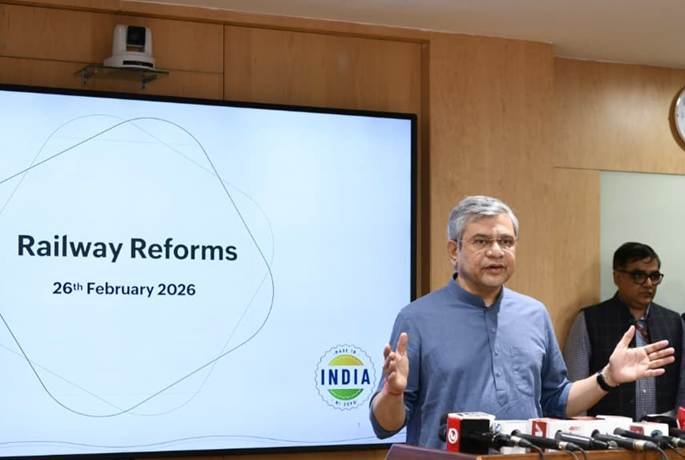
India Rail Tech policy has been launched to channel startup innovation into railway safety and exports, marking a strategic push to modernize the national transporter. The framework aims to accelerate technology adoption, enhance safety standards, and position India as a railway solutions exporter.
India Rail Tech policy launched this week signals a decisive shift toward integrating startup driven innovation into one of the world’s largest rail networks. The policy is designed to strengthen railway safety systems, improve operational efficiency, and build globally competitive rail technology exports. With Indian Railways operating one of the most extensive passenger and freight networks worldwide, the need for modernization has become central to infrastructure planning.
The initiative recognizes that emerging technologies such as artificial intelligence, predictive analytics, Internet of Things sensors, and advanced signaling can significantly reduce accidents and improve asset utilization. By creating a structured pathway for startups to test and scale solutions within the railway ecosystem, the policy seeks to shorten innovation cycles.
Focus on Railway Safety and Modernization
Railway safety remains a top priority for policymakers. Over the years, India has invested heavily in track renewal, automatic signaling, and train protection systems. The new Rail Tech policy complements these efforts by encouraging private innovators to develop tools that can prevent collisions, detect track faults, and monitor rolling stock health in real time.
Advanced train control systems, including indigenous automatic train protection technologies, have already been deployed across key routes. The policy aims to widen such deployment by inviting startups to offer complementary solutions such as smart braking diagnostics, drone based track inspection, and AI powered traffic management.
Data analytics will play a critical role. Real time monitoring of locomotives and coaches can identify anomalies before they escalate into operational risks. By embedding digital systems across assets, Indian Railways can transition from reactive maintenance to predictive maintenance, reducing downtime and improving passenger safety.
Startup Ecosystem and Public Procurement Reform
A central feature of the India Rail Tech policy is easing entry barriers for startups. Traditionally, public procurement in large infrastructure sectors has favored established vendors due to scale and compliance requirements. The new framework proposes pilot programs, sandbox testing environments, and simplified qualification norms for early stage companies.
By creating dedicated innovation corridors within railway zones, startups can test prototypes under controlled conditions. Successful pilots may be fast tracked for larger contracts. This reduces the time between concept validation and commercial deployment.
Funding mechanisms are also expected to align with innovation goals. Collaboration with incubators, technology institutes, and venture capital networks could accelerate development of railway specific solutions. The approach mirrors broader national efforts to strengthen the startup ecosystem through policy backed support.
Export Ambitions and Global Railway Markets
Beyond domestic modernization, the Rail Tech policy places strong emphasis on exports. India has already emerged as a supplier of locomotives, coaches, and signaling systems to select global markets. With rising infrastructure investment across Asia, Africa, and Latin America, demand for cost effective rail solutions is expanding.
By fostering homegrown technology companies, India can move up the value chain from hardware manufacturing to integrated digital solutions. Exporting signaling systems, safety software, and analytics platforms offers higher margins and recurring revenue opportunities.
Government backed certification and quality standards will be critical for international credibility. Aligning products with global benchmarks ensures that Indian startups can compete in tenders abroad. Strategic partnerships with foreign rail operators may further open new markets.
Economic and Industrial Impact
Railways are not just a transport network but a backbone of industrial supply chains. Enhancing efficiency through technology can lower logistics costs, improve freight turnaround times, and strengthen manufacturing competitiveness.
The Rail Tech policy supports broader economic goals such as Make in India and infrastructure led growth. Encouraging domestic innovation reduces reliance on imported technology and strengthens local value chains. It also creates skilled employment in engineering, software development, and system integration.
As India invests heavily in high speed corridors, dedicated freight routes, and station redevelopment, integrating advanced technology at the design stage can optimize long term performance. This policy creates a pipeline of solutions that can scale alongside infrastructure expansion.
Challenges and Implementation Outlook
While the intent of the India Rail Tech policy is clear, implementation will determine its success. Coordinating across multiple railway zones, ensuring interoperability of new systems, and maintaining cybersecurity standards are complex tasks.
Startups entering safety critical sectors must meet rigorous testing and certification requirements. Balancing innovation speed with regulatory compliance will require structured oversight. Clear timelines and transparent evaluation criteria will be essential to sustain industry confidence.
If executed effectively, the policy can transform Indian Railways into a living innovation laboratory. Continuous feedback loops between operators and technology providers will drive iterative improvement.
The launch of the India Rail Tech policy represents more than a reform announcement. It signals a long term commitment to modernizing railway safety systems, supporting startup innovation, and expanding India’s footprint in global rail technology markets.
Takeaways
• India Rail Tech policy aims to integrate startup innovation into railway safety and modernization
• Sandbox testing and pilot programs will ease entry barriers for technology firms
• The policy supports export ambitions in global railway technology markets
• Implementation success depends on regulatory clarity and interoperability standards
FAQs
Q1. What is the main objective of the India Rail Tech policy?
The policy seeks to enhance railway safety, improve operational efficiency, and promote export of indigenous rail technologies.
Q2. How will startups benefit from this policy?
Startups will gain access to pilot programs, testing corridors, and simplified procurement pathways within the railway ecosystem.
Q3. Will this policy impact railway exports?
Yes, by fostering advanced signaling and digital solutions, India can strengthen its position in global railway technology markets.
Q4. What technologies are expected to be prioritized?
Artificial intelligence, predictive maintenance systems, smart signaling, drone inspection tools, and digital monitoring platforms are key focus areas.