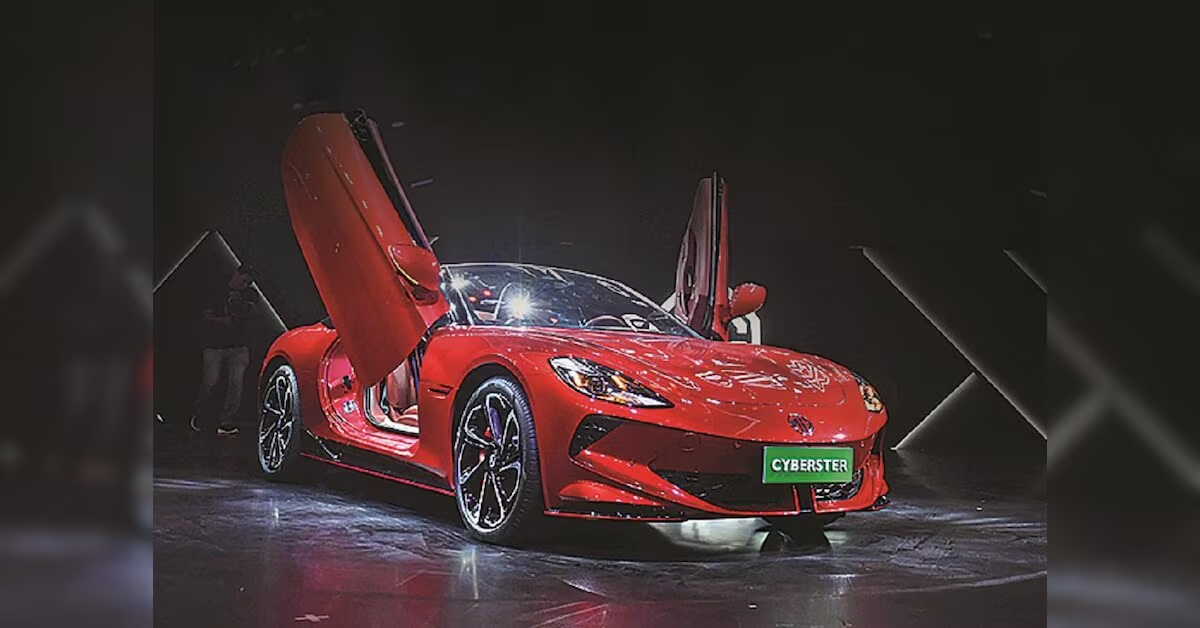
JSW Group and China’s SAIC Motor are discussing another round of capital support for JSW MG Motor India as the automaker prepares for its next growth phase. The company is expanding manufacturing capacity, localising components and adding new electric and hybrid models.
JSW and SAIC weigh another capital infusion
JSW Group and SAIC Motor are discussing fresh capital for their Indian joint venture, JSW MG Motor India, as the automaker prepares to increase production and expand its new-energy vehicle portfolio. The talks come as the company steps up investments in manufacturing, localisation and new products.
JSW currently holds a 35% stake in the venture, while SAIC owns 49%. The remaining ownership is spread among other Indian investors, dealers and employees. The partners are already investing around ₹3,500 crore in localisation, capacity expansion and new product development.
The latest discussions point to a larger ambition for MG Motor India. The company is looking beyond its existing expansion programme and assessing how additional capital could support a substantially larger manufacturing footprint and broader product range.
The exact amount of any new shareholder funding and its impact on the ownership structure has not been finalised.
MG Motor targets major production capacity expansion
Manufacturing capacity is at the centre of the company’s growth strategy.
JSW MG Motor is currently expanding its Halol plant in Gujarat, with the near-term objective of taking annual capacity to 2.2 lakh vehicles by January 2028. The company and its vendors are expected to invest around ₹6,000 crore in capacity expansion and operations as part of this phase.
The company has also indicated that the Halol facility could eventually be scaled to around 4 lakh vehicles annually. Separate reports on the latest shareholder discussions have pointed to an even more ambitious long-term possibility of reaching 1 million vehicles a year, although that remains a longer-term aspiration rather than an approved production plan.
The immediate focus is therefore on executing the existing capacity expansion before any much larger manufacturing scale-up is considered.
₹3,500 crore already committed to growth
JSW MG Motor is not starting its expansion from scratch.
The joint venture has been deploying about ₹3,500 crore towards capacity, localisation and new products. The company has also outlined a broader medium-term capital expenditure requirement of ₹3,000 crore to ₹4,000 crore for new products, manufacturing expansion and deeper localisation.
For FY27 alone, the automaker plans to invest around ₹1,400 crore across localisation, new product development and plant expansion, according to Managing Director Anurag Mehrotra.
This spending is aimed at reducing dependence on imported components while allowing the company to introduce more vehicles designed for Indian market requirements.
Higher localisation can also improve supply-chain resilience and potentially reduce exposure to currency movements and import-related costs.
New EV and hybrid models become central
The capital discussions come at a critical point for MG Motor India as it broadens its electric and hybrid vehicle portfolio.
On August 26, JSW MG Motor launched the Hector Tomahawk in both electric and plug-in hybrid versions. The launch gives the company a new product across multiple powertrain technologies as it attempts to strengthen its position in India’s changing passenger vehicle market.
The company has positioned the plug-in hybrid as part of its strategy to offer more choices beyond conventional internal-combustion vehicles and battery-electric models.
The Tomahawk is based on the company’s ADAPT platform, which is designed to support multiple powertrains. Company executives have also indicated that the platform could support extended-range electric vehicle technology in the future.
This multi-powertrain approach is important because India’s vehicle market is developing differently from markets where battery-electric vehicles dominate new-car sales.
MG wants deeper localisation by 2027
Localisation is another major part of the next growth phase.
JSW MG Motor is targeting 70% localisation for models including the Windsor and Tomahawk by 2027. The company has said localisation is increasing gradually as more components are sourced and manufactured within India.
The strategy could help the company control costs while building a stronger domestic supplier ecosystem.
It also fits with India’s broader push for local manufacturing and supply-chain development in electric mobility.
Battery manufacturing and assembly are part of this effort. The company is commissioning cell-to-pack assembly lines for battery storage, according to the Economic Times.
For MG, improving local sourcing is particularly relevant because battery systems, electronics and other high-value components account for a significant share of an electric vehicle’s cost.
Profitability remains an important milestone
The expansion is taking place while JSW MG Motor works towards profitability.
The joint venture is targeting profitability in calendar year 2027, according to reports citing company executives. The business is also targeting strong annual volume growth as new models and greater localisation begin contributing to its financial performance.
That makes the next 12 to 18 months particularly important.
The company needs to increase volumes while managing the costs associated with new model launches, factory expansion and localisation. More products can create greater revenue opportunities, but they also require spending on manufacturing, inventory, marketing and distribution.
The success of the strategy will therefore depend on whether higher volumes and improved localisation can translate into stronger operating economics.
MG is trying to regain ground in India’s EV market
The latest investment push comes as competition in India’s electric vehicle market intensifies.
JSW MG Motor has faced increasing pressure from domestic competitors, particularly Mahindra & Mahindra, in the electric passenger vehicle segment. Mint reported that MG had lost its previous number two position in India’s EV market, prompting a new product offensive.
The company is responding with a broader portfolio rather than relying on a single successful model.
The Windsor remains an important product for MG, while the new Tomahawk adds another SUV offering across electric and plug-in hybrid powertrains.
The upcoming product cycle, combined with greater local manufacturing, is intended to help MG regain momentum and build a stronger position in India’s rapidly developing new-energy vehicle market.
Ownership discussions remain separate from capital plans
The fresh funding discussions also come alongside ongoing discussions about ownership in the joint venture.
JSW has been considering the acquisition of an additional stake in MG Motor India. However, the company has said that nothing has been finalised.
The question of who contributes fresh capital and whether shareholder stakes change will therefore remain important for investors and the broader automobile industry.
Parth Jindal, director of JSW MG Motor, declined to comment on whether additional shareholder funding would alter the existing ownership structure, according to The Times of India.
For now, the central development is that JSW and SAIC are discussing additional funding while the company continues with its existing expansion programme.
What the next phase means for MG Motor India
The discussions indicate that JSW MG Motor is preparing for a substantially larger role in India’s passenger vehicle market.
The company is simultaneously expanding its Halol manufacturing capacity, increasing local sourcing, launching EV and plug-in hybrid models and preparing for higher volumes. It is also working towards profitability by 2027.
The immediate production target is 2.2 lakh vehicles annually by January 2028, while a potential 4 lakh-unit capacity at Halol represents a further expansion possibility. The much larger 1 million-unit figure remains a longer-term ambition rather than a confirmed near-term project.
Fresh capital from shareholders could accelerate this strategy, but the final funding structure, ownership implications and scale of future investment will depend on the outcome of ongoing discussions.
Key takeaways
- JSW Group and SAIC Motor are discussing additional capital for JSW MG Motor India.
- The Halol plant is being expanded to 2.2 lakh vehicles annually by January 2028.
- MG is investing heavily in localisation and new EV and plug-in hybrid models.
- The company is targeting profitability in calendar year 2027 as it seeks stronger market share.
FAQ
Why are JSW and SAIC discussing fresh capital for MG Motor India?
The partners are discussing additional funding as JSW MG Motor expands manufacturing capacity, increases localisation and launches more new-energy vehicles. The company wants to move beyond its current planned capacity and support its next phase of growth.
How much is JSW MG Motor investing in expansion?
The company and its vendors are investing around ₹6,000 crore for capacity expansion and operations, while the joint venture is already deploying around ₹3,500 crore toward localisation, capacity and new products.
What is the Halol plant’s planned capacity?
The immediate target is to increase annual capacity at the Halol plant to 2.2 lakh vehicles by January 2028. The company has also indicated potential for capacity of around 4 lakh vehicles in a later phase.
Is JSW increasing its stake in MG Motor India?
JSW is in discussions regarding a possible acquisition of an additional stake, but no final decision has been announced. The current reported ownership is 35% for JSW and 49% for SAIC, with the balance held by other Indian stakeholders.
(Internal keywords: JSW SAIC fresh capital, JSW MG Motor India, MG Motor India investment, JSW MG investment 2026, SAIC MG India, MG Motor capacity expansion, Halol plant expansion, MG Motor EV India, MG Motor PHEV, JSW MG localisation, MG Motor India profitability, Indian EV market 2026)