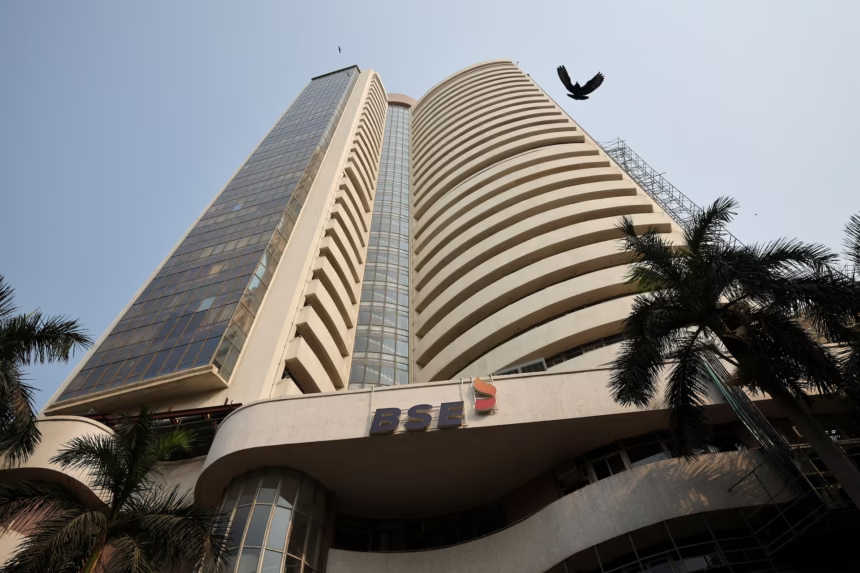
Indian stocks fell to a three-month low on September 11 as Brent crude moved above $108 a barrel and escalating Middle East tensions raised concerns over inflation, interest rates and corporate costs. The sell-off spread across most sectors, while oil producers bucked the trend.
Indian Stocks Fall as Middle East Tensions Deepen
Indian stocks came under renewed pressure on Friday, September 11, as rising crude prices and worsening geopolitical risks triggered a broad sell-off across Dalal Street. The Nifty 50 fell 0.92% to 23,261.7, while the BSE Sensex declined 0.84% to 74,272.61 as of 9:35 a.m. IST, according to Reuters. Both benchmarks touched their lowest levels since June 11.
The decline was not limited to large-cap stocks. Fifteen of the 16 major sectors were trading lower, while the Nifty mid-cap and small-cap segments fell 1.4% and 1.2%, respectively. The breadth of the decline showed that investors were responding to a broader risk-off environment rather than a problem confined to a handful of companies.
The immediate trigger was another sharp move in crude oil prices, with Brent rising above $108 a barrel. For an oil-importing economy such as India, sustained increases in crude prices can raise concerns about inflation, the current account balance and corporate input costs.
Brent Crude Crosses $108 as Shipping Risks Rise
Oil prices have moved sharply higher as the conflict in the Middle East creates fresh risks around major energy and shipping routes.
Reuters reported that Iran-aligned Houthi forces seized Yemen’s port city of Mocha on Thursday and moved along the Red Sea coast toward strategic islands. The developments have raised concerns about shipping through the Red Sea, while tanker attacks have also intensified around the Strait of Hormuz.
The Strait of Hormuz is particularly important to global energy markets because it is a major route for oil shipments from the Gulf. Any prolonged disruption can quickly change expectations for global oil supply and push prices higher.
Brent crude reached a four-month high of $109.97 per barrel in wider global trading on Friday, according to Reuters. The combination of supply concerns and geopolitical uncertainty has also pushed global bond yields higher, adding another layer of pressure on equity markets.
Why Higher Oil Prices Matter for Indian Markets
India imports a large share of the crude oil it consumes, which makes domestic markets sensitive to sharp changes in international oil prices.
When crude becomes significantly more expensive, the impact can spread through fuel costs, transportation expenses and other business inputs. It can also put pressure on India’s external balance and the rupee if the value of energy imports rises substantially.
That is why the latest oil rally has become a key concern for investors. Markets are not only watching the price of crude itself, but also assessing how long elevated prices could remain in place.
The pressure is particularly important for companies with high energy or transportation costs. Airlines, automobile companies, logistics businesses and several manufacturing industries can face margin pressure when fuel and input costs rise.
Financials, Metals and Auto Stocks Lead Declines
Friday’s selling was broad based, with several major sectors recording notable losses.
Financial stocks fell 1.4%, while the metals index declined 2.8% and auto stocks lost 1.3%, Reuters reported.
Financial companies can be affected when investors become more cautious about economic growth and interest rates. Higher bond yields can also change the relative attractiveness of equities and influence borrowing costs across the economy.
Metal stocks, meanwhile, remain sensitive to expectations around global growth and industrial demand. Auto companies can face a different pressure point because higher fuel prices and input costs can affect consumer sentiment as well as operating expenses.
The broad weakness indicates that investors were pricing in the possibility of a more difficult macroeconomic environment if the oil shock continues.
Bond Yields Add Another Layer of Pressure
The stock market decline came alongside a sharp rise in Indian government bond yields.
India’s benchmark 10-year government bond yield moved above 7% in early trading on Friday, reaching its highest level in more than three months. Reuters attributed the move to the combination of higher oil prices and rising US yields.
Higher bond yields matter for equity investors because they can make fixed-income assets relatively more attractive while also increasing financing costs.
The global bond market has also been under pressure. US 10-year Treasury yields have moved close to 5%, while longer-term US yields have reached multi-year highs. Investors are increasingly concerned that persistent energy inflation could make central banks more cautious about cutting rates, or even force some policymakers toward tighter monetary policy.
That backdrop is particularly challenging for emerging markets such as India because higher global yields can encourage investors to shift money toward developed-market assets.
Indian Stocks Head for Fifth Weekly Decline
The latest fall extends a difficult run for Indian equities.
As of Friday morning, the Nifty 50 was down 2.7% for the week, while the Sensex had declined 2.9%. Both benchmarks were on course for their fifth consecutive weekly fall.
The weakness follows several sessions of pressure linked to crude prices, foreign fund flows, global interest-rate expectations and geopolitical uncertainty.
The previous session had already seen the Indian benchmarks close near three-month lows. On September 9, the Sensex fell more than 800 points and the Nifty declined 0.86% as Brent crude crossed $100 a barrel and selling intensified in IT stocks.
The latest escalation means investors now have to assess whether the oil shock remains temporary or develops into a longer-lasting threat to inflation and economic growth.
Oil Producers Buck the Broader Market Sell-Off
While most sectors moved lower, oil producers benefited from the sharp increase in crude prices.
ONGC shares rose 1.3% and Oil India gained 0.7% in Friday’s trading, according to Reuters. Higher crude prices can support the earnings outlook for upstream oil producers because their revenues are closely linked to international oil prices.
This divergence highlights how the same geopolitical event can affect different parts of the stock market in opposite ways.
Companies that consume large quantities of fuel can face higher expenses, while upstream energy producers may benefit from higher selling prices. Refiners, fuel retailers and other energy businesses can experience more complicated effects depending on margins, government policy and the relationship between crude prices and domestic fuel prices.
For investors, sector-level performance will therefore remain important as the oil rally develops.
What Investors Are Watching Next
The immediate focus is likely to remain on developments in the Middle East and their impact on crude oil and shipping routes.
Investors are also watching global bond yields and expectations for central-bank policy. Reuters reported that federal funds futures were indicating a greater than 70% chance of a US rate hike the following week, according to HDFC Securities’ Devarsh Vakil.
For India, the direction of crude oil prices, the rupee, foreign portfolio flows and domestic bond yields will remain important market indicators.
The key question is whether geopolitical tensions ease enough for oil prices to retreat, or whether disruptions around major shipping routes keep energy prices elevated. A sustained oil shock would create a tougher environment for inflation-sensitive sectors and could keep pressure on Indian equities.
For now, Friday’s market action reflects a clear shift toward caution, with investors balancing geopolitical risk against the possibility of tighter global financial conditions.
Key Takeaways
- The Nifty 50 fell 0.92% to 23,261.7 and the Sensex dropped 0.84% to 74,272.61 as of 9:35 a.m. IST on Friday.
- Both Indian benchmarks touched their lowest levels since June 11.
- Brent crude moved above $108 a barrel amid heightened Middle East and shipping-route concerns.
- ONGC and Oil India gained as higher crude prices supported upstream energy stocks.
FAQ
Why did Indian stocks fall on September 11?
Indian stocks fell mainly because Brent crude prices moved above $108 a barrel amid escalating Middle East tensions. Higher oil prices raised concerns about inflation, interest rates and the potential impact on India’s economy and corporate costs.
What happened to the Nifty and Sensex?
As of 9:35 a.m. IST on September 11, the Nifty 50 was down 0.92% at 23,261.7 and the Sensex was down 0.84% at 74,272.61. Both indices touched their lowest levels since June 11.
Why is rising crude oil a concern for India?
India is highly dependent on imported crude oil. A sustained increase in global oil prices can raise the country’s import bill and create pressure on inflation, the rupee and businesses that rely heavily on fuel and transportation.
Which Indian stocks benefited from higher oil prices?
Upstream oil producers were among the exceptions to Friday’s broader market decline. ONGC gained 1.3% and Oil India rose 0.7%, as higher crude prices can improve the earnings outlook for oil producers.
(Internal keywords: Indian stocks today, Nifty Sensex September 11 2026, Indian stock market crash, Brent crude oil price, Middle East tensions, Indian stock market today, Nifty 50 today, Sensex today, crude oil and Indian stocks, India market news)