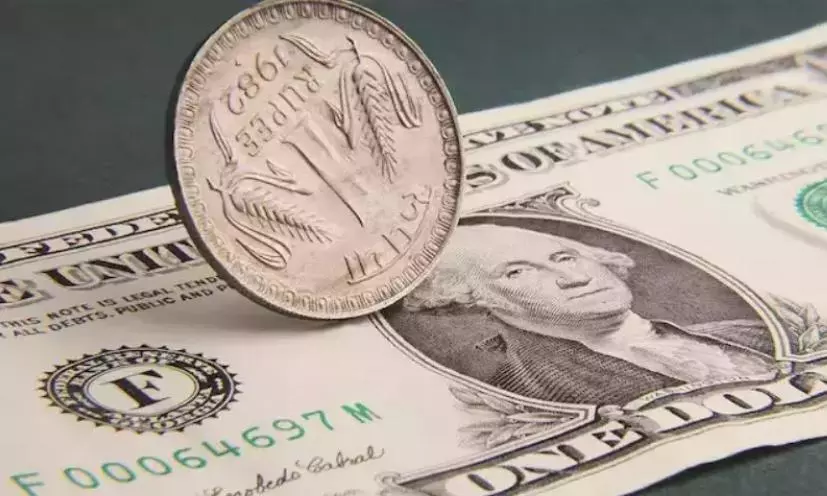
The Indian rupee weakened to 95.79 against the US dollar on Friday as crude oil prices stayed above $108 a barrel and foreign portfolio investors continued selling Indian equities. Rising US bond yields and escalating Middle East tensions added to pressure on the currency.
Rupee Slips to 95.79 Against US Dollar
The Indian rupee came under fresh pressure on September 11, with the currency falling 27 paise in early trading to touch 95.79 against the US dollar. The move extended a three-session losing streak as elevated crude prices, foreign portfolio outflows and broader risk aversion weighed on the domestic currency.
The rupee had closed at 95.44 against the dollar on Thursday after losing 38 paise during the session. Before the latest decline, the currency had already weakened sharply from levels seen earlier in September, when it had briefly strengthened toward 94.30 following large overseas Indian deposit inflows.
The latest fall reflects a combination of domestic and global pressures. Oil has become the immediate concern because India imports most of the crude oil it consumes. At the same time, rising US Treasury yields are making dollar assets more attractive and adding pressure to emerging-market currencies.
Crude Oil Stays Above $108 as Middle East Risks Rise
The biggest pressure point for the rupee is the sharp increase in international crude oil prices.
Brent crude rose above $108 a barrel on Friday and reached levels close to $110 during Asian trading. AP reported Brent at $108.59 a barrel in early Friday trading, up 0.9%, while Reuters reported that prices had approached $110 amid escalating tensions in the Middle East.
The oil rally has accelerated during the week as concerns grow over disruptions to major energy and shipping routes. Brent has risen nearly 12% this week after gaining about 8% the previous week, according to Reuters.
For India, a sustained oil rally can quickly become a currency concern. Higher crude prices increase the country’s import bill and can put pressure on the external balance. If the rise also feeds into domestic inflation, it can complicate monetary policy and affect expectations for interest rates.
Foreign Investors Resume Selling Indian Equities
Foreign portfolio investor selling is another factor weighing on the rupee.
Foreign investors pulled out Rs 7,443 crore from Indian equities during the first week of September, reversing the positive investment trend seen during the previous two months. Rising crude prices, stronger US bond yields and a firmer dollar were among the factors cited for the change in investor sentiment.
The selling has continued during September. On September 9, foreign institutional investors were net sellers of Indian equities worth Rs 583 crore, according to exchange data, while domestic institutional investors bought shares worth Rs 1,509 crore on a net basis.
The impact goes beyond the stock market. When foreign investors sell Indian assets, they typically need to convert rupees into dollars or other foreign currencies, creating additional demand for the dollar. That can add downward pressure on the rupee, particularly when the currency is already facing a large external shock from higher oil prices.
US Bond Yields Add Pressure on Rupee
The dollar’s strength is also being influenced by movements in the US bond market.
US Treasury yields have risen sharply as investors reassess inflation and interest-rate expectations. The US 10-year Treasury yield has moved close to 5%, while markets are pricing a significantly higher probability of a Federal Reserve rate hike at its upcoming meeting.
Higher US yields can make dollar-denominated assets more attractive to global investors. This can encourage capital to move toward US markets and away from emerging markets, putting pressure on currencies such as the rupee.
For India, the combination is particularly challenging. A weaker rupee can make imported commodities more expensive, while higher global yields can increase the cost of financing for companies and governments.
The currency is therefore being squeezed from several directions at once: expensive crude oil, foreign portfolio selling, higher US yields and geopolitical uncertainty.
RBI Steps In as Currency Volatility Increases
The Reserve Bank of India is also watching the currency closely.
Reuters reported that the RBI likely intervened in the foreign exchange market on Friday to limit the rupee’s decline. Three foreign exchange traders at banks and another trader at a brokerage said state-run banks were seen offering dollars, likely on behalf of the central bank.
The rupee fell as much as 0.4% to 95.7925 before recovering slightly to 95.7275 in the trading cited by Reuters.
The intervention indicates that the RBI remains prepared to smooth excessive volatility in the currency market. However, the central bank cannot directly control global crude prices or US interest-rate expectations.
The challenge is therefore not simply defending a particular rupee level. It is managing volatility while allowing the exchange rate to respond to genuine changes in India’s external conditions.
Earlier this month, the RBI had helped support the rupee as large overseas Indian deposit inflows boosted dollar availability. The currency had climbed to around 94.30 last week before the latest oil shock reversed part of those gains.
Why the Rupee’s Fall Matters for India
The rupee’s decline matters because exchange-rate movements affect several parts of the economy.
A weaker rupee raises the domestic cost of imported goods when international prices remain unchanged. The effect is particularly important for commodities such as crude oil, where India has substantial import requirements.
Higher oil prices combined with a weaker rupee can therefore increase the rupee cost of energy imports more sharply than either factor would on its own.
Businesses that rely heavily on imported raw materials or energy may also face higher costs. Airlines, transport companies and some manufacturing industries can be particularly sensitive to fuel and input prices.
At the same time, exporters can benefit from a weaker rupee because overseas revenues translate into more rupees. The impact is not uniform across the economy, however, and the benefits depend on how much of an industry’s revenue and cost base is exposed to foreign currencies.
Stock Market Weakness Deepens Currency Pressure
The rupee’s decline is taking place alongside a broader sell-off in Indian equities.
On Friday morning, Indian benchmark indices fell sharply as crude prices remained above $108 and global markets weakened. The Nifty 50 dropped around 1% at the open, while the Sensex fell more than 700 points in early trading.
The market weakness adds another layer of pressure because sustained foreign selling in equities can translate into additional dollar demand.
The latest decline also follows a difficult period for Indian stocks. The Sensex and Nifty have been under pressure as investors assess geopolitical risks, expensive oil, global interest rates and foreign capital flows.
There is also a clear contrast within foreign investment flows. While foreign investors have been selling listed Indian shares, they have continued to show interest in India’s primary market. Economic Times reported that foreign institutional investors had withdrawn nearly Rs 2.8 lakh crore from India’s secondary equity market during 2026 while investing more than Rs 47,000 crore in IPOs.
That suggests the current selling is not necessarily a complete withdrawal from India’s long-term growth story. Instead, investors appear to be becoming more selective amid higher volatility and changing global conditions.
What Could Happen to the Rupee Next
The near-term direction of the rupee will depend heavily on crude oil, global yields and developments in the Middle East.
If oil prices remain close to or above $110, India’s import bill could face additional pressure. Continued foreign selling could further increase demand for dollars, while higher US Treasury yields could keep global investors cautious toward emerging-market currencies.
On the other hand, any easing of geopolitical tensions or improvement in global risk sentiment could reduce pressure on crude and emerging-market currencies.
The RBI’s response will also remain important. The central bank has significant foreign-exchange reserves and has previously intervened to limit excessive volatility. However, market forces can remain powerful when several external pressures occur simultaneously.
For now, the rupee’s move toward 96 per dollar is an important market signal. Investors are closely watching whether the current weakness remains a short-term reaction to the oil shock or develops into a more prolonged period of currency pressure.
Key Takeaways
- The rupee fell 27 paise to 95.79 against the US dollar in early trading on September 11.
- Brent crude remained above $108 a barrel and approached $110 as Middle East tensions intensified.
- Foreign portfolio investors withdrew Rs 7,443 crore from Indian equities in the first week of September.
- Rising US Treasury yields and higher oil prices are adding to pressure on the rupee and Indian financial markets.
FAQ
Why did the Indian rupee fall to 95.79?
The rupee weakened because of a combination of high crude oil prices, foreign portfolio outflows, rising US Treasury yields and increased geopolitical risk. Brent crude remained above $108 a barrel, increasing concerns over India’s import bill.
How do high crude oil prices affect the rupee?
India imports most of its crude oil requirements, so higher global oil prices increase the country’s dollar demand and import costs. A sustained rise in crude can therefore put pressure on the rupee and potentially affect inflation and the external balance.
Are foreign investors still investing in India?
Foreign investors have been selling Indian listed equities, but their activity is not uniform across the market. FIIs withdrew nearly Rs 2.8 lakh crore from India’s secondary equity market in 2026 while investing more than Rs 47,000 crore in IPOs, indicating continued interest in selected new companies and sectors.
Is the RBI supporting the rupee?
Reuters reported that the RBI likely intervened through state-run banks selling dollars as the rupee weakened on Friday. Such intervention is generally aimed at reducing excessive currency volatility rather than permanently fixing the rupee at a specific exchange rate.
(Internal keywords: rupee falls today, rupee at 95.79, Indian rupee dollar rate, USD INR today, crude oil price today, Brent crude above $108, FPI outflows India, foreign investors India, RBI rupee intervention, Indian economy news, rupee depreciation 2026, India oil imports)