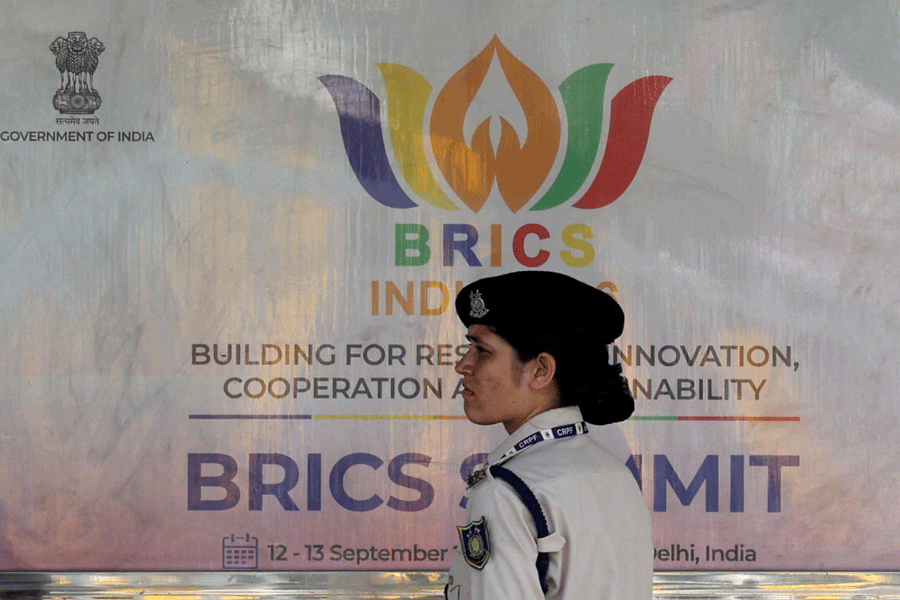
India is pushing for a digital currency and payments link among BRICS members ahead of the September 12-13 summit in New Delhi. The proposal aims to make cross-border payments faster and cheaper, but political tensions and technical differences could slow progress.
India Pitches BRICS Digital Currency Link
India is pushing to connect central bank digital currencies, or CBDCs, across BRICS countries as leaders prepare to meet in New Delhi on September 12 and 13. The proposal is focused on improving cross-border payments and trade rather than creating a single BRICS currency.
Two sources familiar with the discussions told Reuters that India is advocating a system that could link the official digital currencies of BRICS members. The Reserve Bank of India had proposed linking the group’s digital currencies to facilitate cross-border trade, with the issue now moving closer to the leaders’ summit.
The proposal comes as India chairs BRICS in 2026 and prepares to host the 18th BRICS Summit. The bloc currently has 11 members: Brazil, China, Egypt, Ethiopia, India, Indonesia, Iran, Russia, Saudi Arabia and the United Arab Emirates, along with South Africa.
BRICS Summit to Focus on Cross-Border Payments
The digital payments proposal is part of a broader effort to improve financial cooperation within BRICS.
India’s position is important because officials have distinguished between creating a new common currency and building infrastructure that allows existing national currencies and payment systems to work more efficiently across borders.
A senior Indian government official previously clarified that creating a BRICS currency or pursuing formal de-dollarisation was not the immediate objective. Instead, the focus was on developing a cross-border digital payments ecosystem that could allow transactions using members’ respective national currencies.
That distinction matters. A shared payment network would be significantly different from replacing national currencies with a single BRICS currency.
The proposed approach could eventually allow businesses and financial institutions in participating countries to settle transactions more efficiently without relying on the same traditional cross-border payment channels for every transaction.
China Creates a Major Challenge for India
The biggest obstacle may not be technology but trust between major BRICS economies.
India and China have been working toward a diplomatic thaw, but their economic relationship remains constrained by security concerns, investment restrictions and regulatory barriers. Chinese President Xi Jinping is scheduled to visit India for the BRICS summit, his first visit to the country in seven years.
Reuters reported that businesses in both countries continue to face hurdles involving investments, visas, industrial equipment and technology transfers. India has also maintained restrictions and scrutiny around certain Chinese investments and financial technology initiatives because of national security concerns.
Those tensions create a difficult backdrop for deeper financial integration.
A system connecting digital currencies requires countries to agree on technical standards, settlement procedures, data handling, regulatory oversight and mechanisms for managing currency conversion. Political disagreements can complicate each of those areas.
Why CBDC Interoperability Matters
Central bank digital currencies are digital forms of sovereign money issued by central banks. Unlike privately issued cryptocurrencies, CBDCs are created and backed within the monetary systems of individual countries.
Connecting CBDCs across borders could potentially reduce friction in international transactions.
For businesses trading within BRICS, the attraction is straightforward. Faster settlement can reduce the time money remains in transit, while more direct payment arrangements could potentially reduce some transaction costs.
India already has one of the world’s most developed instant payment ecosystems through UPI. The country has also been working to expand UPI’s international reach through agreements with other nations.
BRICS discussions are now looking at whether similar interoperability can be developed across a much larger group of economies with very different financial systems.
The challenge is that a system designed for domestic instant payments cannot simply be copied internationally. Each country has different rules governing currencies, banking, capital flows and financial data.
UPI Could Become Part of Wider BRICS Network
India’s experience with UPI gives it a strong position in discussions around cross-border digital payments.
An Economic Times editorial noted that India has been advocating greater integration of UPI and other digital payment systems among BRICS countries. The broader objective would be to make international payments more efficient while supporting greater use of national currencies.
UPI already processes large volumes of domestic digital transactions in India and has been connected with payment systems in several foreign markets.
The BRICS proposal could take the idea further by creating interoperability among national payment systems rather than requiring every country to adopt the same platform.
Other payment networks could also play a role. A Times of India report on a BRICS digital asset roundtable in Delhi said discussions would include linking national digital currencies and payment networks, including India’s UPI and Brazil’s Pix.
Whether that becomes an operational system will depend on agreements between participating central banks and governments.
Currency Swap Arrangements Remain a Hurdle
Another major issue is how countries would manage differences in trade flows and currency demand.
Reuters reported that currency-swap arrangements could be required as part of a functioning cross-border system. Such mechanisms can provide liquidity between participating currencies and help manage situations where trade flows are heavily unbalanced.
This becomes more complicated when the participating economies have different levels of financial openness.
For example, countries may have different rules governing capital movement, foreign exchange and conversion between currencies. Some BRICS members also face sanctions or restrictions that could affect their ability to participate in international financial infrastructure.
The proposed system therefore requires much more than simply connecting digital wallets or payment applications.
Central banks would need to establish common technical and regulatory standards before meaningful large-scale transactions could take place.
Political Divisions Could Slow Digital Payments Plan
BRICS has expanded significantly in recent years, increasing its economic and political weight but also making consensus more complicated.
The current 11-member group represents about 49.5% of the world’s population, 40% of global GDP and 26% of global trade, according to India’s Press Information Bureau.
That scale gives any successful financial initiative potentially significant importance.
At the same time, the members have different relationships with the United States, different monetary systems and different geopolitical priorities.
Reuters reported that tensions between Iran and the UAE, as well as India’s concerns about deeper financial integration with China, are among the political complications surrounding the proposal.
This means the summit may produce agreement on principles without immediately producing a fully operational digital currency network.
India Is Not Proposing a New BRICS Currency
One of the most important points for businesses and investors is that the current Indian proposal should not be described as the launch of a BRICS currency.
India has repeatedly framed the initiative around payment interoperability and easier transactions using national currencies.
That is considerably different from creating a common currency that would replace the rupee, yuan, real, ruble or other national currencies.
The distinction also matters when discussing the US dollar.
While BRICS countries have discussed reducing transaction dependence on the dollar, Indian officials have indicated that the current digital payments proposal is about making cross-border transactions more efficient rather than immediately replacing the dollar as the world’s dominant reserve currency.
For now, the proposal is better understood as an attempt to build alternative payment connectivity.
What to Watch at the Delhi BRICS Summit
The September 12-13 summit will provide the next major test for India’s proposal.
The key question is whether BRICS leaders can move beyond broad support for digital payments and agree on practical mechanisms for interoperability.
India’s presidency has placed economic and financial cooperation among the group’s priorities. The government says more than 350 meetings and high-level engagements have been held across India during its 2026 chairship, with financial and economic cooperation forming one of the bloc’s three main pillars.
A concrete agreement on payment-system connectivity would give the initiative momentum.
However, political differences, technical compatibility and currency-management issues mean implementation is likely to take longer than the announcement of a framework.
For India, the initiative is also a chance to showcase UPI and its digital payments infrastructure on a much larger international platform.
BRICS Digital Payments Plan Faces Long Road Ahead
India’s push to link BRICS digital currencies comes at a time when the group is seeking greater financial cooperation while navigating major internal differences.
The proposal has a practical objective: making cross-border payments faster, cheaper and more accessible. But turning that objective into a functioning system will require central banks to solve difficult questions around technology, regulation, currency liquidity and data.
The presence of Chinese President Xi Jinping in New Delhi adds another layer to the discussions. India and China are attempting to improve bilateral relations, but their economic relationship still carries significant strategic concerns.
The summit could therefore deliver an important political signal without producing an immediate digital currency network.
For now, the most significant development is that India is placing CBDC interoperability and cross-border digital payments firmly on the BRICS financial agenda. The next step will be determining whether the expanded group can turn that ambition into a workable system.
Key Takeaways
- India is pushing for greater interoperability between BRICS central bank digital currencies and payment systems.
- The proposal is not a confirmed plan to create a single BRICS currency.
- Political tensions, particularly between India and China, could complicate deeper financial integration.
- The September 12-13 BRICS summit in New Delhi will be an important test of whether the proposal can move toward practical implementation.
FAQ
Is BRICS creating a new digital currency?
No confirmed launch of a single BRICS digital currency has been announced. India’s current proposal focuses on connecting national digital currencies and payment systems to make cross-border transactions more efficient.
What is India proposing at the BRICS summit?
India is pushing for greater interoperability between central bank digital currencies and national payment systems among BRICS members. The objective is to facilitate faster and potentially cheaper cross-border payments using participating countries’ national currencies.
Why is China a hurdle for India’s BRICS digital payments plan?
India and China have ongoing economic and security concerns despite a recent diplomatic thaw. Restrictions around investment, technology, financial services and national security could make deeper financial integration more difficult.
Will the BRICS payment system replace the US dollar?
India’s current proposal is not presented as an immediate replacement for the US dollar. The focus is on improving cross-border payment connectivity and enabling transactions using national currencies.
(Internal keywords: BRICS digital currency, BRICS digital payments, India BRICS summit 2026, BRICS CBDC, cross-border digital payments India, UPI BRICS, India China BRICS, BRICS currency, BRICS summit Delhi, digital rupee international payments, CBDC interoperability, BRICS financial cooperation)