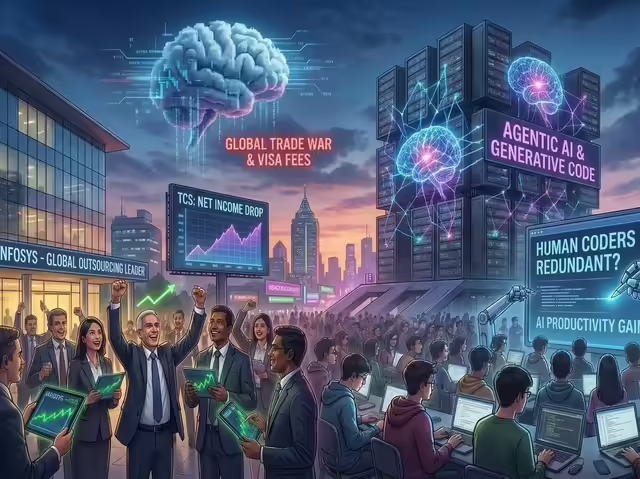
AI-driven cost cutting is rapidly reshaping India’s IT outsourcing model as global clients demand faster delivery, leaner teams, and lower operational costs. Indian technology firms are now restructuring traditional service models around automation, generative AI tools, and outcome-based contracts.
AI-driven cost cutting is fundamentally changing India’s IT outsourcing industry as global corporations increasingly expect technology partners to deliver more work with smaller teams and greater automation. Indian IT companies that once relied heavily on manpower-based service delivery are now being pushed toward AI-enabled operational models focused on productivity, efficiency, and cost optimization.
The shift is becoming visible across software development, customer support, cloud operations, cybersecurity, data analytics, and enterprise technology management. Global clients are adopting generative AI tools internally while simultaneously asking outsourcing vendors to reduce project costs and accelerate delivery timelines.
This transition marks one of the biggest structural changes in India’s IT services sector in decades. Industry leaders believe artificial intelligence will remain central to future outsourcing growth, but the economics of traditional offshore service models are rapidly evolving.
Traditional IT Outsourcing Models Face Structural Pressure
India’s outsourcing success was historically built on large-scale engineering talent and labor cost advantages. Global corporations outsourced software development, maintenance, testing, and support functions to Indian firms because companies could deploy large teams at competitive costs.
Artificial intelligence is now disrupting that equation. Generative AI systems can automate portions of coding, testing, documentation, technical support, and workflow management that previously required significant human involvement.
As a result, global enterprises are renegotiating outsourcing contracts with stronger focus on business outcomes and operational efficiency rather than team size. Clients increasingly expect vendors to use AI internally to reduce costs while maintaining or improving delivery quality.
Industry analysts say this is placing pressure on traditional billing models tied to employee headcount and hourly service structures. Large outsourcing contracts still exist, but profitability is becoming more difficult as clients push aggressively for productivity gains.
Several Indian IT firms are already redesigning service delivery systems around automation and AI-assisted workflows.
Generative AI Adoption Accelerates Across Enterprises
Global businesses across banking, healthcare, retail, telecom, manufacturing, and financial services are rapidly integrating generative AI into operations. Companies are deploying AI copilots for software engineering, customer support automation, enterprise search, workflow management, and internal knowledge systems.
This widespread enterprise AI adoption is directly influencing outsourcing expectations. Clients want IT vendors capable of deploying AI-driven efficiencies at scale rather than simply supplying large engineering teams.
Indian outsourcing companies are responding by building internal AI platforms, investing in automation systems, and partnering with global cloud and AI providers. Firms are also retraining employees to work alongside AI-assisted development environments.
However, the transition requires major investments. Companies must spend heavily on AI infrastructure, cloud capabilities, cybersecurity systems, and employee upskilling while simultaneously managing pricing pressure from clients.
This is creating a difficult balancing act where firms must modernize operations quickly without damaging profitability.
Mid-Level Technology Roles Face Growing Automation Pressure
The rise of AI-driven outsourcing is also reshaping workforce structures inside India’s technology industry. Many repetitive operational functions traditionally handled by mid-level software engineers and support professionals are increasingly being automated.
Tasks such as code generation, quality assurance testing, technical documentation, customer query handling, and routine maintenance are now partially assisted by AI tools. Companies are gradually reducing dependence on manpower-heavy delivery systems in these areas.
Industry observers note that the transition is not happening entirely through large layoffs. Instead, firms are slowing hiring in selected roles, restructuring internal teams, and prioritizing specialized AI-related skills.
Demand remains strong for professionals working in cybersecurity, cloud architecture, AI operations, data engineering, and enterprise transformation consulting. Companies now value employees who can manage AI systems, interpret outputs, and solve complex business problems rather than simply execute repetitive workflows.
This workforce transition may permanently alter the traditional pyramid-shaped hiring structure that defined India’s IT outsourcing industry for years.
AI Cost Optimization Creates New Competitive Landscape
Artificial intelligence is not only reducing operational costs but also changing competitive dynamics within the outsourcing industry. Companies capable of delivering AI-enabled efficiency gains may gain market share even if overall workforce expansion slows.
Indian IT firms are increasingly positioning themselves as digital transformation and AI consulting partners instead of low-cost outsourcing vendors. Businesses are focusing more heavily on enterprise modernization, cloud migration, cybersecurity, and AI governance services.
At the same time, smaller outsourcing firms may struggle to compete because advanced AI adoption requires significant financial investment and technical capability.
Global clients are also becoming more selective when awarding large outsourcing contracts. Enterprises want vendors with proven AI expertise, strong cybersecurity infrastructure, and scalable automation capabilities.
Analysts believe future outsourcing deals will increasingly combine AI deployment, cloud transformation, and long-term operational optimization instead of traditional staffing-based service arrangements.
India’s IT Industry Enters a New Transformation Phase
India’s IT services sector remains one of the country’s largest export industries and white-collar employment generators. The global demand for technology transformation services is still growing, but the delivery model is clearly changing.
Artificial intelligence is pushing outsourcing firms toward leaner operational structures and higher-value consulting capabilities. Companies that adapt quickly to AI-enabled delivery may strengthen their global competitiveness despite ongoing pricing pressure.
However, the transition also raises broader concerns about workforce adaptation, skill development, and employment structures across the technology sector.
Industry experts believe the next phase of outsourcing growth will depend less on workforce scale and more on how effectively companies integrate AI into enterprise operations while maintaining trust, security, and service quality.
Takeaways
- AI-driven cost cutting is reshaping India’s traditional IT outsourcing model
- Global clients now expect faster delivery with smaller and more automated teams
- Mid-level operational technology roles face growing automation pressure
- Indian IT firms are shifting toward AI consulting and digital transformation services
FAQ
Why is AI changing India’s IT outsourcing industry?
AI tools can automate many repetitive technology tasks, allowing companies to deliver services with smaller teams and greater efficiency.
What types of jobs are most affected?
Routine coding, software testing, technical support, and documentation-related roles are seeing the strongest automation pressure.
Are outsourcing companies still hiring employees?
Yes. Hiring remains active in areas such as AI operations, cloud computing, cybersecurity, and enterprise transformation consulting.
How are global clients changing outsourcing contracts?
Clients increasingly focus on productivity gains, automation, and business outcomes instead of manpower-based billing structures.