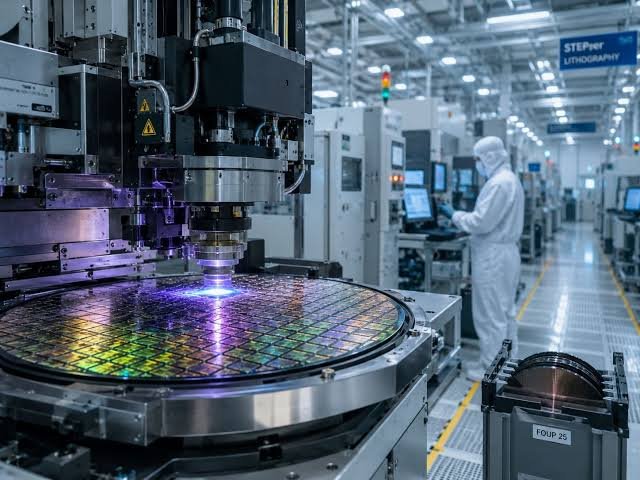
China’s manufacturing sector has returned to growth, supported by surging global demand for AI-related products and advanced technology exports. While the recovery signals renewed industrial momentum, economists caution that weak domestic consumption and property sector challenges continue to weigh on the broader economy.
China’s factory activity returned to expansion in June, providing fresh evidence that the country’s manufacturing sector is benefiting from the global artificial intelligence boom. The official Manufacturing Purchasing Managers’ Index (PMI) rose to 50.3 in June from 50.0 in May, moving above the threshold that separates expansion from contraction. The improvement was driven by strong demand for chips, computers, servers and other AI-related products, helping Chinese manufacturers offset weakness in traditional export sectors and slower domestic demand.
The latest data suggest that China’s high-tech manufacturing industry is becoming an increasingly important engine of economic growth. However, economists say the recovery remains uneven, with consumer spending, the property market and business confidence still facing significant challenges.
AI Exports Drive Manufacturing Recovery
One of the biggest contributors to the rebound has been rising global investment in artificial intelligence infrastructure.
As governments and technology companies continue investing heavily in AI, demand for semiconductors, automated data processing equipment, networking hardware and data centre components has increased sharply. China, which remains one of the world’s largest manufacturing hubs, has benefited from this trend through higher exports of technology products.
Recent trade data showed strong growth in shipments of AI-related equipment, while exports of more traditional products such as furniture and footwear remained comparatively weak. This highlights a growing shift in China’s export mix toward higher-value manufacturing supported by advanced technology.
The official PMI also showed improvements in production and new orders, indicating that factories have been receiving stronger business despite continued uncertainty in the global economy.
Manufacturing PMI Signals Expansion but Recovery Remains Uneven
A Manufacturing Purchasing Managers’ Index above 50 indicates that factory activity is expanding, while a reading below 50 signals contraction.
China’s June PMI of 50.3 represents a modest improvement but carries significant importance because it marks a return to expansion after factory activity had stalled in May. Private-sector surveys also showed continued manufacturing growth, with factory output rising for the seventh consecutive month and the strongest quarterly performance since late 2020.
Despite these encouraging indicators, analysts point out that much of the recent strength has come from export-oriented industries rather than domestic consumption.
China’s property market remains under pressure, household spending has yet to recover fully and many businesses continue to face deflationary pricing conditions. These structural issues limit the pace of the broader economic recovery even as high-tech manufacturing performs well.
Global AI Investment Is Reshaping Industrial Demand
Artificial intelligence has become one of the most powerful drivers of industrial production worldwide.
The rapid expansion of cloud computing, AI software, large language models and data centres has created unprecedented demand for advanced chips, servers, networking equipment and electronic components. Chinese manufacturers have been major suppliers of many of these products.
This trend is also influencing manufacturing activity across other Asian economies, including Japan and South Korea, where factories producing semiconductors and electronics have reported stronger production levels. Global factory surveys indicate that AI-related investment is helping manufacturers offset some of the economic pressures created by geopolitical tensions, higher energy costs and changing trade patterns.
Industry experts believe AI infrastructure spending will remain a key growth driver over the coming years as businesses continue expanding digital capabilities.
Challenges Continue Beyond High-Tech Manufacturing
While AI exports are supporting China’s industrial sector, policymakers continue to face broader economic challenges.
Domestic demand remains relatively weak as consumers remain cautious about spending. The prolonged slowdown in the property sector continues to affect household confidence, while many traditional manufacturers are experiencing slower order growth compared with companies serving the technology sector.
Factory gate prices have also remained under pressure, reflecting persistent deflation in parts of the manufacturing industry. Employment conditions have improved modestly, but economists say sustainable long-term growth will require stronger domestic consumption rather than relying primarily on exports.
The Chinese government has indicated that additional fiscal and monetary measures could be introduced if economic momentum weakens during the second half of the year.
Why Global Businesses Are Watching China’s Manufacturing Recovery
China remains the world’s largest manufacturing economy and an essential part of global supply chains.
Improving factory activity has implications for commodity markets, shipping companies, technology firms and multinational manufacturers worldwide. Stronger industrial production can increase demand for raw materials such as copper, aluminium and steel while supporting international trade volumes.
For technology companies, continued growth in AI infrastructure creates opportunities throughout the semiconductor, cloud computing and electronics industries. Investors are also closely monitoring China’s manufacturing performance because it often provides an early indication of broader global economic trends.
Although uncertainties remain, the latest factory data suggest that AI-driven manufacturing is providing an important source of resilience for China’s economy during a period of uneven global growth.
Key Takeaways
- China’s official manufacturing PMI rose to 50.3 in June, returning the sector to expansion.
- Strong global demand for AI-related products has boosted factory production and exports.
- High-tech manufacturing is outperforming many traditional export industries.
- Weak domestic demand and property market challenges continue to limit broader economic recovery.
Frequently Asked Questions
Q1. What does China’s manufacturing PMI of 50.3 mean?
A PMI reading above 50 indicates that manufacturing activity is expanding. June’s reading of 50.3 shows factories returned to growth after stagnating in May.
Q2. Why is AI boosting China’s factories?
Global investment in artificial intelligence has increased demand for semiconductors, computers, servers and other technology products manufactured in China.
Q3. Is China’s overall economy fully recovering?
Not yet. While manufacturing has strengthened, domestic consumption, the property sector and consumer confidence remain relatively weak.
Q4. Why is China’s manufacturing performance important globally?
China is one of the world’s largest manufacturing economies. Changes in its factory activity affect global supply chains, commodity demand, technology industries and international trade.
(Internal keyword suggestions: China factory activity, China PMI June 2026, AI manufacturing demand, China manufacturing growth, China economy news, AI exports China, global semiconductor demand, China’s factory expansion, manufacturing PMI China, AI-driven exports)