
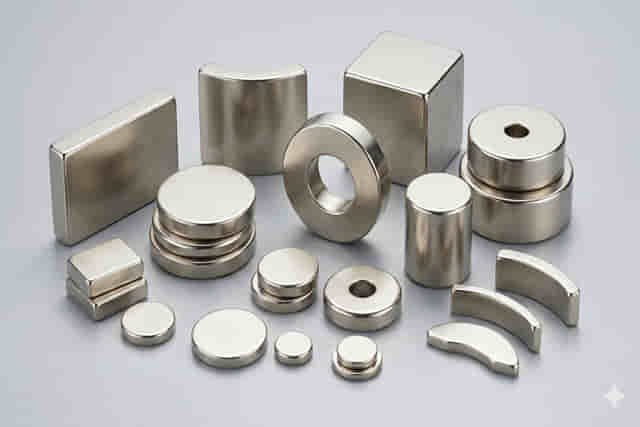
Coal India Limited has received a Letter of Intent from the Ministry of Heavy Industries to establish a rare earth permanent magnet manufacturing facility with an annual capacity of 1,200 tonnes. The project marks a significant expansion of the state-owned company’s business beyond coal mining and supports India’s efforts to reduce dependence on imported critical materials.
Coal India Rare Earth Magnet Project: What Happened?
Coal India Limited (CIL) announced on November 19, 2026, that a consortium led by the company had received a Letter of Intent (LoI) from the Ministry of Heavy Industries for setting up a manufacturing facility for sintered rare earth permanent magnets.
The company is leading the consortium in partnership with the Non-Ferrous Materials Technology Development Centre (NFTDC). According to its regulatory filing, the consortium has been declared the L2 bidder under the government’s Scheme to Promote Manufacturing of Sintered Rare Earth Permanent Magnet.
The proposed facility will have an annual manufacturing capacity of 1,200 tonnes, also expressed as 1,200 tonnes per annum (TPA). It will be established through a Special Purpose Vehicle (SPV).
The project is expected to be executed over seven years, including two years for pre-construction activities and five years of operations. The LoI is an important step towards the project, although it does not mean that commercial manufacturing has already started. NSE India Archives+2
Why Coal India Is Entering Rare Earth Magnet Manufacturing
Coal India has traditionally been associated with coal production and the supply of fuel to India’s power and industrial sectors. Its participation in rare earth magnet manufacturing reflects a broader diversification strategy as the country increasingly focuses on critical minerals and advanced manufacturing.
Rare earth permanent magnets are essential components in several industries. They are used in electric vehicles, wind turbines, consumer electronics, aerospace equipment and defence systems.
Among the most widely used varieties are neodymium-iron-boron (NdFeB) magnets. These magnets offer high magnetic strength in a relatively compact size, making them particularly important for electric motors and other high-performance applications.
As demand for electric mobility, renewable energy and advanced electronic equipment increases, reliable access to these magnets has become an important industrial priority.
For Coal India, the proposed project creates an opportunity to participate in a manufacturing segment that is different from its traditional mining business. It also connects the company with India’s broader efforts to build domestic capabilities in strategic materials.
India’s ₹7,280 Crore Rare Earth Magnet Manufacturing Scheme
Coal India’s project is part of a larger government initiative designed to establish a domestic rare earth permanent magnet manufacturing ecosystem.
The Union Cabinet approved the Scheme to Promote Manufacturing of Sintered Rare Earth Permanent Magnet in November 2025, with a total financial outlay of ₹7,280 crore.
The scheme aims to create an integrated manufacturing capacity of 6,000 metric tonnes per annum across India. It plans to allocate this capacity among five beneficiaries through a competitive bidding process, with each beneficiary eligible for up to 1,200 tonnes per annum.
The programme includes a two-year period for establishing manufacturing facilities, followed by five years of production-linked incentive support. The government has designed the initiative to encourage companies to develop domestic manufacturing capabilities rather than depend heavily on imported finished magnets.
Coal India’s selection as an L2 bidder places it among the companies participating in this national manufacturing push. Press Information Bureau+1
China Dependence and India’s Critical Mineral Strategy
One of the major reasons behind India’s rare earth manufacturing push is the concentration of global supply chains.
China has a dominant position in rare earth processing and permanent magnet manufacturing. Its export restrictions introduced in April 2025 highlighted the risks faced by industries that depend on a limited number of international suppliers.
Rare earth magnets are particularly important because they are used in products that support the energy transition and advanced industrial development. Any disruption in their availability can affect electric vehicle manufacturing, renewable energy projects and electronics production.
India has mineral resources, but building a complete manufacturing ecosystem requires more than access to raw materials. Mining, separation, refining, oxide production and magnet manufacturing involve specialised technologies, infrastructure and technical expertise.
The government’s scheme attempts to address this gap by supporting the production of finished magnets within the country.
For Indian manufacturers, increasing domestic availability could eventually improve supply-chain resilience and reduce exposure to international disruptions. However, the actual impact will depend on production costs, technology development, raw material availability and the ability of domestic facilities to operate at scale. The Economic Times+2
What the Coal India and NFTDC Partnership Means
Coal India is not undertaking the proposed project alone. Its consortium partnership with NFTDC brings together an established public-sector company and a specialised technology organisation.
NFTDC, the Non-Ferrous Materials Technology Development Centre, is involved in research and development related to non-ferrous materials and associated technologies.
The proposed Special Purpose Vehicle structure will provide a separate framework for implementing the manufacturing project.
This partnership is relevant because rare earth magnet manufacturing requires specialised technical capabilities. Producing NdFeB magnets involves several stages, including processing rare earth materials, preparing alloys, forming magnet components and carrying out sintering and finishing operations.
The involvement of a technology-focused institution could support the development of domestic manufacturing expertise. However, detailed information about the project’s technology arrangements, investment requirements, manufacturing location and equipment has not yet been disclosed in the available company filing.
The seven-year execution period also indicates that the project is a long-term industrial initiative rather than an immediate production expansion.
Other Companies Selected Under the Government Scheme
Coal India is not the only company entering India’s rare earth magnet manufacturing sector through the government programme.
According to reporting published on November 20, 2026, Coal India, ReNew, Prozeal Green Energy and Midwest Energy received Letters of Intent under the scheme.
The government initiative is designed to support five beneficiaries, with a combined target of 6,000 tonnes of annual manufacturing capacity. Each beneficiary can receive an allocation of up to 1,200 tonnes per annum.
The selection process involved competitive bidding, with companies evaluated on their proposals and manufacturing preparedness.
The Economic Times also reported that Coal India did not seek production-linked incentives during the bidding process. This is notable because the scheme offers financial support to encourage domestic magnet production.
The participation of companies from different business backgrounds also reflects the growing interest in India’s critical materials and advanced manufacturing ecosystem. The Economic Times+2
What the Project Could Mean for India’s Electric Vehicle Industry
India’s electric vehicle industry is one of the potential beneficiaries of increased domestic rare earth magnet production.
Permanent magnets are used in several types of electric motors because of their ability to deliver strong magnetic performance in compact designs. They are also important in wind turbine generators and certain advanced industrial applications.
At present, dependence on imported magnets exposes manufacturers to international supply disruptions, pricing fluctuations and geopolitical developments.
A domestic manufacturing ecosystem could give Indian businesses another sourcing option over time. It could also encourage investment in related industries, including electric motor manufacturing, material processing and specialised engineering.
However, the proposed 1,200-tonne facility should not be interpreted as an immediate solution to India’s import dependence. The plant must first be established, equipped and brought into commercial operation.
Its eventual contribution will depend on production quality, cost competitiveness and the availability of a reliable domestic supply of rare earth oxides.
Challenges Ahead for Coal India’s New Manufacturing Business
Despite the opportunity, establishing a rare earth magnet manufacturing facility will involve several challenges.
First, the company will need access to a consistent supply of rare earth materials. Domestic mining and processing capabilities must develop alongside magnet manufacturing to create a sustainable supply chain.
Second, the technology requirements are specialised. Producing high-performance NdFeB magnets requires technical expertise, quality control and advanced manufacturing infrastructure.
Third, the company will need to establish commercial competitiveness. Domestic production must eventually compete with established international manufacturers on quality, pricing and supply reliability.
The two-year pre-construction period will be important for addressing these requirements. The subsequent five-year operational period will determine how effectively the facility contributes to India’s manufacturing ambitions.
The project also represents a strategic shift for Coal India as it explores opportunities beyond conventional coal operations.
What Lies Ahead for Coal India?
Coal India’s entry into rare earth magnet manufacturing represents an important development in its diversification journey. The proposed 1,200-tonne annual capacity facility gives the company an opportunity to participate in an industry closely connected with electric mobility, renewable energy and advanced technology.
The government-backed programme provides a policy framework for developing domestic manufacturing capabilities and reducing dependence on imported magnets.
However, the project’s success will depend on execution, technology partnerships, raw material availability and commercial viability. The next important developments will include the establishment of the Special Purpose Vehicle, project implementation arrangements and progress towards setting up the manufacturing facility.
For India, the larger objective is to build a stronger domestic supply chain for materials that are becoming increasingly important to its industrial and energy sectors.
Key Takeaways
- Coal India has received an LoI for a proposed rare earth permanent magnet facility with 1,200 tonnes of annual capacity.
- The company is leading a consortium with the Non-Ferrous Materials Technology Development Centre (NFTDC).
- The project is part of the government’s ₹7,280 crore rare earth magnet manufacturing scheme targeting 6,000 tonnes of annual capacity.
- The implementation timeline is seven years, including two years of pre-construction and five years of operations.
Frequently Asked Questions (FAQs)
1. What is Coal India’s new rare earth magnet project?
Coal India has received a Letter of Intent to establish a manufacturing facility for sintered neodymium-iron-boron (NdFeB) permanent magnets with an annual capacity of 1,200 tonnes.
2. Who is partnering with Coal India on the project?
Coal India is leading a consortium with the Non-Ferrous Materials Technology Development Centre (NFTDC) to establish the proposed manufacturing facility.
3. What is the total investment under India’s rare earth magnet scheme?
The Union Cabinet approved a total financial outlay of ₹7,280 crore for the Scheme to Promote Manufacturing of Sintered Rare Earth Permanent Magnet.
4. Why are rare earth permanent magnets important for India?
These magnets are used in electric vehicles, wind turbines, electronics, aerospace and defence equipment. Domestic manufacturing can help strengthen India’s supply-chain security and reduce dependence on imported magnets.