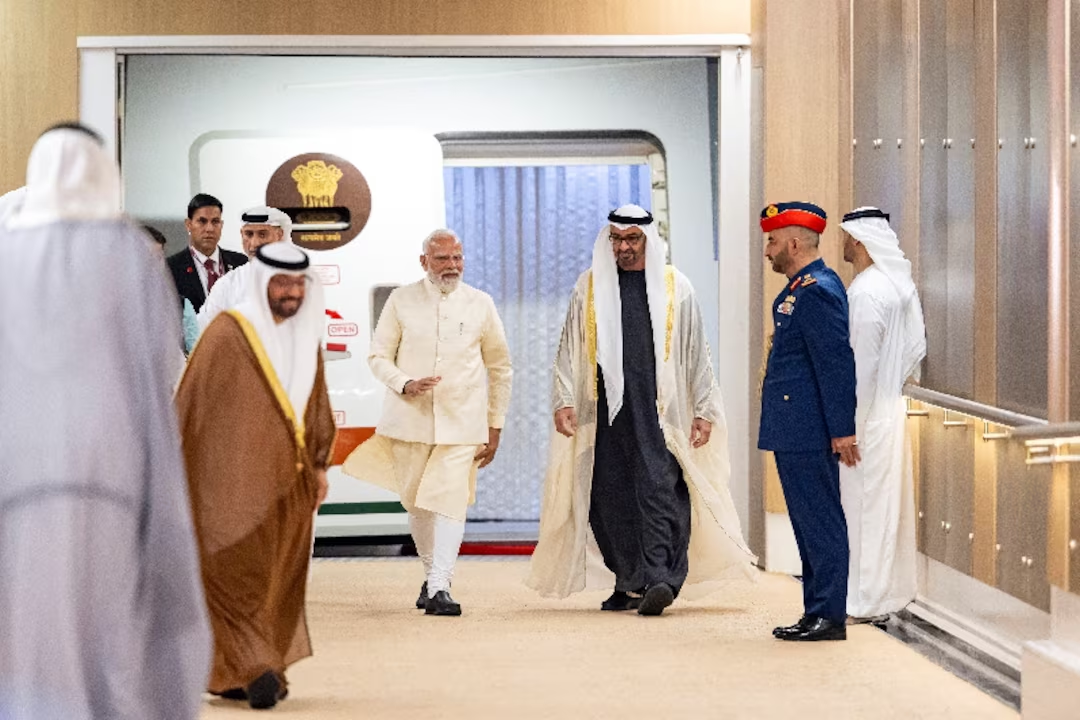
Prime Minister Narendra Modi’s brief visit to the United Arab Emirates on May 15, 2026, produced seven major agreements spanning defence, energy, shipping, and investment. The visit comes at a crucial time as India looks to secure fuel supplies, attract foreign capital, and strengthen ties with one of its most important Gulf partners.
India-UAE Agreements Strengthen Strategic Partnership
Prime Minister Narendra Modi’s UAE visit delivered a significant diplomatic and economic breakthrough for India. During his stop in Abu Dhabi, India and the UAE signed seven strategic agreements aimed at deepening cooperation in defence, energy security, maritime infrastructure, and financial investment.
The visit was particularly important because it took place against the backdrop of elevated crude oil prices and geopolitical tensions in West Asia. With India importing nearly 90 percent of its crude oil requirements, ensuring stable and affordable energy supplies has become a top national priority.
The UAE is India’s third-largest trading partner and a critical supplier of crude oil, LPG, and investment capital. Bilateral trade has already crossed $100 billion, and both nations are targeting $200 billion in the coming years.
Seven Strategic Deals Signed During Modi’s UAE Visit
The headline outcome of the visit was the signing of seven strategic agreements. While some were government-to-government pacts and others were commercial commitments, together they signal a major expansion in India-UAE ties.
The key agreements include:
- Strategic Defence Partnership Framework
- MoU on Strategic Petroleum Reserves
- Long-term LPG Supply Agreement
- MoU for a Ship Repair Cluster in Vadinar, Gujarat
- UAE investment commitment of $5 billion in India
- Cooperation in maritime and logistics infrastructure
- Expanded collaboration in advanced technology and innovation
These deals cover both immediate priorities such as energy security and longer-term goals including defence manufacturing and infrastructure development.
Energy Security Takes Center Stage
One of the most significant outcomes of the visit was the agreement to expand cooperation on strategic petroleum reserves.
India maintains emergency crude oil storage facilities to cushion the economy during supply disruptions. Under the new agreement, the UAE, through ADNOC, is expected to increase crude storage in India and support future expansion of reserve capacity.
Another major agreement was a long-term LPG supply deal between Indian Oil Corporation and ADNOC. This will help India secure a stable supply of cooking gas, reducing exposure to spot market volatility.
These agreements are especially relevant at a time when tensions in the Strait of Hormuz have raised concerns over global oil and gas shipments. Since a substantial portion of India’s energy imports transit through this route, securing preferential access to UAE supplies strengthens India’s energy resilience.
UAE Announces $5 Billion Investment Commitment
Beyond energy, the UAE announced investments worth $5 billion in India.
The proposed investment envelope includes infrastructure projects, banking, and non-banking financial companies. Reports indicate that institutions such as RBL Bank and Sammaan Capital are among the intended beneficiaries.
This fresh capital commitment underscores growing investor confidence in India’s economy and supports the government’s broader strategy of attracting long-term foreign investment into critical sectors.
Defence and Maritime Cooperation Expand
The defence partnership framework marks a notable evolution in India-UAE relations.
The agreement includes cooperation in defence technology, co-development, training, maritime security, cyber defence, and intelligence sharing. This signals a shift from transactional ties to a more strategic security relationship.
The MoU to establish a ship repair cluster at Vadinar in Gujarat is another important outcome. The project is expected to strengthen India’s maritime infrastructure and support the country’s ambitions to become a regional hub for ship maintenance and repair.
Why the UAE Matters to India
The UAE occupies a special place in India’s foreign and economic policy.
More than 4.5 million Indians live and work in the UAE, making it one of the largest Indian expatriate communities in the world. The country is also a major source of remittances and investment into India.
Since the India-UAE Comprehensive Economic Partnership Agreement came into force, bilateral trade has expanded rapidly. Cooperation now extends far beyond oil to include fintech, logistics, clean energy, and defence.
Modi’s latest visit reinforces this momentum and demonstrates how strategic partnerships can help India address both economic and geopolitical challenges.
What This Means for India’s Economy
The agreements announced during Modi’s UAE visit could have several immediate and long-term benefits:
Stable crude and LPG supplies during volatile global conditions.
Higher foreign investment in infrastructure and financial services.
Stronger defence and maritime cooperation.
Improved strategic reserves to protect against energy shocks.
Together, these outcomes support India’s efforts to strengthen macroeconomic stability while accelerating growth.
Key Takeaways
- India and the UAE signed seven major agreements during PM Modi’s May 2026 visit.
- Energy security was a central focus, with pacts on petroleum reserves and LPG supply.
- The UAE announced a $5 billion investment commitment in India.
- Defence, shipping, and advanced technology cooperation were significantly expanded.
FAQs
Why was PM Modi’s UAE visit important?
The visit secured critical agreements on energy, defence, and investment at a time of rising oil prices and geopolitical uncertainty.
What were the most important agreements signed?
The biggest outcomes were the strategic petroleum reserve MoU, long-term LPG supply agreement, defence partnership framework, and the $5 billion investment commitment.
How does this help India’s energy security?
The agreements ensure more reliable crude oil and LPG supplies and expand India’s emergency petroleum reserves.
How much trade does India do with the UAE?
Bilateral trade has crossed $100 billion, with both countries aiming to reach $200 billion in the coming years.