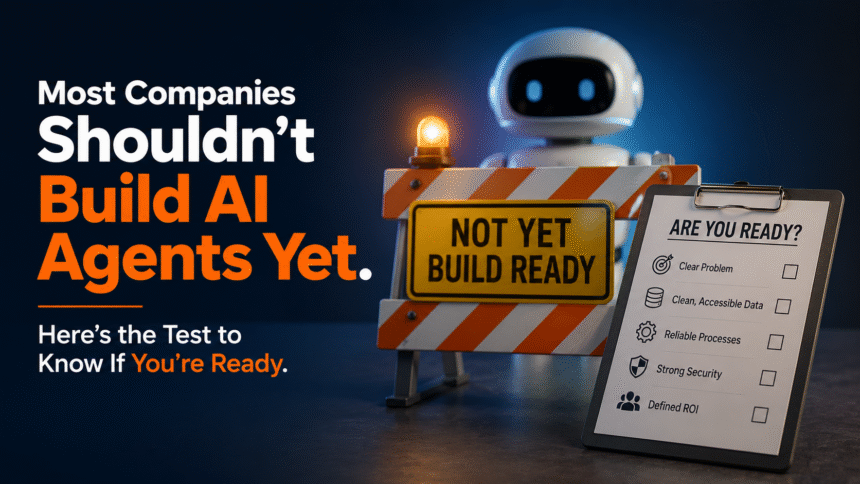
AI agents are getting a lot of attention. But before you build one, there are five questions that can tell you whether your business is actually ready.
We build AI agents.
We also turn down some of the agent projects we’re asked to quote.
Not because the technology isn’t capable.
Usually because the business isn’t ready for an agent yet.
Building one anyway often means spending months automating a process that was never clearly defined, didn’t happen often enough to justify the investment, or didn’t have reliable data behind it.
The result is predictable.
The agent gets built.
People try it.
Something goes wrong.
Nobody is quite sure how to measure whether it is actually working.
And a few months later, it gets switched off.
The problem wasn’t necessarily the technology.
It was the choice of project.
An AI agent is different from a simple chatbot or traditional automation. An agent can be given an objective, decide what steps to take, use tools or systems, and act on the result.
That autonomy is what makes agents useful.
It is also what makes choosing the right use case so important.
Before we quote an agent project, these are the five questions we ask.
1. Can You Describe the Task as a Process Someone New Could Follow?
Imagine giving the process to a new employee on their first day.
Could they follow the instructions without constantly asking someone what to do next?
If your team cannot explain the process clearly, an AI agent won’t magically make it clearer.
It will automate the ambiguity.
That’s a problem.
Before building an agent, map out:
- What starts the process?
- What information does it need?
- What decisions need to be made?
- What actions does it take?
- When does the process end?
- When should a person take over?
If those answers are unclear, the process needs work before the agent does.
2. Does the Task Happen Often Enough to Justify an Agent?
Agents can involve more complexity than simple workflow automation.
They need to be tested, monitored, maintained, and improved.
So look at the economics.
If a task happens five times a month, building an agent for it may be difficult to justify.
If the same task happens hundreds of times a week, the calculation looks very different.
Frequency isn’t the only factor, of course.
The value of each task matters too.
But you should be able to explain why automating this particular process is worth the investment.
“It would be cool if AI could do this” isn’t a business case.
3. Can You Tell Whether the Agent Did the Right Thing?
This is one of the most important questions.
Some tasks have relatively clear outcomes.
A document was classified correctly.
A request was routed to the right team.
A report contained the required information.
A customer inquiry was answered using the correct policy.
Other tasks are much more subjective.
Two experienced employees might make different decisions and both have reasonable explanations.
Those cases aren’t impossible for AI agents, but they are harder to evaluate and control.
Before building, ask:
How will we know whether the agent succeeded?
If you cannot answer that, you don’t yet have a good way to measure the system.
And without measurement, improving the agent becomes guesswork.
So, Are You Ready for an Agent?
Use these five questions as a practical starting point.
If you can answer yes to all five, you may have a strong candidate for an agent.
If you can answer yes to three or four, the project may still make sense, but you probably need tighter scoping, better controls, or human review.
If you struggle to answer most of them, don’t rush into development.
Fix the underlying process first.
That’s not delaying the AI project.
That is part of the AI project.
The Biggest Mistake Is Choosing the Wrong First Project
The question isn’t:
“Can AI agents do this?”
In many cases, the answer is yes.
The better question is:
“Is this the right process to give an agent responsibility for?”
That’s where the real evaluation starts.
“We turn down some agent projects because we’d rather lose a project than build something that gets switched off before it creates value.”
Siddharth Mishra, CEO, Gigaflop TechLab
If you’re considering an AI agent and aren’t sure whether the use case is ready, we can help you assess it before you commit to development.