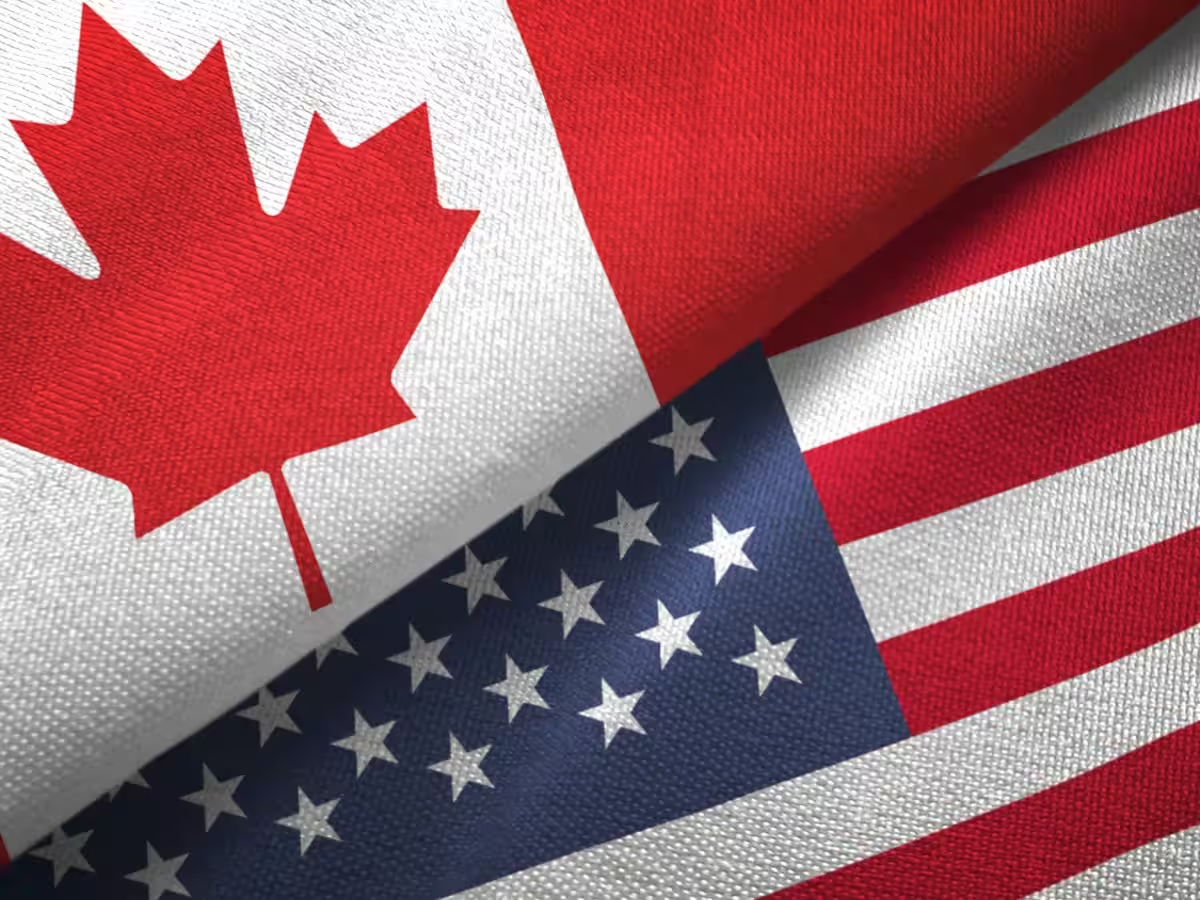
The US-Canada tariff standoff is keeping North American manufacturers, exporters and logistics companies on alert as Washington delays the rollout of threatened 50% tariffs for three days. The pause gives negotiators more time, but uncertainty continues to complicate cross-border supply planning.
US-Canada tariff talks enter another critical phase
The latest US-Canada trade dispute has moved into another high-stakes phase after Washington delayed the implementation of threatened 50% tariffs on Canadian goods for three days. The decision temporarily eases the immediate pressure on businesses, but it does not remove the underlying uncertainty surrounding North American trade.
The threatened duties were scheduled to take effect on August 19 under Section 338 of the US Tariff Act of 1930. The measures cover specified Canadian products and were presented by the US administration as a response to what it considers discriminatory Canadian trade practices.
The timing matters because Canada and the United States have deeply integrated supply chains. Components, raw materials and finished products frequently cross the border multiple times before reaching customers.
That means a tariff decision can affect businesses far beyond the company that directly pays the import duty.
Tariff uncertainty puts manufacturers under pressure
The North American manufacturing system relies heavily on predictable cross-border movement. Automotive production is one of the clearest examples. A vehicle assembled in the United States can contain Canadian-made components, while Canadian plants also depend on US parts and materials.
Any sudden increase in import costs can force companies to reconsider sourcing, inventory and production schedules.
The new US measures specifically include Canadian motor vehicles among the targeted categories, while the wider tariff framework reaches products across multiple sectors. Legal and trade assessments have identified exposure involving areas such as machinery, chemicals, wood products, food ingredients, textiles and other manufactured goods.
For companies operating on tight margins, the immediate challenge is not simply the tariff itself. It is the difficulty of knowing whether the rate will remain in place, change during negotiations or be suspended.
That uncertainty makes long-term purchasing and logistics decisions harder.
Supply chain costs could rise if tariffs return
A prolonged tariff standoff could increase costs across North American supply chains through several channels.
Importers may face higher customs bills on covered Canadian goods. Manufacturers could then pass part of those costs to distributors or customers. Companies may also search for alternative suppliers outside Canada, but changing suppliers can require new contracts, certifications, transportation routes and production testing.
Inventory decisions are another concern.
Businesses may choose to hold more goods inside the United States or Canada to protect themselves against future tariff changes. Higher inventories can reduce the risk of immediate shortages, but they also tie up working capital and increase warehousing requirements.
Freight companies and customs brokers are also facing additional administrative complexity because the treatment of each product depends on its tariff classification and the specific rules applying to that shipment.
USMCA protection does not settle every tariff question
The dispute is particularly significant because the United States, Canada and Mexico operate under the US-Mexico-Canada Agreement, commonly known as USMCA or CUSMA in Canada.
The agreement has historically provided a framework for preferential treatment of qualifying goods moving between the three economies. However, the new Section 338 measures create additional exposure for covered Canadian products even where normal USMCA qualification would otherwise provide preferential treatment.
This creates a complicated environment for businesses that have built supply chains around the assumption of relatively predictable regional trade rules.
Companies now need to distinguish between products that remain protected under existing arrangements and those that fall within the new tariff measures.
For procurement teams, that means tariff classification, country-of-origin documentation and customs compliance have become even more important.
Automotive sector faces particular supply chain risks
The automotive industry remains one of the most sensitive areas in the US-Canada tariff dispute because production is highly integrated across the border.
Parts can move between manufacturing facilities several times during the production process. Even a tariff applied to one stage can increase the eventual cost of a vehicle or component.
The latest US measures specifically target Canadian motor vehicles, making the auto sector a major focus of the negotiations. Recent reporting indicates that car tariffs have become one of the main sticking points in the latest US-Canada trade discussions.
Automakers and suppliers therefore face a difficult balancing act. They need to maintain production while preparing for potentially higher costs and changing trade rules.
Moving manufacturing capacity is not an immediate solution either. Automotive plants require substantial investment, trained workers and established supplier networks. Relocating production can take years rather than weeks.
Canadian exporters face uncertainty beyond tariffs
For Canadian businesses selling into the US market, the uncertainty extends beyond the headline tariff rate.
Exporters need to determine whether individual products fall under the affected tariff classifications. They also need to assess whether existing contracts allow them to pass additional costs to US customers.
Smaller businesses may have fewer options than large multinational manufacturers. A major corporation can potentially diversify suppliers or redesign its logistics network. A smaller exporter may depend heavily on one US market and have limited bargaining power.
The potential impact is also important for companies on the US side of the border. US importers that rely on Canadian suppliers could face higher input costs even if their own businesses do not export anything.
This is why the dispute is better understood as a supply chain issue rather than simply a Canada-US political disagreement.
Three-day pause offers businesses temporary relief
The latest tariff pause gives negotiators a short window to continue discussions and gives companies some additional time to prepare. However, the pause should not be treated as a permanent resolution.
Current reporting says Washington has delayed the 50% tariffs for three days while trade discussions continue. Canadian Prime Minister Mark Carney has also indicated that negotiations remain ongoing rather than describing the situation as a completed trade agreement.
That distinction is important for businesses.
Companies still need contingency plans because the final outcome could involve a further delay, a negotiated change in tariffs or renewed duties on affected products.
The immediate uncertainty may therefore continue even if the threatened tariffs do not take effect exactly as originally scheduled.
What the standoff means for North American trade
The US and Canada have one of the world’s most integrated trading relationships, making prolonged tariff uncertainty particularly disruptive.
The latest confrontation highlights how quickly policy decisions can affect manufacturing, logistics, inventory management and pricing across both countries.
For businesses, the priority is increasingly flexibility. Companies with diversified suppliers, accurate customs data and adaptable logistics networks are better positioned to respond if tariff rules change again.
For consumers, the eventual impact will depend on how companies absorb, distribute or pass on additional costs.
The three-day pause provides another opportunity for negotiations, but the wider issue remains unresolved. Until businesses have greater clarity over tariff rates and trade rules, North American supply chains are likely to remain under pressure.
Takeaways
- The US has delayed threatened 50% tariffs on specified Canadian goods for three days while negotiations continue.
- Automotive manufacturers and suppliers remain particularly exposed because US and Canadian production networks are deeply integrated.
- Companies face higher potential costs, customs uncertainty and pressure to reassess sourcing and inventory strategies.
- The latest pause provides temporary relief but does not represent a final resolution of the US-Canada trade dispute.
FAQ
Why are the US and Canada facing a tariff standoff?
The latest dispute involves US complaints about Canadian trade practices in areas including motor vehicles, dairy and alcoholic beverages. Washington has threatened additional tariffs under Section 338, while Canadian officials have challenged the measures and continued negotiations.
How could tariffs affect North American supply chains?
Higher tariffs can raise the cost of imported components and raw materials. Companies may respond by increasing prices, changing suppliers, holding more inventory or adjusting production and logistics networks.
Are Canadian goods protected by USMCA?
Not necessarily. The new Section 338 measures apply additional duties to specified Canadian products even where normal USMCA treatment would otherwise apply. The exact treatment depends on the product and applicable tariff classification.
Have the new 50% tariffs taken effect?
The threatened tariffs were scheduled for August 19, 2026, but Washington has delayed their rollout for three days while discussions with Canada continue. The situation remains subject to further negotiations and policy changes.