
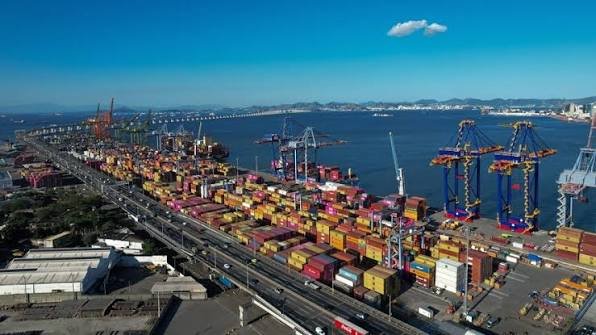
The World Trade Organization (WTO) has warned that global trade restrictions are increasing sharply as geopolitical tensions and economic uncertainty reshape international commerce. Its latest report shows that restrictive measures reached record levels, raising concerns about supply chains, international investment and global economic growth.
WTO Reports Sharp Rise in Global Trade Restrictions
Global trade restrictions have increased significantly during the first half of 2026, according to the latest monitoring report released by the World Trade Organization on November 17.
The report, titled Overview of Developments in the International Trading Environment, highlights a growing number of tariffs, export controls and other trade-related measures introduced by governments worldwide.
During the first six months of 2026, WTO members and observers introduced 1,048 new trade and trade-related measures. This compares with 1,229 measures recorded throughout 2025, indicating a substantially faster pace of trade policy activity.
The increase reflects growing economic uncertainty and geopolitical tensions affecting international business relationships. Governments are increasingly using trade policies to protect domestic industries, strengthen supply chains and secure access to strategically important products.
However, the WTO has raised concerns about the cumulative impact of these decisions on international commerce.
The report also highlights an important distinction: not every new trade measure restricts commerce. Governments have simultaneously introduced policies intended to facilitate imports and exports.
Trade Restrictions Reach Highest Levels Since 2009
One of the most significant findings in the WTO report is the record accumulation of restrictive trade measures.
As of June 30, 2026, import-related restrictive and other non-facilitating measures introduced since 2009 and still in force covered approximately $5.4 trillion worth of international trade.
This represents 21.3% of total world imports.
Export-related restrictive measures also reached a record level, covering approximately $1.5 trillion, equivalent to 6.3% of global exports.
These figures represent the highest levels recorded since the WTO began its trade monitoring exercise in 2009.
The accumulated stockpile is particularly important because it captures measures that remain active rather than only counting newly introduced restrictions.
For international businesses, this means that trade barriers are becoming an increasingly significant part of the global operating environment.
Companies importing raw materials, exporting manufactured products or depending on international suppliers may need to account for additional tariffs, regulatory requirements and export restrictions when planning their operations.
New Trade Restrictions Cover $2 Trillion in Imports
The WTO report also highlights the scale of restrictions introduced during January-June 2026.
During this period, members and observers introduced 333 new restrictive and other non-facilitating trade measures. This was already higher than the 300 measures recorded throughout the whole of 2025.
The trade affected by these measures was substantial.
New import-related restrictive measures covered an estimated $2 trillion, representing 8% of world imports during the first half of 2026.
Meanwhile, export-related restrictive measures covered approximately $794 billion, equivalent to 3.2% of global exports.
These developments indicate that governments are becoming more active in regulating cross-border trade.
Import restrictions can increase the cost of foreign products, affect domestic competition and change sourcing decisions. Export restrictions can limit the availability of essential materials and intermediate goods in international markets.
For manufacturers, these developments can create uncertainty around production costs and delivery schedules.
Businesses operating across multiple countries may also need to reconsider their supplier networks to reduce exposure to sudden policy changes.
WTO Highlights Growth in Trade-Facilitating Measures
Despite the increase in restrictions, the report also identifies a significant rise in policies designed to support international trade.
During the first half of 2026, WTO members and observers introduced 466 new trade-facilitating measures. This exceeded the 391 measures recorded throughout 2025.
These initiatives are intended to simplify trade procedures, support the movement of goods and help businesses navigate disruptions.
New import-facilitating measures covered approximately $1.3 trillion, equivalent to 5.2% of world imports, during the first six months of 2026.
Export-facilitating measures covered a record $570 billion, representing 2.3% of global exports.
Much of the increase in trade facilitation was linked to temporary actions taken in response to disruptions associated with the Strait of Hormuz situation.
This development highlights the two different directions in which global trade policy is moving. While governments are introducing restrictions to protect strategic interests, they are also taking steps to maintain the movement of essential goods across borders.
The WTO believes that these facilitating measures have helped sustain global trade flows despite geopolitical and economic uncertainty.
US-China Tensions and Geopolitical Uncertainty Affect Trade Policies
Rising geopolitical tensions remain an important factor shaping international trade decisions.
Major economies are increasingly treating trade as part of their broader economic and national security strategies. Tariffs, industrial subsidies, export controls and restrictions involving strategically important products have become more prominent in international economic discussions.
Competition in sectors such as electric vehicles and solar photovoltaic cells has been particularly visible.
According to WTO Director-General Ngozi Okonjo-Iweala, these two sectors were exceptions to the broader trend in which trade-facilitating measures covered a larger share of imports than restrictive measures.
The competition for market share in electric vehicles and photovoltaic cells has generated significant trade policy debates among major economies.
These industries are strategically important because they are connected to clean energy transitions, advanced manufacturing and future industrial competitiveness.
For companies, the consequences extend beyond direct tariffs. Changes in government policies can influence investment decisions, manufacturing locations, technology partnerships and access to international markets.
The growing use of trade restrictions therefore presents challenges for businesses trying to maintain stable global operations.
Global Trade Shows Resilience Despite Rising Restrictions
Although trade restrictions have increased, international commerce has remained more resilient than some earlier projections suggested.
The WTO’s October 8, 2026, Global Trade Outlook and Statistics report revised its forecast for global merchandise trade volume growth in 2026 to 3.9%, compared with its earlier baseline forecast of 1.9% issued in March.
The improved outlook was supported partly by strong demand for artificial intelligence-related goods.
Products connected to AI infrastructure, including semiconductors and other technology equipment, contributed to international trade growth during the first half of the year.
In value terms, global merchandise trade increased by approximately 15% year-on-year during the first six months of 2026.
However, the outlook for commercial services trade was less encouraging. The WTO forecast growth of 3.3% for 2026, down from its earlier estimate of 4.8%, largely because of the impact of the Middle East conflict on transportation and travel services.
These figures demonstrate that rising trade restrictions have not stopped global commerce from expanding. However, the structure and direction of trade are increasingly influenced by geopolitical developments and government policy decisions.
What Rising Trade Restrictions Mean for India
The latest WTO findings are relevant for India because the country is closely connected to international supply chains through manufacturing, technology, energy, pharmaceuticals and merchandise exports.
Indian businesses depend on imported components, machinery, chemicals, electronic equipment and industrial materials to support domestic production.
When major economies introduce additional tariffs or export controls, Indian companies can face indirect consequences through changes in global prices, sourcing arrangements and supplier availability.
For example, restrictions involving semiconductor exports or critical minerals can affect manufacturers in electronics, automobiles and renewable energy.
Export-oriented industries may also face difficulties when overseas markets introduce additional trade barriers or change import requirements.
India’s pharmaceutical, engineering goods, textile and chemical exporters operate in competitive international markets where changes in tariffs and regulatory standards can influence their ability to access customers.
At the same time, shifts in global supply chains could create opportunities for Indian manufacturers as international companies look to diversify production and sourcing locations.
However, these opportunities will depend on India’s manufacturing competitiveness, infrastructure, logistics costs and ability to meet international quality standards.
The WTO report does not identify India as the principal source of the restrictions. Its findings cover measures introduced by WTO members and observers across the international trading system.
WTO Calls for Greater Restraint in Trade Restrictions
WTO Director-General Ngozi Okonjo-Iweala has called on member countries to exercise restraint when introducing new trade barriers.
She highlighted the importance of maintaining open, predictable and transparent international trade policies, particularly during a period of geopolitical uncertainty.
The WTO believes that excessive restrictions can weaken economic cooperation, create uncertainty for businesses and affect the benefits associated with international commerce.
Trade-facilitating measures, meanwhile, can help companies manage disruptions and maintain the movement of goods across borders.
The organisation has also emphasised the need for stronger cooperation between countries to preserve the multilateral trading system.
The latest findings add to wider concerns about the future of global trade rules. Governments are increasingly balancing domestic economic priorities with international commitments, creating additional challenges for the existing trade framework.
For businesses, the direction of government policy will remain an important factor in investment and expansion decisions.
The coming months will show whether countries can balance domestic economic interests with the need for stable international trade relationships.
Key Takeaways
- Import-related restrictive measures still in force covered $5.4 trillion, or 21.3% of global imports, as of June 30, 2026.
- WTO members and observers introduced 333 new restrictive trade measures during the first half of 2026, exceeding the 300 recorded throughout 2025.
- Trade-facilitating measures also increased, reaching 466 during the first six months of 2026.
- The WTO has called for restraint and greater international cooperation to maintain predictable global trade conditions.
Frequently Asked Questions
1. Why has the WTO warned about rising global trade restrictions?
The WTO has reported a sharp increase in tariffs and other restrictive trade measures. Their growing accumulation can increase business costs, disrupt supply chains and create uncertainty for international commerce.
2. How much global trade is affected by import restrictions?
As of June 30, 2026, import-related restrictive and other non-facilitating measures introduced since 2009 and still in force covered approximately $5.4 trillion, equivalent to 21.3% of world imports.
3. How many new trade restrictions were introduced in 2026?
WTO members and observers introduced 333 new restrictive and other non-facilitating trade measures during the first half of 2026, compared with 300 throughout the whole of 2025.
4. How could rising trade restrictions affect India?
Indian exporters and manufacturers could face higher sourcing costs, supply-chain disruptions and additional barriers in overseas markets. However, global supply-chain diversification could also create opportunities for Indian manufacturing and export businesses.