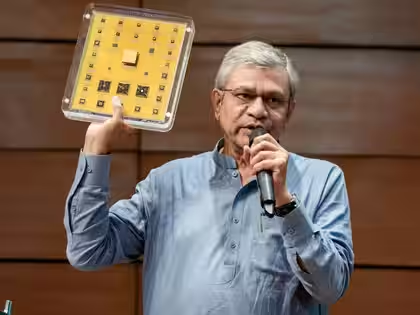
India’s latest semiconductor policy marks one of the country’s biggest industrial bets in recent years. The Union Cabinet’s approval of Semicon 2.0 and a parallel mobile phone manufacturing scheme aims to strengthen domestic chip production, reduce import dependence, and position India as a major global electronics manufacturing hub.
India’s chip manufacturing push entered a new phase after the Union Cabinet approved the India Semiconductor Mission (ISM) 2.0 with a budget of ₹1.27 lakh crore. Alongside it, the government also cleared a ₹62,500 crore Mobile Phone Manufacturing Scheme, signalling a broader strategy to strengthen the country’s electronics ecosystem beyond assembly and move toward high-value semiconductor manufacturing. The announcement is a time-sensitive policy development and represents one of the most significant industrial decisions taken by the government in 2026.
The decision builds on the first phase of the semiconductor mission, which attracted investments exceeding ₹1.64 lakh crore across approved manufacturing projects and helped establish India’s early chip manufacturing ecosystem. The second phase expands the government’s focus from individual factories to an integrated value chain that includes research, design, materials, equipment, packaging, workforce development, and fabrication.
Semicon 2.0 Expands India’s Semiconductor Strategy
Unlike the first phase, which primarily encouraged semiconductor fabrication and packaging facilities, Semicon 2.0 follows a broader six-pillar approach.
The programme focuses on chip design, semiconductor equipment, manufacturing materials, fabrication plants, advanced packaging facilities, research and development, and talent creation. The objective is to create a complete domestic semiconductor ecosystem rather than relying heavily on imported technologies and components.
Government officials have said that India already has more than 100 startups engaged in semiconductor design, while multiple manufacturing projects approved under the earlier scheme have either begun commercial production or are expected to start operations soon. The second phase seeks to accelerate this momentum by strengthening supply chain capabilities and encouraging private investment across every stage of chip production.
Electronics Manufacturing Receives Parallel Policy Support
The Cabinet did not stop with semiconductor incentives.
It simultaneously approved the Mobile Phone Manufacturing Scheme, which carries an outlay of ₹62,500 crore over five years. The scheme aims to increase domestic manufacturing, improve exports, generate employment, and encourage global electronics companies to expand production in India.
India has already emerged as one of the world’s largest smartphone manufacturing destinations, with several global brands producing devices locally. However, many high-value semiconductor components continue to be imported. Policymakers believe that strengthening chip manufacturing alongside electronics assembly will increase domestic value addition and improve India’s competitiveness in global supply chains.
Why Semiconductor Manufacturing Matters for India’s Economy
Semiconductors power nearly every modern electronic device, from smartphones and laptops to automobiles, telecom equipment, medical devices, defence systems, industrial machinery, and artificial intelligence infrastructure.
Recent global supply chain disruptions exposed the risks of depending heavily on imported chips. Many countries, including the United States, Japan, South Korea, and members of the European Union, have introduced large incentive programmes to secure domestic semiconductor capacity.
India’s latest policy reflects this global trend while adapting it to domestic strengths such as engineering talent, software expertise, electronics manufacturing, and a rapidly expanding digital economy.
If executed successfully, the programme could help reduce import dependence, improve supply chain resilience, create high-skilled jobs, attract multinational investments, and support India’s long-term manufacturing ambitions under the Make in India initiative.
Challenges Will Determine Long-Term Success
Despite the ambitious roadmap, semiconductor manufacturing remains one of the world’s most capital-intensive industries.
Building fabrication plants requires billions of dollars in investment, stable power supply, ultra-pure water, specialised chemicals, precision equipment, and highly skilled engineers. It also demands close coordination between government agencies, research institutions, and private industry.
Industry experts note that success will depend not only on financial incentives but also on execution, infrastructure readiness, regulatory stability, and India’s ability to attract global technology partners. Creating a competitive supply chain for semiconductor materials and manufacturing equipment will also be essential if India wants to move beyond chip assembly into advanced manufacturing.
What the Cabinet Decision Means Going Forward
The approval of Semicon 2.0 signals that semiconductor manufacturing has become a long-term national priority rather than a short-term industrial policy.
By combining semiconductor incentives with expanded support for electronics manufacturing, the government is attempting to position India as a larger participant in global technology supply chains at a time when companies are actively diversifying production beyond traditional manufacturing centres.
While the full impact will unfold over several years, the latest Cabinet decision reinforces India’s ambition to become not only a major electronics assembly destination but also a significant player in semiconductor design, manufacturing, research, and innovation. If implementation progresses as planned, the policy could reshape India’s technology manufacturing landscape and strengthen its role in the global electronics economy.
Takeaways
- The Union Cabinet has approved Semicon 2.0 with an outlay of ₹1.27 lakh crore.
- A separate ₹62,500 crore Mobile Phone Manufacturing Scheme will support electronics production and exports.
- The new semiconductor mission expands support across design, manufacturing, research, packaging, materials, and workforce development.
- The initiative aims to reduce import dependence and strengthen India’s position in the global semiconductor supply chain.
FAQ
Q1. What is Semicon 2.0?
Semicon 2.0 is the second phase of India’s Semiconductor Mission, designed to strengthen the country’s semiconductor design and manufacturing ecosystem through long-term policy support and financial incentives.
Q2. How much has the government allocated for Semicon 2.0?
The Union Cabinet has approved a total outlay of ₹1.27 lakh crore for the programme.
Q3. Why are semiconductors important for India?
Semiconductors are essential for electronics, automobiles, telecom equipment, artificial intelligence, healthcare devices, and defence technologies. Domestic manufacturing can improve supply chain security and reduce dependence on imports.
Q4. How does the Mobile Phone Manufacturing Scheme complement the semiconductor mission?
The scheme encourages large-scale mobile manufacturing and exports while supporting higher domestic value addition through stronger integration with India’s growing semiconductor ecosystem.