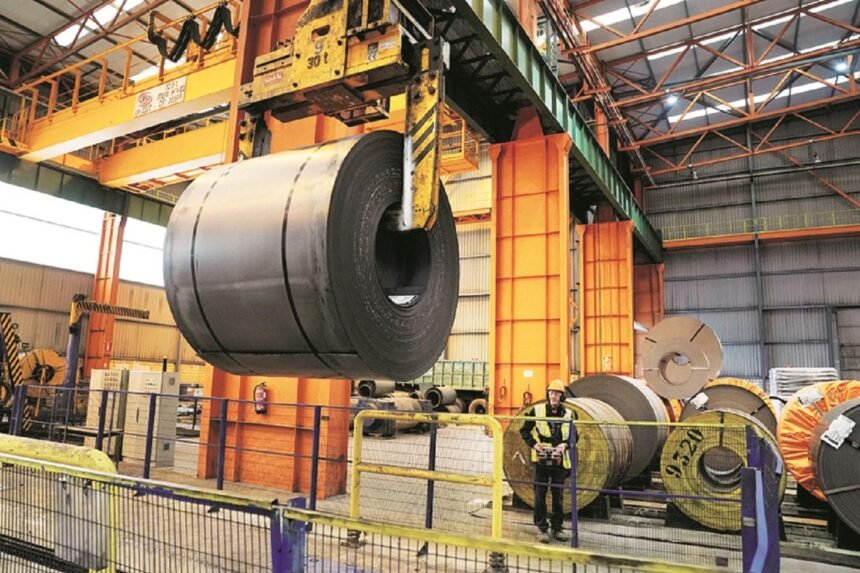
India’s core sector growth has reached a two-month high, supported by rising steel and cement demand linked to infrastructure activity. The latest industrial data indicates improving momentum in construction-led sectors, offering early signs that public capex spending and project execution are regaining pace.
India’s core sector growth accelerated to a two-month high as stronger output in steel and cement sectors signaled renewed infrastructure activity across the country. The latest data has strengthened expectations that government-led capital expenditure and construction demand may support industrial growth during the first half of the financial year.
The eight core industries form the backbone of India’s industrial economy and contribute significantly to the Index of Industrial Production. These sectors include coal, crude oil, natural gas, refinery products, fertilizers, steel, cement and electricity. Together, they account for over 40 percent of the country’s industrial output weight.
Steel And Cement Demand Reflect Infrastructure Push Revival
The latest core sector numbers showed improved growth in steel and cement production, two industries closely linked to infrastructure development, housing activity and public construction projects.
Steel demand generally rises when large-scale infrastructure projects gain momentum. Roads, railways, metro systems, ports, airports and industrial corridors require substantial steel consumption. Cement production also tends to increase alongside real estate construction and government-funded projects.
Analysts believe the recent uptick reflects faster project execution after slower activity during the previous months. Several states have accelerated road construction, urban development and industrial infrastructure spending ahead of the monsoon season.
India’s infrastructure-focused growth model continues to rely heavily on public capital expenditure. In recent budgets, the central government increased infrastructure allocations to support long-term economic expansion, manufacturing growth and employment generation.
Higher demand for steel and cement is therefore often interpreted as an indicator of broader economic activity rather than isolated sectoral growth.
Public Capex Spending Continues To Support Industrial Activity
Government capital expenditure has become one of the strongest drivers of India’s industrial growth over the past few years. Large infrastructure projects have supported demand across construction materials, engineering services, logistics and industrial manufacturing.
Economists tracking the latest core sector data say the improvement suggests that project pipelines are moving forward despite concerns related to global slowdown risks and uneven private investment recovery.
Public spending on highways, railways, renewable energy and urban infrastructure has created steady demand for industrial inputs. The railway sector in particular continues to generate strong orders for steel manufacturers and engineering companies.
At the same time, housing demand in several urban regions has remained relatively stable, supporting cement consumption and related industries. Industry executives say real estate launches in metro and tier-two cities have contributed to steady construction activity despite higher borrowing costs.
The combination of government projects and selective private sector demand appears to be helping industrial production regain momentum after earlier signs of moderation.
Energy And Electricity Consumption Offer Mixed Signals
While steel and cement output improved, analysts note that some other core industries continue to show uneven performance. Crude oil and natural gas production remain structurally weak due to long-term domestic supply constraints.
Coal and electricity sectors have shown relatively stable growth, supported by industrial power demand and summer consumption patterns. Electricity generation usually serves as a broader economic activity indicator because it reflects industrial operations, commercial demand and urban consumption.
However, economists caution that core sector growth alone does not guarantee broad-based economic acceleration. Manufacturing exports, rural demand, global commodity prices and inflation trends will continue to influence industrial momentum in the coming quarters.
International economic uncertainty also remains a risk factor. Slower global growth could affect export-oriented industries and commodity demand, especially if external markets weaken further.
Still, India’s domestic infrastructure cycle has so far helped offset some global pressures by supporting construction-linked sectors internally.
Why Core Sector Data Matters For India’s Economy
Core sector growth data is closely watched because it provides an early signal of industrial and economic direction before broader manufacturing figures are released. Financial markets, policymakers and businesses use these indicators to assess economic momentum and future investment conditions.
Stronger infrastructure-related activity may also influence banking, employment and logistics sectors. Higher project execution can improve credit demand, create construction jobs and support transport networks tied to industrial supply chains.
The latest numbers may also strengthen expectations that India’s economy will continue relying on public investment-led growth while private corporate investment gradually recovers.
For investors, rising steel and cement demand often points toward improving order books for infrastructure companies, engineering firms and industrial material producers.
The coming months will remain important because monsoon conditions, inflation trends and global economic developments could influence how long the current industrial momentum continues.
Takeaways
• India’s core sector growth reached a two-month high due to stronger steel and cement output
• Rising infrastructure activity and public capex spending are supporting industrial demand
• Steel and cement sectors are seen as key indicators of construction and project execution
• Economists believe infrastructure-led growth is helping offset global economic uncertainty
FAQ
Q1. What is India’s core sector?
India’s core sector includes eight major industries such as steel, cement, coal, electricity and refinery products that are crucial to industrial and economic activity.
Q2. Why is steel demand important for the economy?
Steel demand is often linked to infrastructure construction, manufacturing and industrial expansion, making it a key economic growth indicator.
Q3. How does cement production reflect infrastructure growth?
Higher cement production usually signals increased construction activity in roads, housing, commercial projects and public infrastructure.
Q4. Why do investors track core sector growth data?
Core sector data provides early insight into industrial momentum, economic trends and potential investment opportunities across infrastructure-related industries.